Frequently Asked Questions

General Product Information

What is subscription management?

Subscription management is the process of overseeing a customer's subscription from initial signup through billing, upgrades or downgrades, retention, and cancellation. It involves the technology and operations that provide a seamless experience for customers, automating recurring billing, tracking key metrics like churn and lifetime value, and improving business predictability. [Source]

How does subscription management differ from traditional billing?

Unlike one-time billing, subscription management handles recurring payments, lifecycle events (such as upgrades or cancellations), and ongoing subscriber engagement, ensuring a seamless customer experience throughout the subscription lifecycle. [Source]

What types of subscription models are supported?

Subscription management supports replenishment ("subscribe and save"), curation (subscription boxes), and access models (SaaS, streaming services), each catering to different customer needs and industries. [Source]

What is Zuora and what does it do?

Zuora is a leading SaaS company providing a comprehensive subscription management platform that automates and orchestrates the entire quote-to-cash and revenue recognition process. It supports businesses in launching, scaling, and monetizing subscription services, and is used by over 1,000 companies worldwide. [Source]

What products and services does Zuora offer?

Zuora offers a suite of products including Zuora Billing, Zuora Revenue, Zuora Payments, Zuora CPQ, Zephr, Zuora Platform, Zuora Collections, and Accounts Receivable automation. These tools manage the entire subscription lifecycle, from pricing and quoting to billing, payments, revenue recognition, and analytics. [Source]

Who are some notable Zuora customers?

Zuora serves over 1,000 companies globally, including Zoom, Box, Zendesk, Asana, The Financial Times, The Guardian, GoPro, Siemens Healthineers, Schneider Electric, Ford, Toyota, and General Motors. [Source]

What industries does Zuora support?

Zuora supports a wide range of industries, including SaaS, communications, consumer goods/retail, finance, healthcare, manufacturing & IoT, media/publishing, OTT/entertainment, software & technology, telecommunications, video games, and more. [Source]

Who is the target audience for Zuora's platform?

Zuora's platform is designed for finance professionals, IT leaders, product managers, operations teams, and sales/customer success teams in industries such as technology, media, healthcare, retail, manufacturing, and telecommunications. [Source]

What are the main steps in effective subscription management?

Effective subscription management involves defining clear packages, making management pipeline user-friendly, regularly updating offerings, and ensuring optimal security for subscriber data and payments. [Source]

What are the most important metrics for subscription businesses to track?

Key metrics include Monthly Recurring Revenue (MRR), Annual Recurring Revenue (ARR), Average Revenue Per User (ARPU), Net Revenue Retention (NRR), Customer Lifetime Value (CLV), Customer Acquisition Cost (CAC), and Net Promoter Score (NPS). [Source]

Features & Capabilities

What features should a subscription management platform include?

Essential features include flexible billing models, integration capacity, dunning management, multi-currency and multi-language support, revenue deferral automation, revenue recognition, and audit trail/compliance reporting. [Source]

What are the key capabilities of Zuora's platform?

Zuora's platform supports over 50 pricing models, automates billing and revenue recognition, scales to millions of users, enables personalized subscription journeys, ensures global compliance, and provides real-time analytics and AI-driven insights. [Source]

Does Zuora support integration with other systems?

Yes, Zuora offers over 60 pre-built connectors (including Salesforce, HubSpot, NetSuite, Snowflake), REST and SOAP APIs, warehouse connectors, payment gateway integrations, and a marketplace with nearly 100 apps. [Source]

Does Zuora provide APIs for integration?

Yes, Zuora provides both REST and SOAP APIs for seamless integration with external systems, supporting common web storefront operations and detailed application needs. [Source]

What technical documentation is available for Zuora?

Zuora offers extensive technical documentation, including platform docs, developer resources, SDK references, and integration guides. These are available via the Zuora Docs Portal, Developer Center, and Knowledge Center. [Source]

What payment gateways does Zuora support?

Zuora supports over 40 payment gateways, including Stripe, GoCardless, Worldpay, and more, enabling global payment management and fraud protection. [Source]

What are real-time product performance metrics in Zuora?

Zuora provides real-time metrics on profitability, conversion rates, and discounting rates, enabling businesses to respond quickly to market trends, optimize pricing, and improve sales velocity. [Source]

Use Cases & Benefits

What are the main benefits of using subscription management tools?

Subscription management tools improve revenue predictability, reduce churn, automate billing and payment workflows, and provide analytics for data-driven decisions about pricing and engagement. [Source]

What business impact can customers expect from using Zuora?

Customers can expect recurring revenue growth, operational efficiency, improved customer retention, faster time-to-market, enhanced financial operations, scalability, and global compliance. For example, Swiftpage saw a 140% increase in subscription customers and a 131% ARR growth after launching on Zuora. [Source]

Can you share specific case studies or success stories of Zuora customers?

Yes. Zoom scaled from 10 million to 300 million users with Zuora. The Financial Times grew digital subscriptions, Asana reduced SSP analysis time by over 90%, and Hudl saved over 100 hours per month by automating processes. [Source]

What feedback have customers given about Zuora's ease of use?

Customers like Mindflash, TripAdvisor, FireHost, Briggs & Stratton, Buildium, and AppFolio have praised Zuora for its flexibility, ease of use, rapid pricing changes, and simplified operations. For example, TripAdvisor reduced sync times from 5 hours to 5 minutes. [Source]

What core problems does Zuora solve for businesses?

Zuora solves slow, manual close cycles, compliance challenges (ASC 606/IFRS 15), scaling usage-based/hybrid monetization, multi-entity/currency compliance, revenue leakage, data quality issues, spreadsheet dependency, quote-to-cash misalignment, and forecasting difficulties. [Source]

What pain points do Zuora customers commonly express?

Common pain points include slow, manual close cycles, compliance and audit readiness, scaling monetization models, multi-entity/currency challenges, revenue leakage, poor data quality, spreadsheet dependency, quote-to-cash misalignment, and forecasting issues. [Source]

Why should a customer choose Zuora over other solutions?

Zuora offers flexibility (50+ pricing models), scalability (proven by Zoom's growth), AI-powered tools (Zephr), hybrid monetization, compliance (SOC 2, PCI DSS), and a track record of success with leading brands. [Source]

Technical Requirements & Implementation

How long does it take to implement Zuora?

Implementation timelines vary: focused scopes can be completed in as little as 30 days, typical implementations range from 30 to 90 days, and multi-product/multi-entity programs may take several months. Pre-built connectors can enable integrations within one day. [Source]

How easy is it to get started with Zuora?

Zuora offers Quick Start Tutorials, Zuora University (500+ courses), 24x5 live support, developer resources, and a community portal to ensure a smooth onboarding process. [Source]

What support options are available for Zuora customers?

Zuora provides 24x5 live global support, email support, online ticketing, and premium options like Technical Account Managers and Enterprise Solution Architects. Customers can also access the Zuora Community for peer support. [Source]

Security & Compliance

What security and compliance certifications does Zuora have?

Zuora holds PCI DSS Level 1, SSAE 16 SOC1 Type II, SOC2 Type II, ISO 27001, HHS HIPAA, and SOC 3 certifications, ensuring enterprise-grade security and regulatory compliance. [Source]

How does Zuora ensure data security and privacy?

Zuora employs data encryption, role-based access controls, regular audits, and built-in compliance features to protect sensitive customer data and support regulations like GDPR, PCI DSS, and SOX. [Source]

How does Zuora support global compliance?

Zuora helps businesses navigate complex regulatory landscapes, including multi-currency and tax compliance, and supports global operations with built-in localization for over 30 markets. [Source]

What built-in compliance features does Zuora provide?

Zuora includes data encryption, role-based access control, audit trails, and compliance reporting to simplify adherence to regulations such as GDPR, PCI DSS, and SOX. [Source]

Glossary Hub / Subscription management: Definition, process, tools

Subscription management: Definition, process, tools

A person points at a transparent board displaying graphs and charts with increasing trends. Other people are visible in the background, suggesting a collaborative workspace.

TL;DR
Subscription management refers to the processes, tools, and operations that help businesses handle the full lifecycle of a customer subscription—from signup through billing, upgrades/downgrades, retention, and cancellation. Effective subscription management systems automate recurring billing, track key metrics like churn and lifetime value, and improve customer experience and business predictability.


Subscription businesses have experienced 4.6x faster growth than the S&P 500 over the last decade, according to the Zuora Subscription Economy Index report. As a result, there has been substantial market size and demand for subscription management and billing systems, with a projected growth of $7.4 billion by 2027.

However, this surge in subscriptions, spanning from streaming services to software solutions, brings forth a new set of challenges. Businesses are now tasked with tracking and measuring recurring revenue from subscriptions along with metrics such as churn, retention, acquisition, cancellation, and lifetime value.

An effective subscription management system becomes paramount in order for businesses to optimize their subscriptions—and drive better sales and customer loyalty.

Simply having a subscription management system is not enough —companies also need to maintain that system. Otherwise, the operational ease it provides can get complex and costly quickly.

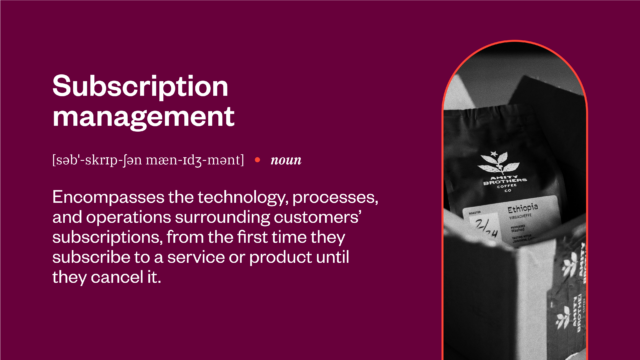
What is subscription management?

An image showcasing the definition of "Subscription management"

Subscription management is the process of managing a customer’s subscription from when they first subscribe to a product or service until they cancel. It includes the technology and operations that provide a seamless experience for customers.

Businesses use subscription management tools to oversee trials, process recurring billing payments, and handle other non-automated tasks.

Types of subscription management

There are three common subscription management models:

Replenishment subscriptions

Replenishment subscriptions — or “subscribe and save” — involve recurring payments for item replacements within certain time intervals. This model is common for frequently used commodity products.

It’s particularly popular in the direct-to-consumer market. Replenishment subscriptions keep consumers from having to remember to replace consumables, so convenience is the main appeal. With this model, timely delivery is crucial.

Examples: subscription services for essentials like toiletries, home goods, or pet supplies.

Curation subscription models

Curation subscriptions are also known as “subscription box” models. These consist of a tailored selection of products based on the customer’s preferences.

Curated subscriptions’ appeal is in their capacity for product discovery and personalized touch. Since your team chooses the products for each customer, this model can foster h3 brand loyalty. Curated subscriptions span various product categories, with beauty and skincare subscriptions among the most favored.

Examples: subscription boxes such as Stitch Fix for curated fashion items or Blue Apron for curated meal ingredients.

Access subscription models

This subscription model gives customers content or service access for a monthly or annual fee. Unlike the replenishment and curation models, an access subscription offers broader content and services. This makes it a popular business model for SaaS providers such as HubSpot, Adobe, and Zendesk who can offer multiple pricing tiers with different features.

Access subscriptions ensure continuous delivery. Plus, with exclusive deals, they cost less for customers on a tight budget.

Examples: streaming services like Netflix or Spotify, where subscribers gain access to a library of content, or software companies like HubSpot and Adobe, where subscribers obtain access to software and tools.

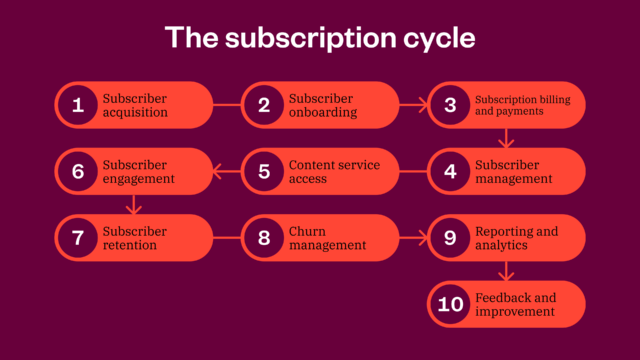
How does subscription management work?

Subscription management is more than just automating certain aspects of a customer subscription.

Flowchart illustrating subscription management cycle: acquisition, onboarding, billing, management, content access, engagement, retention, churn management, reporting, and feedback.

Subscriber acquisition

Subscription management starts with subscriber acquisition. Companies reach prospects through marketing efforts like ads and promotions across different channels. To convert a prospect, one best practice is to offer free trials that allow users to test out the product before committing to a purchase.

Subscriber onboarding

Once you convert a lead, they can select their preferred subscription plan. However, the main goal is to keep the subscriber after signing up. A seamless onboarding experience is crucial. Ensure that your subscription management platform can initiate an upgrade, downgrade, or trial extension if needed.

Subscription billing and payments

How you collect and secure a customer’s payment details is crucial to the success of subscription management. Enable customers to set up automated payment plans and billing frequencies. Payment gateways are another important component — one essential factor is to ensure it adheres to up-to-date payment industry standards like PCI DSS.

Subscription management should also generate invoices for every payment a customer makes. If there’s a change in customer billing information, the invoice should reflect the same.

Related: How to tame the complexity of electronic payments and reduce revenue leakage

Subscriber management

Most subscription management platforms allow subscribers to upgrade, downgrade, or cancel. But they should also let subscribers update their account info, payment details, and preferences.

Content service access

After every successful payment, subscribers should have instant access to the products and features they’ve bought. An effective subscription management platform should include authentication steps to ensure uninterrupted access. Otherwise, that customer may churn.

Subscriber engagement

A subscription management system should provide regular, high-quality content or services to engage subscribers. Newsletters, updates, and personalized content are great places to start. Throughout the subscriber lifecycle, a brand should ensure subscribers have easy access to important information, news, or upcoming changes.

Subscriber retention

A business needs to monitor usage patterns and engagement with subscription management channels. This makes it easy to identify — and retain — one-time subscribers. Since customers can churn involuntarily, subscriber retention should be a conscious effort.

The brand can then rally customers with solid retention strategies like custom recommendations, loyalty rewards, or discounts for long-term subscribers.

Churn management

Churn is a stealthy adversary for subscription businesses. Customers can churn intentionally or inadvertently, so subscription management systems should mitigate this.

For SaaS businesses, you want to measure customer churn, gross revenue churn, and net revenue churn. From there, the goal is to convince subscribers to remain active users. You can start retention measures like usage pattern tracking, subscriber surveys, and reactivation campaigns or offers.

Related: How to measure subscriber churn

Reporting and analytics

Reporting and analytics are pivotal for subscription management. They can monitor subscription performance, revenue, and customer insights. Beyond those, analytics are useful for data-informed decisions about pricing, marketing strategies, content development, and trends.

Feedback and improvement

Customer support rounds out any effective subscription management system. Brands should prioritize email, chat, and phone service to promptly address inquiries and issues.

To further improve your subscription management, gather subscriber feedback via surveys, reviews, and direct communication.

Subscription pricing models

A subscription regularly charges customers a recurring product or service fee. Below are the popular pricing models available today:Subscription management is more than just automating certain aspects of a customer subscription.

Freemium pricing

The freemium pricing model offers a free basic version of your product or service, with the option to pay for more premium features.

Businesses that want to build brand awareness and lower subscriber acquisition costs often use this model. SaaS companies successfully using this model include Buffer, Evernote, Drift, and Slack.

Flat-rate pricing

A flat-rate pricing model charges a fixed fee for a product or service, regardless of usage or consumption.

Brands can increase rates when adding valuable features or products on top of the base rate. However, the pricing model may limit revenue potential, as lower prices deter more enterprise subscribers.

Usage-based pricing

Also known as the pay-as-you-go model, usage-based pricing charges subscribers based on how much they consume a product or service.

The pro of this model is the correlation between pricing and usage (as someone engages with the service more, they pay you more). However, on the downside, it introduces revenue unpredictability due to potential billing fluctuations.

Pay-per user

Pay-per-user or per-seat pricing involves charging subscribers based on the number of individuals within their organization who access the service or software.

Pay-per-user simplifies the sales process and enables straightforward monthly revenue forecasting, since revenue scales with the user count. However, it can also encourage users to share logins, which could reduce revenue.

Tiered pricing

Tiered pricing, or good, better, best pricing, offers service or product subscriptions at different price points based on specific tiers or levels. The tiers could be based on features, usage, or customer segments. An example of companies that use this model include HubSpot.

Most companies that use this model organize their packages from low to high, for an average of 3.5 packages. As customers move up to higher tiers, they pay more to gain access to additional benefits or functionality.

Related: How to refresh your subscription pricing strategy

Why does subscription management matter?

A typical customer lifecycle for subscription business models goes deeper than “click, bill, and go.” Every user subscription has nuances, some of which might not be automated. Unlike traditional transactions, subscription services involve ongoing relationships.

Each user subscription can be unique, ranging from customization preferences to billing cycles. These intricacies demand a robust subscription management platform, to ensure personalized, seamless experiences for subscribers.

A comprehensive, customer-centric subscription management process will acknowledge and adapt to subscribers’ diverse needs over their entire lifecycle.

Benefits of subscription management

Subscription management, especially in a modern SaaS environment, enhances revenue predictability, strengthens customer relationships, and helps to drive growth. 

For customers, subscription management provides numerous benefits that enhance their overall experience, gives them flexibility, which is very important to modern consumers, and ensures they get the most value from their ongoing relationship with your business. 

Here are some key advantages for both businesses and customers:

Benefits for businesses

Predictable revenue

As long as your subscription management system allows recurring billing, you’ll be able to track customer subscription payments throughout the entire lifecycle. This provides predictable visibility into your cash flow.

Improved customer retention

Customer retention is the key to sustainability for many businesses, especially subscription models. Within a subscription system, different pricing tiers and plans provide customers flexibility. Monthly plans offer customers low-barrier entry (which is crucial for acquisitions). Meanwhile, annual plans provide upfront cash and loyalty.

Both play a role in your customer’s lifetime value. Properly managing subscriptions helps encourage a recurring commitment from customers, which reduces their likelihood of switching to competitors or unsubscribing from the service.

Improved customer insights

Subscriber management lets businesses gather meaningful data on customer behavior, preferences, and usage patterns. This empowers more informed, subscriber-facing decisions and personalized experiences.

Operational cost efficiency

With a subscription model, businesses can streamline their operations and cut down on the variable costs associated with one-time buyers. A subscription management platform provides analytics, enables data-driven decision-making, optimizes operational processes and resource allocation, and improves cost-effectiveness.

Enhanced customer relationships

Subscriber management can help businesses maintain recurring engagement, communication, and personalized interactions with subscribers. This helps the organization better understand their customers’ needs, preferences, and behaviors — ultimately leading to h3er, more loyal customer relationships.

Optimize pricing strategies

Often, businesses start with low pricing to attract many customers. But after some time, they might need to scale to sustain profitability. Subscription management solutions help your finance team manage the operational aspects of price changes. It generates updated invoice amounts per the modified pricing plans.

Without the right platform in place, it can be challenging to identify the affected customers, determine the correct invoicing details, and assess the revenue being generated from the price adjustment.

Benefits for customers

Convenience

Subscription management platforms come with many features, such as automated billing, a self-service portal, and customized notifications. All of these help the customer easily access products and services, while eliminating the hassle of start-stop purchases.

Cost savings

Subscription management often allows subscribers to enjoy lower, predictable costs compared to one-time purchases.

Predictable expenses

Since they know exactly how much they spend on their subscriptions each month, subscribers can budget and plan their finances with certainty.

Personalization

An effective subscription management tool tailors content, services, and experiences to a subscriber’s preferences and needs, which enhances their overall satisfaction.

Steps to manage subscriptions effectively

How can you set the right pattern for your product’s subscription management?

Define subscription packages carefully

This helps subscribers clarify their expectations and pricing decisions. Properly-labeled packages enhance customer satisfaction, simplify billing, and support processes further down the line.

Make subscription management user-friendly

More streamlined, intuitive subscription management makes it easier for subscribers to find, manage, cancel, compare, and get help with their subscriptions.

Regularly update product offerings

Dynamic product offerings can help a brand keep its subscribers engaged, provide them with the latest features, and make it easy to find and manage subscriptions. This can drive down their churn risk.

Ensure optimal security

Set up processes that prevent unauthorized access and account breaches, and safeguard sensitive subscriber payment information.

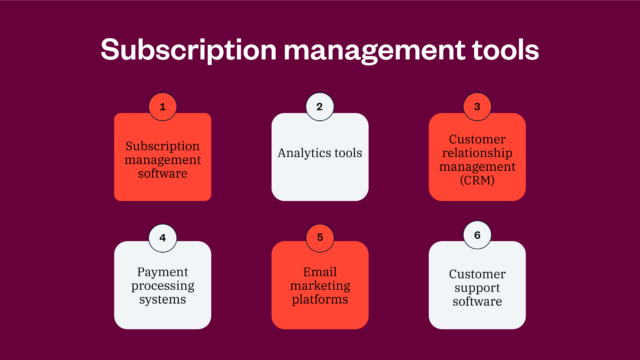
The right subscription management tools

Below are some tools that can help you seamlessly set up your subscription management:

Infographic titled "Subscription Management Tools" highlights six tools: Subscription management software, Analytics tools, CRM, Payment processing systems, Email marketing platforms, and Customer support software.

Subscription management software (as a source of truth)

Subscription management software lets you handle recurring payments, track subscriptions, and prevent revenue leakage—all from one console.

You should also be able to track and measure key subscription metrics and gather insights into subscriber engagement and revenue operations. Zuora helps businesses do this with features like subscription lifecycle tracking and automatic payment and billing calculations.

Analytics tools

Businesses need to track and analyze their subscription data, identify trends, and make informed decisions about their business. A wealth of data helps track subscription growth and churn rates, which gives a business the info it needs to identify effective marketing channels.

Examples: Google Analytics and Chartmogul are great analytics tools to start with.

Customer relationship management (CRM)

A CRM integration for subscription management can help you automate tasks and improve customer service.

Example: HubSpot CRM provides all the tools and software a brand needs to increase sales, reduce churn, and get a complete view of subscribers.

Payment processing systems

payment processing system lets businesses automatically process monthly or annual payments. It should provide different payment options to customers, like paying via a credit card or bank account.

Examples: Stripe and PayPal now use advanced security tech to prevent fraud and chargebacks.

Email marketing platforms

An email marketing platform like Mailchimp, ConvertKit, or ActiveCampaign provides centralized control, automation, and analytics. This can ensure efficient, effective communication with subscribers.

Customer support software

Customer support software streamlines customer inquiries, resolves issues efficiently, and ensures accurate billing. There are excellent customer support software options, such as Zendesk and Freshdesk.

Key subscription business model metrics to track

If you are a subscription business, make sure to track the following metrics.

Monthly recurring revenue (MRR)

Monthly recurring revenue (MRR) measures how much predictable recurring revenue a business generates from customers each month.

Annual recurring revenue (ARR)

Annual recurring revenue (ARR) measures a business’s revenue from subscriptions, contracts, or recurring bills in 12 months. It is commonly simplified as ARR = MRR x 12.

Average revenue per user (ARPU)

ARPU tells you the average revenue each user generates over a specific period.

Net revenue retention (NRR)

Net revenue retention (NRR) measures the ability of a business to retain recurring revenue from existing subscribers over a set period. A good net revenue is anything over 100%.

Customer lifetime value (CLV)

Customer lifetime value (CLV)tells you the total revenue a business will accrue from a customer over the course of the relationship. This is the total dollar value a customer represents to your business.

Customer acquisition cost (CAC)

Customer acquisition cost is the cost of earning a new customer. It’s calculated by dividing all marketing costs by the number of new customers you close within a set period.

Net promoter score (NPS)

Your NPS is a customer success metric that measures customer experience and loyalty. This metric tells you the likelihood of customers referring your business to others.

Must-have features of a subscription management platform

Below are some essential factors to consider when choosing a subscription management solution:

Flexible subscription billing model

Subscription management software should accommodate different billing and payment options. Does it include the capacity to offer different pricing tiers, add-ons, and discounts? Can it handle one-time payments?

Integration capacity

Connection with various popular payment gateways provides customers with diverse payment methods and enables you to accommodate global audiences. Does the subscription management software connect seamlessly with other sales tools like your CRM, ERP, and other accounting software? These connections provide you with a 360-degree view of your customers.

Dunning management

Failed payment is one of the biggest contributions to churn. You want a system that automates dunning processes to handle failed payments, including retry mechanisms and customizable communication.

Related: Eliminate operational challenges of subscription payments

Multi-currency and multi-language support

The platform should support transactions in various currencies to cater to a global customer base. It should also include localization features for customer communication in different languages.

Revenue deferral automation

One tough process in a subscription-based business is revenue recognition and deferrals. If your team does this manually, it is time-consuming and error-prone. Your preferred subscriber management solution should support automated deferral handling.

Revenue recognition

Subscription management platforms should handle complex revenue recognition scenarios for different subscription models — and stay in compliance with accounting standards such as ASC 606 and IFRS 15.

Audit trail and compliance reporting

Your ideal subscription management platform should record user logins, subscription modifications, billing changes, and any actions affecting customer accounts.

Zuora provides an end-to-end subscription management platform that integrates pricing and billing, payments, collections, and revenue recognition. Learn how Zuora can help you launch and scale any subscription or pricing model.

Subscription management FAQs

How does subscription management differ from traditional billing?

Unlike one-time billing, subscription management handles recurring payments, lifecycle events (such as upgrades or cancellations), and subscriber engagement over time, ensuring a seamless customer experience throughout.

What types of subscription models can subscription management support?

Subscription management supports a variety of models including replenishment (e.g., “subscribe and save”), curated boxes, and access subscriptions (e.g., SaaS or streaming services).

What are the key benefits of using subscription management tools?

Subscription management tools improve revenue predictability, reduce churn, automate billing and payment workflows, and provide analytics that help businesses make data-driven decisions about pricing and engagement.

How do businesses measure success in subscription management?

Common metrics tracked include monthly recurring revenue (MRR), churn rate, customer lifetime value (CLV), and net revenue retention (NRR)—all of which help assess growth and customer health.

Who typically uses subscription management software within an organization?

Subscription management software is commonly used by finance, billing, operations, product, and revenue teams. It helps align these teams by providing a single source of truth for subscription data, revenue performance, and customer lifecycle activity.

What features should a subscription management system include?

A subscription management system should include recurring billing, flexible pricing and packaging, automated invoicing, payment processing, lifecycle management (upgrades, downgrades, cancellations), reporting, and integrations with CRM, ERP, and analytics tools.