Frequently Asked Questions

Monthly Recurring Revenue (MRR) Fundamentals

What is monthly recurring revenue (MRR)?

Monthly recurring revenue (MRR) is a financial metric that measures the predictable and consistent revenue a business expects to receive each month from active subscriptions. It represents the total value of all customer relationships, normalized to a monthly basis, and is essential for forecasting and planning in subscription-based businesses.

How do you calculate monthly recurring revenue (MRR)?

To calculate MRR, multiply the total number of paying users by the average revenue per user (ARPU). The formula is: Number of paying users × ARPU = MRR. For contracts billed annually or quarterly, convert the revenue to a monthly equivalent before including it in MRR.

What types of revenue are included in MRR?

MRR includes revenue from all active subscription fees and recurring charges, normalized to a monthly value. One-time fees, setup charges, and non-recurring services are not included in MRR calculations.

What are the different types of MRR?

The main types of MRR are: Gross MRR (total monthly revenue from all subscribers before adjustments), Net MRR (after discounts and refunds), New MRR (from new customers), Expansion MRR (from upsells/cross-sells), Churn MRR (lost from cancellations/downgrades), Contraction MRR (decreases over time), and Reactivation MRR (revenue from reacquired customers).

What is the difference between MRR and ARR?

MRR measures recurring revenue on a monthly basis, while ARR (Annual Recurring Revenue) is MRR multiplied by 12. ARR is used for longer-term planning and investor reporting, whereas MRR provides more granular, month-to-month insights.

How does MRR differ from total revenue?

MRR focuses specifically on monthly recurring revenue from subscriptions, while total revenue includes all income over a specified period, such as monthly, quarterly, or annually, and may include one-time charges and non-recurring fees.

What is a good MRR growth rate for a subscription business?

A good MRR growth rate varies by market and business stage, but many experts suggest a 10-20% MRR growth rate after reaching million in ARR positions a company well for funding and sustainable revenue growth.

What are the main benefits of tracking MRR for subscription businesses?

Tracking MRR provides increased predictability, improved sales planning, better understanding of customer lifetime value, more insight into churn, and steadier cash flow. These benefits help businesses make informed decisions and plan for growth.

What are the disadvantages of relying solely on MRR?

Disadvantages include hidden revenue loss from downgrades or pauses, dependence on new customer acquisition, the impact of churn on growth, lack of long-term revenue insights, and complexity in calculation for businesses with many pricing options.

How can a business increase its MRR?

Businesses can increase MRR by cross-selling and upselling to existing customers, offering discounts and promotions, improving customer retention, focusing on customer satisfaction, and introducing new products and services.

Does MRR include upgrades and downgrades?

Yes, MRR should account for expansion MRR (upgrades or add-ons) and contraction MRR (downgrades) to reflect the true change in recurring revenue.

Can MRR decrease, and what causes it?

Yes, MRR can decrease due to customer cancellations, downgrades, or reductions in recurring spend. Tracking churn and contraction MRR helps businesses understand and address revenue declines.

Why is MRR important for SaaS and subscription businesses?

MRR provides predictable financial visibility, supports forecasting and budgeting, and helps identify growth trends or issues early, making it indispensable for SaaS, media, membership, and other subscription models.

How does MRR help with forecasting and planning?

MRR enables businesses to predict future revenue with greater accuracy, making it easier to plan for growth, expansion, and resource allocation. It also helps identify trends in customer acquisition, retention, and churn.

What are some common mistakes when calculating MRR?

Common mistakes include including one-time fees, not normalizing annual or quarterly contracts to monthly values, and failing to account for downgrades, churn, or reactivations in the calculation.

How does churn affect MRR?

Churn reduces MRR by decreasing the number of active paying customers or the amount they pay. Monitoring churn MRR helps businesses identify retention issues and take corrective action.

What metrics should be tracked alongside MRR?

Key metrics to track alongside MRR include total active customers, total active subscriptions, total contract value (TCV), and net revenue retention (NRR). These provide a more comprehensive view of business health.

How can MRR be used to identify opportunities for growth?

By analyzing changes in MRR over time, businesses can identify trends in customer acquisition, expansion, and churn, helping them focus on strategies that drive growth and improve retention.

What are some real-world examples of MRR calculations?

Example 1: A SaaS company with 2,358 customers paying 9/month each has an MRR of 1,342. Example 2: A company with 500 customers at , 1,000 at 0, and 500 at 0 has an MRR of 5,000. Example 3: If 1,000 customers churn at 0/month, churn MRR is 0,000.

How does Zuora help businesses manage and optimize MRR?

Zuora provides a comprehensive monetization platform that automates billing, revenue recognition, and reporting, enabling businesses to track, analyze, and optimize MRR. Its solutions support flexible pricing, real-time metrics, and integration with CRM and ERP systems for accurate forecasting and growth management. Learn more.

Zuora Platform Features & Capabilities

What products and services does Zuora offer for subscription businesses?

Zuora offers a robust monetization platform including Zuora Billing (flexible billing), Zuora Revenue (automated revenue recognition), Zuora Payments (payment orchestration), Zuora CPQ (configure-price-quote for subscriptions), Zephr (digital subscription journeys), and the Zuora Platform (data management, workflows, integrations). See all products.

What are the key capabilities of Zuora's platform?

Zuora's platform enables flexible pricing and product catalog management, recurring and usage-based subscription management, automated billing and taxation, payment orchestration, and automated revenue recognition. It also offers integration capabilities, compliance features, and real-time analytics for subscription businesses.

Does Zuora support real-time product performance metrics?

Yes, Zuora provides real-time product performance metrics such as profitability, conversion rates, and discounting rates. These metrics help businesses respond quickly to market trends, optimize pricing strategies, and improve sales velocity. Learn more.

What integrations does Zuora offer?

Zuora integrates with CRM systems (Salesforce, HubSpot, NetSuite), payment gateways (Stripe, GoCardless), data warehouses (Snowflake, Databricks), ERP systems (SAP, Workday), and offers 60+ pre-built connectors via its Integration Hub. Zephr also supports third-party integrations for digital subscriptions. See integration details.

Does Zuora provide APIs for integration?

Yes, Zuora offers SOAP and REST APIs, as well as v1 and Quickstart APIs, for seamless integration with external systems. Additional APIs are available for real-time decision-making and content management. Explore the Zuora Developer Center.

What technical documentation is available for Zuora?

Zuora provides comprehensive technical documentation, including a Developer Portal, SDK guides, product documentation for Billing, Payments, CPQ, and Revenue, API changelogs, and legacy CPQ documentation. Access the Developer Portal.

How does Zuora ensure security and compliance?

Zuora is committed to security and compliance, holding certifications such as PCI DSS Level 1, SOC 1 Type II, SOC 2 Type II, ISO 27001, ISO 27018, ISO 27701, HIPAA, and Safe Harbor. The platform includes built-in compliance features, encryption, access control, and global data center options. See legal & compliance details.

What makes Zuora's platform flexible for different pricing models?

Zuora supports over 50 pricing models, including subscription, usage-based, hybrid, and outcome-based models. This flexibility allows businesses to tailor offerings to diverse customer needs and adapt to changing market demands.

How does Zuora help with revenue recognition and compliance?

Zuora Revenue automates revenue recognition and reporting, ensuring compliance with standards like ASC 606 and IFRS 15. This reduces manual work, improves accuracy, and supports audit readiness for subscription businesses. Learn more about Zuora Revenue.

Use Cases, Benefits & Customer Success

Who can benefit from using Zuora?

Zuora is designed for professionals and companies in the Subscription Economy, including controllers, revenue operations leads, finance operators, product managers, and marketing analysts. It serves technology, SaaS, media, healthcare, manufacturing, and consumer services companies. See customer case studies.

What industries does Zuora serve?

Zuora serves a wide range of industries, including business IoT services, communications, consumer goods, education, energy, finance, healthcare, high tech, manufacturing, media, entertainment, retail, software, telecommunications, and video games. Explore industry case studies.

What business impact can customers expect from using Zuora?

Customers can expect recurring revenue growth, improved operational efficiency, enhanced customer retention, scalability, better reporting and analytics, faster time-to-market, and compliance with global standards. Notable customers like Zoom have scaled from 10 million to 300 million users using Zuora. See more.

Can you share some customer success stories with Zuora?

Yes, companies like Siemens Healthineers automated manual processes, Zoom scaled to 300 million users, The Globe and Mail modernized its tech stack, and Hudl cut accounting close time by half using Zuora. Read full case studies.

What feedback have customers given about Zuora's ease of use?

Customers like Mindflash, LEAP Legal Software, TripAdvisor, Buildium, and Carbar have praised Zuora for its flexibility, ease of use, rapid implementation, and ability to automate complex processes. See testimonials.

What are common pain points Zuora helps solve?

Zuora addresses slow manual close, ASC 606/IFRS 15 compliance, scaling usage-based monetization, multi-entity and multi-currency challenges, cash flow and collections issues, data quality and reporting, spreadsheet dependency, quote-to-cash misalignment, and forecasting difficulties.

How long does it take to implement Zuora?

Implementation timelines typically range from 30 to 90 days, with focused scopes as short as 30 days. Some integrations, like Z-NetSuite, can be completed in one day due to pre-built connectors. Learn more about support.

What training and support does Zuora provide?

Zuora University offers over 500 courses, certifications, and virtual classes. Technical support is available 24x5 globally, with premium options like Technical Account Managers and Enterprise Solution Architects. Explore training resources.

What are the core problems Zuora solves for subscription businesses?

Zuora solves outdated billing systems, manual processes, revenue leakage, scaling challenges, integration complexities, compliance risks, customer churn, operational inefficiencies, and employee burnout by providing automation, scalability, and integration solutions.

Why should a customer choose Zuora over alternatives?

Zuora offers unmatched flexibility (50+ pricing models), proven scalability (e.g., Zoom's growth), AI-powered tools (Zephr), hybrid monetization, audit-ready compliance, and a track record of customer success. These strengths make it a top choice for subscription businesses. See product details.

Who are some of Zuora's notable customers?

Notable customers include Zoom, Box, Zendesk, IBM, Sage, The Seattle Times, Guardian News & Media, The Globe and Mail, Siemens Healthineers, CLEAR, Schneider Electric, Caterpillar, General Motors, Toyota, Ford, Sony, and Microsoft. See more customers.

Glossary Hub / Monthly Recurring Revenue (MRR): What it is and how to increase

Monthly Recurring Revenue (MRR): What it is and how to increase

Two professionals analyzing financial data that shows ACV

TL;DR

  • Monthly Recurring Revenue (MRR) is a key subscription metric that measures the predictable revenue a business expects to earn each month from active subscriptions.

  • It includes recurring subscription and renewal revenue normalized to a monthly value and excludes one-time charges or non-recurring fees.

  • MRR helps subscription businesses track growth trends, monitor expansion and churn, and make informed decisions about forecasting, pricing, and customer lifecycle strategies.

  • By analyzing changes in MRR over time, companies can better understand revenue stability and identify opportunities to improve retention and increase customer value.

What is monthly recurring revenue (MRR)?

Monthly recurring revenue (MRR) is a financial metric that measures the total amount of predictable and consistent revenue that a business can expect to receive each month.It represents the total value of all customer relationships, normalized to a monthly basis.Although not every company is in the SaaS business, this model provides value because knowing the number of customers signed up each month allows for easier forecasting of future revenue and planning for expansion or new offerings.

The image defines the "mrr" meaning as the income a business anticipates each month.

Monthly recurring revenue formula: How to calculate MRR

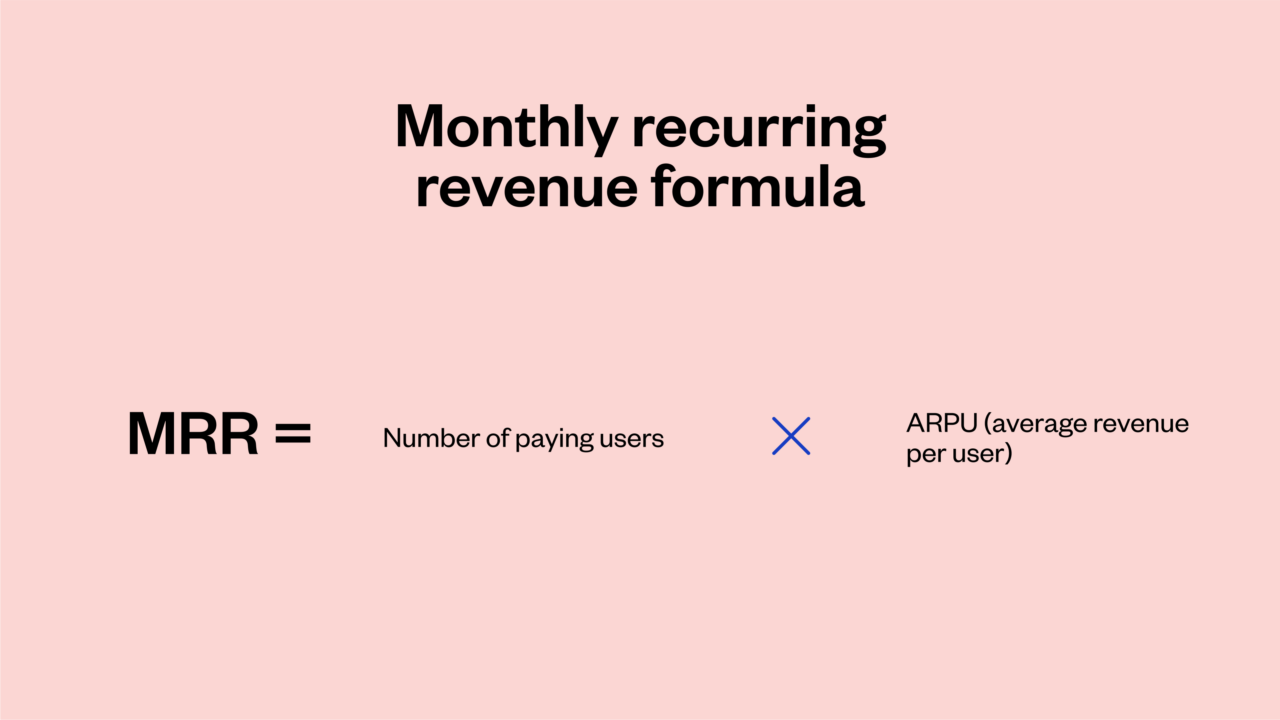
To calculate monthly recurring revenue, multiply the total number of paying users by the average revenue per user (ARPU).

Monthly recurring revenue formula:
Number of paying users x ARPU = MRR

Graphic illustrating the MRR formula: monthly recurring revenue equals the number of paying users multiplied by ARPU (average revenue per user).

Monthly recurring revenue (MRR) Examples

Let’s look at a few examples of how to calculate MRR.

Example 1

Imagine you’re a growing SaaS company with 2,358 customers who have each paid an onboarding fee of $65 and an average of $149 per month for your service. To calculate your monthly recurring revenue, ignore the one-time $65 onboarding fee, as it does not count toward MRR. Instead, focus on the number of customers (2,358) and the average monthly pay ($149). Plug those numbers into the formula:

2,358 paying users x $149 = $35,134 in monthly recurring revenue

Example 2

In a different scenario, let’s consider a SaaS company with 2,000 customers and various pricing tiers:

Tier 1: 500 customers paying $50 per month
Tier 2: 1,000 customers paying $100 per month
Tier 3: 500 customers paying $200 per month

To calculate this company’s MRR, add up the recurring revenue from each tier:

$25,000 + $100,000 + $100,000 = $225,000/month

This SaaS company has a total monthly recurring revenue of $225,000.

Example 3

Finally, let’s take a company that is currently losing revenue and wants to understand where this loss is coming from. In this case, we would calculate the churn MRR. We’ll do this by:

  • Determining the time to measure

  • Identifying the customers who have churned (in this example, customers who have canceled their subscriptions)

  • Summing the MRR lost due to churn

  • Dividing by the total number of customers

Let’s say a SaaS company has 100,000 customers, and during the past month, 1,000 customers have churned from canceling their subscriptions. The average MRR per customer was $100, so the MRR lost due to monthly churn would be $100,000 ($100 x 1,000 customers).

Types of monthly recurring revenue (MRR)

When analyzing your company’s financial health, you can use MRR to draw valuable insights in multiple ways. Here are the types of MRR you can calculate:

Gross MRR

Gross MRR refers to the total monthly revenue generated from all subscribers, before any discounts or adjustments are applied.

Net MRR

Net MRR accounts for discounts, refunds, and other adjustments and represents the actual revenue generated each month.

New MRR

New MRR is recurring revenue generated by new customer acquisitions. For example, if you add a new customer to one of your monthly subscription plans, the revenue they contribute is considered new MRR.

Expansion MRR

Expansion MRR comes from upselling or cross-selling to existing customers. If a current customer upgrades their subscription by adding more users to their account, that revenue counts toward expansion MRR.

Churn MRR

Churn MRR is revenue that decreases from downgrades or gets lost due to canceled subscriptions. Churn MRR is particularly important because it gives insight into the health of the overall customer base and helps you identify areas for improvement. Churn is the enemy of all subscription businesses and should be monitored closely, so keeping an eye on churn MRR is essential.

Contraction MRR

Contraction MRR measures monthly recurring revenue (MRR) decrease over a certain period. It is calculated by subtracting the current MRR from the MRR in the previous period. A contraction in MRR indicates that the company is losing recurring revenue. This can be due to many factors, like a decrease in the number of paying customers, a decrease in the amount paid by existing customers, or a combination of both. Subscription companies need to monitor their contraction MRR and identify the causes to reverse the trend and improve financial performance.

Reactivation MRR

Reactivation MRR is revenue recovered after reacquiring past customers. This process can be done through email, retargeting ads, or even reaching out to customers on social media. It’s a good idea for subscription companies to monitor reactivation MRR because the cost of re-acquisition models can add up quickly.

MRR vs ARR

ARR, or annual recurring revenue, is calculated for annual terms with a one-year minimum. Contracts with terms of less than one year shouldn’t be recorded in ARR. These types of short-term contracts often allow for subscription cancellation within 30 days. If these subscriptions were calculated as ARR, that would be inaccurate. Instead, shorter term subscriptions should be calculated as monthly recurring revenue (MRR).

MRR vs revenue

MRR focuses on monthly revenue, and revenue is a more general term for a company’s income over a specified period. While MRR only applies to monthly income, revenue could be determined for a variety of different periods, such as monthly, quarterly, and annual.

What is a good MRR rate?

Pinpointing a good MRR rate is challenging because the number can vary depending on the market and stage of business you’re in, how much your company is spending on advertising and marketing, the sales channel you are focusing on, as well as your customer demographics. It’s difficult to nail down a specific growth rate to abide by, but many industry experts agree that a 10-20% MRR growth rate after reaching $1 million in ARR should lead you to a great position to raise funding and earn a desirable amount of revenue.

What are the benefits of monthly recurring revenue (MRR) for subscription businesses?

Focusing on monthly recurring revenue (MRR) for subscription businesses includes multiple benefits. Let’s look at some of the most important ones:

Increased predictability: With MRR, subscription businesses can predict future revenue with much more accuracy, which makes it easier to plan for future growth and expansion.

Improved sales planning: MRR analysis can help companies determine which products and services are selling well and which areas need improvement. This information can then be used to make data-driven decisions about products to focus on in the future.

Better understanding of customer lifetime value (LTV): LTV is the total value a customer brings to a business over the entire time they are a customer. MRR is a key factor in determining CLV, which helps businesses understand the long-term value of each customer.

More insight into churn: MRR also makes it easier to monitor and analyze churn (such as customers losses from cancellations or downgrades). By keeping an eye on MRR, businesses can take steps to reduce churn and retain more customers.

Better cash flow: MRR provides a steady stream of revenue to ensure a healthy cash flow for the business. This is especially important for growing businesses that need to invest in new products, marketing, and other initiatives to drive growth.

What are the disadvantages of MRR?

When choosing an MRR model to measure success in your business, several disadvantages exist, such as:

Hidden revenue loss: MRR may not depict the total revenue loss from customers downgrading their service plans or pausing a subscription, giving an incorrect appearance of stability.

Dependence on new customers: If MRR growth is primarily determined by new customer acquisitions instead of customer expansion, it can put unnecessary pressure on sales and marketing teams.

Impact of churn on growth: MRR growth with high customer churn could indicate that the business can’t retain customers over the long term.

Lack of long-term insights: Since customers pay per month, predicting long-term revenue or keeping a steady cash flow is difficult and affects financial planning and strategic projects.

Complexity of calculation: Finding and analyzing MRR growth can be difficult, especially for businesses with numerous pricing options.

MRR growth strategies: How to increase MRR

Here are some strategies you can use to optimize your monthly recurring revenue:

Cross-selling and upselling: When improving MRR, start with an existing customer base. These customers can be offered additional products and services through upsell and cross–sell opportunities, increasing your MRR per customer.

Offer discounts and promotions: Discounts and promotions can incentivize customers to upgrade their subscriptions or subscribe for longer periods, leading to MRR growth.

Improve customer retention: When your business focuses on reducing churn, it can increase its MRR by keeping customers around for longer.

Focus on customer satisfaction: Ensuring that customers are satisfied with the products and services they receive is key to reducing churn and keeping MRR steady.

Introduce new products and services: Offering new products and services can improve MRR by attracting new customers and helping upsell to existing ones.

These optimization strategies can help your business increase its monthly recurring revenue and ensure a more predictable, steady stream of income.

Key takeaways on monthly recurring revenue

SaaS companies love MRR, and for a good reason — the model works because this metric doesn’t lie when it comes to the health of a business. This is why monthly recurring revenue is one of the essential metrics for subscription businesses. By measuring and analyzing this metric for your subscription business, you can stay on top of the information your investors care about most.

Think about what your company offers and whether there is a way to expand further. Can you find new income streams within a monthly model that keeps customers interested enough to return? New MRR is a game changer financially, which is one of the reasons MRR is so effective for SaaS companies. Having cash that a company can count on makes a big difference in future planning and projects.

Combining MRR with other key metrics essential to subscription businesses can help you make even smarter decisions. These metrics include total active customers, total active subscriptions, total contract value (TCV), and net revenue retention (NRR)

Learn more about how to enable revenue growth.

MRR Frequently Asked Questions

What exactly counts toward MRR?
MRR includes revenue from all active subscription fees and recurring charges, normalized to a monthly value. One-time fees, setup charges, and non-recurring services are not included.

How is MRR calculated?
The basic formula multiplies the total number of paying customers by the average monthly revenue per user (ARPU). Contracts billed annually or quarterly are converted to a monthly equivalent before inclusion.

What’s the difference between MRR and ARR?
MRR measures recurring revenue on a monthly basis, while Annual Recurring Revenue (ARR) is simply MRR × 12 and is used for longer-term planning and investor reporting.

Can MRR go down?
Yes — if customers cancel, downgrade plans, or otherwise reduce recurring spend, MRR decreases. Tracking these negative components (churn and contraction) helps understand revenue health.

Why is MRR important for subscription businesses?
MRR provides predictable financial visibility, supports forecasting and budgeting, and helps identify growth trends or issues early — making it indispensable for SaaS, media, membership, and other subscription models.

Does MRR include upgrades and downgrades?
Yes — MRR should account for expansion MRR (upgrades or add-ons) and contraction MRR (downgrades) to reflect the true change in recurring revenue.