Guides / Usage-Based Pricing: Models, Benefits & Implementation
Usage-Based Pricing: Models, Benefits & Implementation

TL;DR: Usage-based pricing is a strategy where customers are charged based on their consumption of a product or service. It aligns costs with value, lowers barriers to entry, and is rapidly gaining adoption for GenAI and many SaaS models, particularly in cloud and AI infrastructure. While it offers flexibility, it introduces complexity in forecasting and revenue recognition that finance teams must manage proactively.
What is usage-based pricing?
Usage-based pricing is a strategy where customers are charged and billed based on how much of a service or product they use. This could be anything from the number of API calls, gigabytes of data used, kilowatt hours of energy, or outputs from a chatbot.
This flexible pricing approach provides value and transparency to customers and helps build trust and loyalty. Usage models are used across multiple industries, including cloud computing, utilities, and telecommunications, where they allow businesses to scale their services according to customer needs and usage patterns.
Usage-based pricing and hybrid models are also quickly becoming the model of choice for AI and GenAI offers, both for vendors and their customers. Launching a usage-based model can seem like an insurmountable challenge, but this guide will provide the knowledge and strategies you need to successfully make the shift across your business.
Usage is fast emerging as the pricing model of choice for companies across industries, especially those developing and launching new GenAI offers. This is because the model provides good alignment with and demonstration of value to the customer.
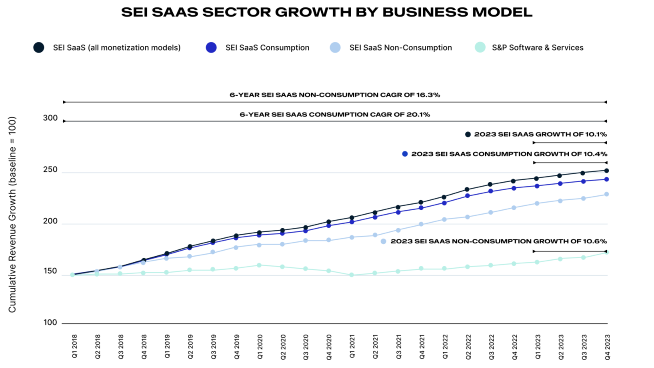
Subscribed Institute research has shown that many of the fastest-growing SaaS companies leverage a usage-based model. In fact, the number of companies employing some form of usage-based pricing increased 9% to 26% between 2020 and 2022.
Why are usage models so popular?
Usage-based pricing can be a competitive differentiator and may enable a lower cost of sale and lower barriers to entry. And when used as part of a hybrid model, usage has been shown to contribute to higher year-over-year (YoY) annual recurring revenue (ARR) growth across all company sizes.
Customers are increasingly demanding a clear return on investment (ROI) and lower upfront risk. They want a better picture of what they’re using and how much value they’ll derive from your product. 80% of customers report that usage-based pricing provides better alignment with the value they receive.
Customers prefer flexibility when they are first trying a product, which makes simple pay-as-you-go pricing a good option for onboarding new customers. But as they adopt and grow more confident in your solution, they are going to want more predictability. Customers will expect the nature of how they pay for their consumption of your product to change as their relationship with you grows.
As a result, your monetization capabilities will also need to be ready to change to meet customer expectations.
How to choose the right usage-based pricing model
When deploying usage, three key factors must be considered to achieve recurring growth: the company and product, use cases, and pricing model.
Company and product
Usage-based business models can be a powerful lever for growth, but some companies hesitate to implement them because of the perceived risks and investments involved. Building the capabilities and deploying in the appropriate situation is critical. Consider the following variables:
- The tech stack: How does the entire technology stack align with respect to flexible use? For Infrastructure as a Service (IaaS) and Platform as a Service (PaaS) companies that sit on an AWS stack, usage flexibility is critical, and usage models tend to fit well. AWS EC2, Snowflake, and Fivetran are examples of three technology offerings that are complementary and aligned in flexible use.
- Product-led vs. sales-led growth: Pure usage-based models often work well with product-led growth because they scale naturally without the need for selling a new contract. Sales-led paradigms can work with usage-based as well, but are best suited for committed spend or hybrid contracts.
- Fixed vs. variable economics: For products with a more predictable cost of goods sold (COGS) and stable usage patterns, a recurring user-based subscription model would be a good choice. For products with spikes in consumption and variable costs (e.g., in many Generative AI use-cases), usage, outcome-based, or hybrid models would be a better choice.
Use cases
A key insight from our data analysis reveals that most deployments of usage-based pricing involve a combination of usage and recurring charges as part of a hybrid model. Companies that succeed in their deployment often target use cases more aligned with the benefits and value they bring.
A few example use cases where usage-based models often make more sense include:
- Spiky demand profiles (e.g., certain analytics workloads, Snowflake) where flexibility is more important than predictability.
- Seasonal businesses and industry sectors (e.g., retail technology around the holidays, accountants at tax season).
- Generative AI tools that have a variable consumption of tokens.
Common usage-based pricing models
Usage-based pricing is at the core of any pure consumption business model. Providers must be able to measure how much product a customer uses to bill effectively. This concept may be referred to as a “value metric,” “unit of measure,” or “pricing basis.”
Your value metric is a usage attribute your company can track that also satisfies value alignment, leaves room for growth, and offers predictability for both the customer and your business. Common metrics are value-based, measurable, and controllable, such as the number of users, the amount of data consumed, or the number of events.
After selecting a value metric, the next step is to determine a price per unit of consumption. This “rating logic” can be as simple as a flat price per usage event (like an API call) or as complex as multi-dimensional algorithms (like a combination of compute and storage).
There isn’t a one-size-fits-all model for usage pricing. As our data shows, you have to find the right level of usage-based pricing within an overall usage-based business model to maximize growth. To see the greatest recurring revenue growth, consider a combination of several models to achieve a hybrid consumption model.
Pure usage models
- Per-unit or pay-as-you-go: This pure usage model allows customers to pay for what they use. This is a solid option for customers with unpredictable needs, and allows for spikes in usage and those associated costs. This option gives the most flexibility for customers to consume only what they need. A pay-per-ride service like Chariot or a pay-per-API offering like Amazon Web Services are great examples of this.
- Volume Pricing: Volume pricing is used to charge a price based on the volume purchased. This kind of pricing can make a lot of sense for certain use cases, such as API calls for SaaS. For example, if you do 1-1000 API calls, you might charge $.15 (flat or per unit), but if you go from 1,001-10,000, you will charge $.10 each. This kind of pricing can be a great incentive for a consumer to use more of the product since the price per unit gets cheaper.
- Tiered or step pricing: Tiered pricing is used to change pricing progressively as the volume increases. Like the volume pricing model, the tiered pricing model uses a price table to calculate the pricing. It differs from volume pricing in that the amount to charge varies progressively as volume increases, so different units may be priced differently depending on the tier they fall into.
- Overage: This pricing model gives your customer a certain quantity of included units, for example, minutes for calls per month. If your customer exceeds the quantity of included units within the billing period, the amount used over the included units is charged on a per-unit basis based on the overage price.
- Tiered with overage: This charge model is similar to the tiered charge model, except there is an overage charge for any units consumed above the ending units of the final tier.
Related resource
How usage models contribute to business success
Learn the proven strategies and tools to launch and scale a usage pricing model. Our research has shown that SaaS companies using hybrid models outperform all other businesses when it comes to recurring growth.
Hybrid & commitment models (the gold standard)
Recently, hybrid consumption models that combine predictable subscription approaches with more variable usage models have gained prominence as drivers of recurring revenue. Although the SaaS sector is still fine-tuning these pricing and packaging strategies, the results are promising compared to non-usage models.
While pure usage revenue can be less predictable and more volatile, hybrid consumption models can be a good fit for SaaS offerings, particularly cloud services and generative AI. These hybrid, agile models can help provide predictability, while also improving value to the customer by tying pricing and payments more directly to usage and actual demand.
Some of the most successful businesses have no more than 25% of their total revenue coming from usage models. They anchor pricing on a value metric first and then grow that pricing by combining pay-as-you-go models (low risk) with pre-paid models (high predictability), thereby driving recurring growth.
- Hybrid consumption: This approach employs a mix of both subscription and usage-based charge models for a single offering.
- Minimum commitment: This allows you to charge your customer at their commitment level on each invoice, even if they don’t fully consume the committed usage amount. With this model, businesses have a level of predictability in revenue expectations according to the customer’s commitment level.
- Pre-paid with drawdown: Customers pay upfront for a set of units (or hold a cash balance) that is drawn down over a period of time. This offers flexibility for customers in terms of choosing a prepaid amount and revenue predictability for the business.
- Multi-attribute: This model charges customers through a variety of different metrics. For example, Zipcar charges customers through a combination of time of day, type of car, day of the week, and other attributes.
Looking at usage from every angle (pros and cons)
Implementing usage-based pricing presents a unique set of advantages and challenges. Here we’ll explore the intricacies of these models, highlighting the pros and cons, as well as presenting practical solutions.
What are the advantages of usage-based pricing?
An ever-increasing number of consumers and businesses have encountered usage-based pricing and billing, and they’re demanding more. There has been a significant increase in the adoption of hybrid consumption models over the last 3 years. Let’s explore some of the benefits of implementing a usage-based pricing model.
- Customer-centric approach: Usage-based models focus on providing value that directly correlates with customer needs and usage, rather than imposing flat rates or bundles. Usage data can provide valuable insights into customer behavior and preferences. Companies can use this data to offer personalized upgrades or additional services tailored to the specific needs of each customer, enhancing the perceived value and differentiating their service in a crowded market. This pricing model also allows businesses to cater to a wide range of customers, from startups to large enterprises, by offering plans that scale according to usage.
- Differentiated value proposition: By targeting the right value metric and optimizing the level of usage pricing, businesses can differentiate themselves from competitors and create a strong value proposition. Plus, usage-based models allow companies to quickly adapt to market changes and evolving customer needs without a significant restructuring of their pricing strategies. Recent Subscribed Institute research also indicates that SaaS companies employing usage-based models are maintaining a long-term revenue growth advantage over their non-usage counterparts.
- Flexible and scalable growth: Because the barrier to entry is lower, customers can start small, see the product in action, and decide whether they want to sign up for a more robust package when the time is right. As customer demand increases, businesses can adjust resources to accommodate higher consumption levels.
- Visibility and control: Customers value real-time usage visibility, enabling them to track daily progress, anticipate overages, and view billing charges. With the right technology in place, usage models can enable your business to push out threshold notifications. This allows customers to monitor their usage and spending, and ultimately, increases overall customer satisfaction. Usage forecasting can also enable your business to monitor behavior and predict expansion opportunities for high-consumption customers.
- Predictable revenue streams: While usage-based pricing models are typically associated with variable costs based on actual usage, companies can introduce predictability by linking prior commitment to customer spending habits. These hybrid consumption models can lead to higher YoY ARR growth across all company sizes. This approach is often referred to as “committed usage” or “pre-paid consumption.” These strategies are fast emerging as the models of choice for companies launching AI and GenAI, due to their potential to drive growth and profitability even in the face of astronomical costs.
What are the challenges of usage-based pricing?
Implementing a usage-based pricing strategy can also present challenges. Companies need to balance value while also having enough cash to cover costs. Pricing too high could put some customers off, while pricing too low will result in a loss. Implementing usage-based pricing requires planning and consideration of the potential risks and challenges.
- Surprise overages or shut-offs: Surprises lead to terrible customer experiences. For this reason, customers tend to dislike simple pay-as-you-go billing; it may not provide the predictability they require. The nature of usage pricing means that customers might not realize how much they’re using. The answer is transparency and mediation. Customers need to stay apprised of their consumption patterns. And if you do it right, it’s not only a better experience, but can be a key growth lever as well.
- Customers may overcommit: Usage-based pricing models may introduce a situation where customers end up overcommitting or pre-paying for too much. Businesses will then have to decide how to handle the extra credits, money, or units customers already paid you for.
- Billing becomes substantially more complicated: Usage charges are typically billed in arrears, after the billing cycle. This may be different from the way your billing team operates today, if your customers are typically billed in advance. This new process means that billing teams will have to ensure charges are calculated accurately, invoices are sent out on time, and billing operations are maintained for customers who may not be on a usage model. This often means that billing teams have to work out of multiple systems to collect the data needed for accurate billing.
- The role of Billing Operations will have to expand: In a traditional subscription model, a customer can’t dispute that they bought 5 seats after they sign the contract and pay the invoice. In a model tied to usage, there’s a myriad of opportunities for billing confusion and inaccuracies to spiral out of control, destroy customer experiences and bog down your support team. Billing Ops will need to expand from deal support and invoice accuracy to forecasting, notification, and dispute defensibility.
- Revenue recognition and reporting can hinder success: Under ASC606 and IFRS15, there are specific revenue recognition rules that accounting teams have to adhere to. Without a system in place to handle complex usage revenue recognition, this will lead to manual efforts and hundreds of thousands of lines of spreadsheets to reconcile.
The financial impact: forecasting & revenue recognition
While usage models are great for certain types of services, they are by no means a “one size fits all.” And many of your customers will see it that way, too. If you’re considering adopting a usage model for the first time, it’s important to take a measured approach.
CFOs need to understand the multi-faceted nature of usage pricing to decide if it’s the best fit for their business, and if so, what kind of strategy, communication, and organizational buy-in are required for success.
The challenge of forecasting usage revenue
The foundation of usage pricing is customer usage data. You need complete, accurate, and timely usage data that can easily be used for rating and billing customers in a reliable, auditable, and defensible way. Unclear usage on a big invoice can quickly absorb hours of your billing ops, support, and even sales teams’ time.
Clean data is also important for supporting accurate forecasting. By nature, usage models are less predictable than traditional subscription models, which makes accurate forecasting more difficult but also more important.
- For example, if you have customers paying for a SaaS license with a yearly contract, you can count on that revenue for a full year, regardless of how much the customer uses the product.
- But with usage models, revenue can change every month, day, or even minute.
As a CFO overseeing a usage model, understanding usage patterns to accurately forecast will become one of your top priorities. Without clean usage data, everything about a usage model becomes significantly more difficult. Whether it’s API calls, number of emails sent, tasks in an application, file uploads, or logins, getting a handle on customer usage data and insights should be the primary focus for any CFO starting a usage journey.
Usage forecasting also brings a unique challenge when it comes to recognizing usage revenue. For instance, here’s a common issue encountered by businesses: FP&A or sales operations teams may develop their own usage forecasting without incorporating the more nuanced revenue treatments demanded by ASC606. This can result in vastly different forecasts from one end of the business to the other.

Tip
Make the most of your data
Work with your analytics team to consolidate and evaluate usage data to uncover trends and help inform the selection of usage value metrics. Consider adding a mediation engine—a purpose-built solution that can handle all your usage data needs and integrate with your current billing and rev rec systems.
To increase the accuracy of usage forecasts, CFOs should encourage cross-functional collaboration within the organization and alignment on the business’s approach to new use cases.
Work with your analytics team to consolidate and evaluate usage data to uncover trends and help inform the selection of usage value metrics. Consider adding a mediation engine, a purpose-built solution that can handle all your usage data needs, and integrate with your current billing and rev rec systems.
To increase the accuracy of usage forecasts, CFOs should encourage cross-functional collaboration within the organization and alignment on the business’s approach to new use cases.
Forecast usage revenue using existing business use cases
Usage forecasting enables revenue teams to anticipate how much revenue will be gained through usage-based pricing models. This means forecasting variables such as usage, customer lifetime value (CLV), and potential overage charges. This gets increasingly complex when you introduce different bundles and offers.
Part of the appeal of usage models is that they allow customers to vary their use of a product or service, and therefore their charges, but this can make revenue predictability and forecasting tenuous. Often, the unique challenges and potential pitfalls presented by usage forecasting are not realized until accounting is tasked with recognizing usage revenue.
For example, FP&A or sales operations teams may develop their own usage forecasting without incorporating the more complicated, GAAP-compliant revenue accounting policies required for usage data and contracts. This can result in vastly different forecasts from one end of the OTC process to the other and may require a cumbersome reconciliation.
To avoid this, revenue accounting teams should advocate for cross-functional networking within the organization and alignment on the business’s approach to new use cases. Look for technology that can capture and analyze multiple dimensions of upstream data to quickly identify and resolve issues. In addition, real-time reconciliation and a close process dashboard can increase visibility and the accuracy of your revenue forecasts.
Ensuring accurate revenue recognition (asc 606)
The conversation about revenue recognition should begin as soon as the business elects to incorporate usage-based pricing. With a usage model, you might charge a flat fee, offer a volume or tier discount, or use multiple units of measurement depending on the country, time of day, or any of dozens of other variables. These varying permutations could create multiple different prices for the same service.
The charge model you implement determines your financial relationship to your customers, and it obligates you to accurately report on that financial relationship in a compliant way.
In particular, ASC 606 can make usage pricing tricky. Usage models require granular, real-time visibility, not just to total up usage at the end of a billing period, but also to monitor customer usage at any given time. Even with the addition of a usage model, you will need to layer in a recurring component. That could be a true prepaid model, a credit system, or a system tied directly to the usage metric itself, for example, gigabytes of storage.
It’s also important to consider what you’ll do if a customer doesn’t use everything they prepaid for and how that discrepancy could impact subscriber experience.
Why manual processes fail:
- Liability: If customers are prepaying on a contract, for example, that creates liability for you as a company and obligates you to deliver against the contract. The customer determines when they want to draw on what they’ve paid for, and that determines when you deliver against it and have to report to the street.
- Drawdown complexity: As different customers draw down their balances at different rates, you face another layer of complexity in tracking and reporting earned and deferred revenue. This is different from a prepaid model based on availability. For example, SaaS subscription companies often charge customers for one seat for one year, even if they collect payment every month. How or when the customer chooses to use that seat doesn’t impact the SaaS company’s revenue because their obligation was simply to make the service available. With usage, however, tracking usage is important not just for providing the service, but also for tracking revenue.
- Audit risk: Manual usage revenue recognition processes, along with increased scrutiny from auditors, will make audits more time-consuming and expensive, as auditors will be forced to sift through thousands of lines of usage data. For companies launching an initial public offering (IPO), issues uncovered during the audit process could cause delays.
Automate revenue recognition to streamline processes
Successfully managing usage data can require multiple tools to track data, meter usage, and analyze historical revenue trends.
Even some level of automation in the form of an ERP may not be enough, since legacy systems were not built for usage. ERP solutions are still built on the basis of handling one-time product fees, and are often unable to fully support usage pricing models without significant customization efforts. Unfortunately, even with customizations, 60% of revenue accounting team members report that their ERP revenue modules do not fully support their business requirements.
Usage models also require granular, real-time visibility, not just to total up usage at the end of a billing period, but also to monitor customer usage at any given time. The time and money spent on retrofitting ERP systems for new models can stall initiatives.
Revenue accounting teams are already feeling the strain of this lack of automation: 68% report not having the right technology to address growing demands from the business. Adding a new usage model without the necessary technology is certain to exacerbate these issues.
By centralizing revenue data through automated integrations, you can eliminate sprawling networks of spreadsheets that need to be updated and linked manually. Eliminating a large chunk of time-consuming, low-value manual tasks translates directly into operational efficiencies and significant savings in both time to close the books and money. Many teams experience a reduced time to close, a reduction in employee overtime, and the ability to focus on more strategic tasks.
More and more companies, especially those adopting usage, have shifted away from managing revenue recognition within an ERP. Instead, they turn to specialized revenue subledger solutions that can operate as a revenue subledger and feed data directly to the ERP general ledger.
The advantage of these point solutions is their native capability to provide features that are critical to the usage revenue accounting process, such as SSP analysis, contract modification, and revenue analytics—without expensive or complex customizations.
How to implement usage-based pricing
Now you know the benefits of usage and how to choose the right model or mix of models for your business, but how do you implement usage pricing quickly, and what features should you look for? Here are the top 4 capabilities you’ll need to make your usage model a success:
- Price without developer intervention:
- No-code pricing tools: Change pricing models or adjust price points without needing extensive developer resources.
- Automated pricing updates: Ensure that changes in pricing are reflected across all systems, including in-app purchases, eCommerce platforms, and CPQ systems.
- Data-based value metrics: Quickly track and define meters you can monetize across all of your products.
- Experiment with diverse pricing strategies:
- Try a mix of models: Include volume, tiered, multi-attribute, or pay-as-you-go options to cater to different customer needs.
- Prepaid credits and top-ups: Allow customers to manage their budgets better by prepaying and using credits as needed.
- Discounts and trials: Introduce promotional pricing or trials to attract new users and encourage consumption.
- Capture, measure, and track usage data:
- Automated mediation: Effectively manage the aggregation and processing of usage data, ensuring that data from various sources is normalized and accurately represented for billing.
- Scalability and integration: Seamlessly integrate usage data into billing systems and support scalability by handling large volumes of data without compromising on performance.
- Dynamic data integration: Stream usage from various sources, then automatically enrich, aggregate, and deduplicate the data.
- Analyze and optimize for growth:
- Real-time analytics: Continuously monitor and analyze usage patterns to understand customer behavior and adjust offerings accordingly.
- Cost and revenue tracking: Compare costs against revenue for each pricing plan to identify the most profitable strategies.
- Experimentation: Apply different pricing plans to the same usage data to discover which maximizes revenue and customer satisfaction.
- Cross-functional implementation: Successfully roll out new pricing company-wide by consulting and planning with multiple stakeholders, such as sales and revenue accounting teams.
Step 1: Mediation and metering
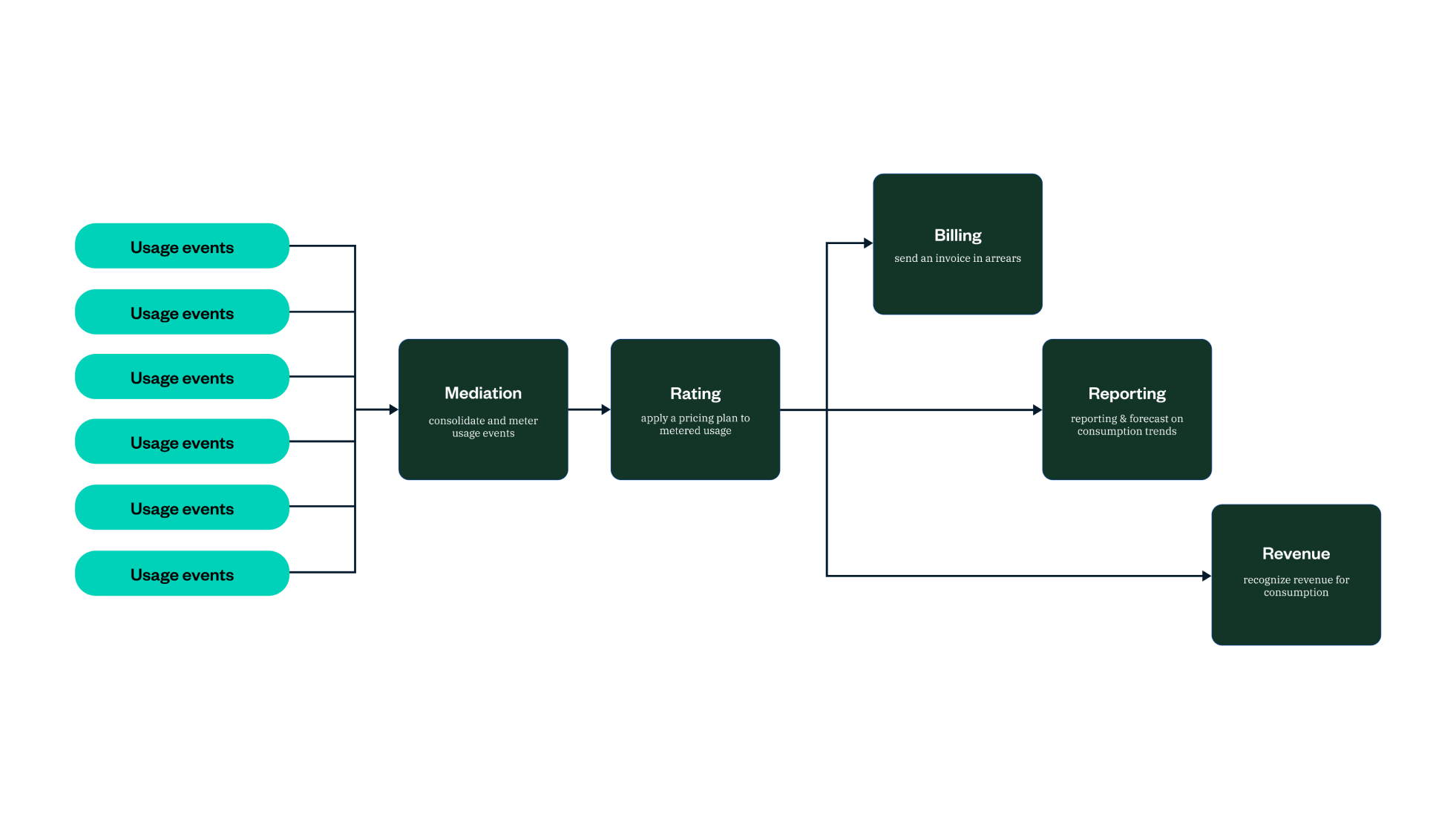
Usage mediation helps maximize the information implicit in every usage event by consolidating, metering, and tracking all customer usage data. Accurate and timely data about how your customer is actually using your product or service is imperative for optimizing your usage pricing and billing strategy.
Many companies that are just beginning their usage journey jump right into rating, which is the process of selecting and implementing a pricing plan. But before you can optimize your pricing and packaging, you must first gain a comprehensive understanding of your customer and their consumption patterns. This can be achieved by gathering and measuring customer usage data through mediation.
While customized or add-on solutions can be layered on top of your billing system to ingest and measure usage data, the most efficient and cost-effective solution for the majority of businesses is a mediation engine, a purpose-built solution that can handle all your usage data needs and integrate with your current billing and revenue recognition systems.
What is a mediation engine?
Much like the electric meter on your house measures your power usage and turns it into billable kilowatt hours (kWh), a mediation engine meters and measures each of your predefined usage value metrics. For your business, these usage value metrics might be GB of storage or minutes of call time instead of kWh, but the idea is the same.
But usage data and the mediation process can and should be used for so much more. To successfully drive recurring growth using a usage-based strategy, you need to be able to uncover actionable insights, like cross-sell/upsell opportunities or cost-saving strategies. When you can understand more about how, when, why, and where your customers are using your product, you can fine-tune your offerings, pricing, and theproduct itself.
Many companies offering usage either don’t know what type of mediation solution to look for, or don’t yet realize they need one. R&D and IT teams are often saddled with building and maintaining custom solutions, like a homegrown mediation tool. Alternatively, they may opt for an add-on product or an extract, transform, and load (ETL) tool but ultimately, most businesses discover that these solutions require a significant amount of developer time and can drive up costs.
A mediation engine, on the other hand, will provide all the tools your business needs to collect, transform, meter, and track usage data. It should give product managers the real-time visibility they need to quickly and seamlessly pivot pricing from pure pay-as-you-go to hybrid usage models—and everything in between. As part of your larger usage-based pricing strategy, a mediation engine should help provide customers with the flexibility to consume what they want when they want and the transparency to keep an eye on their usage and charges.
How do I ingest and store usage data?
To begin mediation, you’ll need to collect usage data from all relevant sources. This could be data from user interactions, system logs, sensors, or other sources.
If you don’t have a mediation solution, your IT team will likely have to manage, route, and clean up all of the usage data coming from your product. After aggregating thousands of events into a data warehouse, they’ll then have to analyze and transform the data to make it accessible.
A mediation engine can automatically stream near real-time usage data from multiple sources using APIs or batch uploads. Look for a solution that allows you to stream at high volumes (up to ~200K) of usage events, so you’re able to accommodate peak periods. And, by using a purpose-built mediation engine for aggregation and storage, your usage data becomes more manageable, accessible, and secure. Plus, removing the need for a separate data warehouse can help cut unnecessary storage costs.
How do I meter usage-based data?
After ingesting and storing your usage data, you must measure it in a process called metering. To do this, you’ll need to determine the metrics that are relevant to your product or service by analyzing customer data. These are the parameters or attributes that you’ll measure and use to charge your customers.
When it comes to usage-based pricing models, you’ll want to identify and measure key usage value metrics. These key metrics should not only be usage attributes that your company can track, but should also satisfy value alignment, leave room for growth, and offer predictability both for the customer and your business.
Research shows that companies utilizing hybrid consumption models, with metrics anchored on both usage and recurring revenue, outperform all other businesses when it comes to year-over-year (YoY) annual recurring revenue (ARR) growth.
Companies that already have an ETL tool might leverage it for usage metering, but ETL tools only do batch loads, so developer involvement is still required to customize and maintain. And as new offerings are added, metering requirements can slow down the time-to-market.
Revenue recognition will be impacted too, when proper metering and measurement of usage data isn’t occurring, or data isn’t in a form that’s readily available to accounting, rev rec will be slowed down, and the business will suffer.
How can a mediation engine help meter and identify key metrics?
A mediation engine can assist in collecting, aggregating, analyzing, and monitoring data related to customer usage. This data-driven approach can help you make informed decisions about which metrics are most relevant for your pricing model, ensuring that you align your pricing with customer behavior and value.
The more attributes you have to base your pricing on, the more you can create the perfect offering for your customers. Look for a solution with drag and drop capabilities, making it easy to quickly put together the right combination of metrics.
Step 2: Rating and pricing strategy
Usage models shine when it comes to product-led growth. Pure pay-as-you-go pricing reduces risk for customers and gives them confidence to try your product, which in turn may help increase your customer acquisition rates at a lower cost.
Ideally, at some point, your customers’ use of your product grows to the point where the cost becomes material to their business. At this point in your customer’s consumption lifecycle, two key concepts become critical: notifications driven by real-time metering and rating, and being able to offer more predictable contract terms and pricing models.
Step 3: Billing and invoicing
For usage pricing to work long-term, you need a system that provides real-time usage rating and threshold notifications. There is almost no worse customer experience than being surprised with a surprisingly large invoice they weren’t expecting. It will always be imperative that you give your customers as much transparency about their costs as possible, in as close to real-time as possible.
The best businesses attack this problem from multiple angles by offering self-service portals, triggering threshold notifications, and arming their field teams supporting customers with data tools to stay ahead of any surprises.
While customized or add-on solutions can be layered on top of your billing system to ingest, meter, and rate data, the most efficient and cost-effective solution for the majority of businesses is a mediation engine, a purpose-built solution that can handle all your usage data needs and integrate with your current billing and revenue recognition systems.
Adding predictability:
If there’s one thing CIOs hate, it’s surprising their CFOs. Pay-as-you-go models work great for enticing customers to try new products, but if you’re not ready to offer contract terms and pricing models that give them more predictability, you’re likely to lose these customers to a competitor who will.
So, while pure usage-based pricing is good for acquisition, adding recurring and pre-paid models to create a hybrid offering tend to be better for retention and allow you to lock customers into a more predictable agreement that serves all parties better.
Step 4: Analyze and optimize
Successful usage models are iterative. You should apply different pricing plans to the same usage data to discover which maximizes revenue and customer satisfaction. Compare costs against revenue for each pricing plan to identify the most profitable strategies.
Best practices for usage-based success
Create a culture of experimentation
The industry conversation around pricing and packaging has recently added an important consideration: experimentation. While everyone would love to say they have great pricing, the reality is that businesses are always tinkering, thinking, “What can I do here? What can I do there? Are my customers really receiving value? Am I capitalizing on that value? Do they feel good about paying for the value they receive? When was the last time we tinkered with pricing? How does that compare to our competitors?”
These questions are great starting points for building experiments around pricing and packaging to discover combinations and approaches that make sense for both your customers and your business.
Experimenting with pricing and packaging has helped many businesses become better at usage-based pricing. Here’s an idea of what continuous fine-tuning looks like:
- Experimenting frequently: Avoid the “we did this last year” mindset and instead get comfortable with iterating as often as possible.
- Running tests: Learn from your data by split testing (also called A/B testing) different versions of it and evaluating based on metrics like conversion rates.
- Trying model variations: Start simply with pay-by-use approaches and then ramp up to something more complex, like tier-based usage.
- Using specific tactics: Plan strategic experiments that are specific to where your business is on its value realization journey.
- Keeping customers in mind: Listen to what customer support and billing ops are hearing about the value of your offers.
Secure executive buy-in
CFOs need to understand the multi-faceted nature of usage pricing to decide if it’s the best fit for their business. While 79% of revenue accounting team members agree that they need higher levels of automation, 67% say they struggle to get buy-in from leadership in order to implement these new solutions.
Given the many hats CFOs and other finance executives must wear, it’s not surprising that they might not have full visibility into the nuances of the revenue process, especially with respect to usage models. Bringing leadership up to speed on the current process, risks, and the implications for supporting a new go-to-market model can help make the business case for automation. And educating finance executives on the benefits of end-to-end revenue automation and the cost of inaction can help revenue leaders further bolster their case.
Align go-to-market strategy
Usage pricing requires a sales model that doesn’t just bring in customers, but also ensures they use the product. The role of the sales team in a traditional product sale is over as soon as the product is delivered. With a subscription, the sales team closes the deal and then takes a backseat until renewal time one or two years later. But usage pricing requires a sales model that provides self-service, such as allowing customers to come to your website and try your product by signing up and test-driving it.
Here, the sales team needs to stay engaged throughout the customer journey to help customers ramp up their use of the product. Many companies are changing their compensation plans to incentivize reps not only to land big, prepaid deals that capture payments up front, but also to tie compensation to how much customers use the product. Reps only make full commission when they verify the customer has used everything they bought.
This type of go-to-market strategy can also affect the AE to SE ratio, the other technical roles needed to support sales, and the ways partners engage.
Companies often start their usage journey with a growth team focused on launching product-led growth. They explore how to make the product more self-service-oriented and which usage models will get customers in the door to test the product.
Then, once they’ve pivoted to product-led growth and gained traction, a second stage of the journey involves getting the customers to commit to a prepaid recurring contract.
How Zuora enables total monetization
Over the past 15 years, we’ve worked with some of the best companies in the world. When it comes to usage-based pricing software, we’ve seen what works, what the pitfalls can be, and where gaps in the market currently exist. We took a holistic, end-to-end approach with our usage solutions.
Zuora gives finance teams the right billing and revenue automation tools, customers the transparency and flexibility to consume what they want, and product owners the right mediation, metering, and pricing tools to pivot from pure pay-as-you-go to hybrid models, and everything in between.
Out-of-the-box support for multiple models
Zuora Billing makes it easy to get started with usage right away:
- Choose from over 50 built-in pricing models, such as pay-as-you-go, minimum commitment, or pre-paid with drawdown.
- Flexible pricing tools and an intuitive interface make it fast and simple to fine-tune your pricing and packaging strategies.
- Apply different pricing plans to the same usage data, and compare which works best for your business.
- Automatically update pricing across multiple systems (in-app, ecommerce, CPQ).
Continuously recognize usage revenue
Zuora Revenue makes it simple to:
- Keep new usage-based offers compliant with your revenue rules.
- Quickly identify any discrepancies with automated reports.
- Spend less time comparing numbers across spreadsheets and multiple systems.
- Gain near real-time insights into your current revenue position and let finance teams focus on closing the books faster.
- Make data-driven decisions by comparing actual revenue and forecasted revenue against each other.
Book a demo to see Zuora in action.
Frequently asked questions
What is the difference between subscription and usage-based pricing?
Subscription companies often charge customers for one seat for one year, even if they collect payment every month. How or when the customer chooses to use that seat doesn’t impact the SaaS company’s revenue because their obligation was simply to make the service available. Usage-based pricing is a strategy where customers are charged and billed based on how much of a service or product they use.
What is a hybrid pricing model?
This approach employs a mix of both subscription and usage-based charge models for a single offering. For example, companies can combine simple usage-based pricing with other recurring charge models to increase customer commitment, facilitate better forecasting, and add recurring revenue streams.
Why is revenue recognition difficult with usage-based pricing?
With usage models, revenue can change every month, day, or even minute. Usage models require granular, real-time visibility, not just to total up usage at the end of a billing period, but also to monitor customer usage at any given time. Manual usage revenue recognition processes will make audits more time-consuming and expensive.