Glossary Hub / Subscription Business Model Defined: Examples, Best Practices
Subscription Business Model Defined: Examples, Best Practices

TL;DR
A subscription business model is a strategy where customers pay recurring fees—such as monthly or annual payments—for ongoing access to products or services instead of making a one-time purchase.
This model creates predictable, stable revenue and fosters long-term customer relationships by prioritizing continuous value delivery and convenience.
Subscription businesses must focus on retaining subscribers, managing churn, and optimizing pricing and service offerings to drive sustainable growth.
It’s widely used across industries like software (SaaS), media streaming, consumables, and services, and supports scalability and stronger customer lifetime value.
There’s been a fundamental shift in people’s relationship to products. Customers now want easy access to personalized products and services that are free from hassles, maintenance costs, and constant upgrades.
As a result, the subscription business model has become a transformative force reshaping how businesses engage and serve their audiences.
This guide will discuss everything you need to know about the subscription business model, how it works, examples, types, and benefits. It will also touch on subscription pricing strategies, the essentials needed to run a subscription business, and its challenges.
What is a subscription business model?
A subscription business model enables customers to make recurring payments to access services or receive products at a defined time interval. The payment can be weekly, monthly, bi-monthly, or even annually
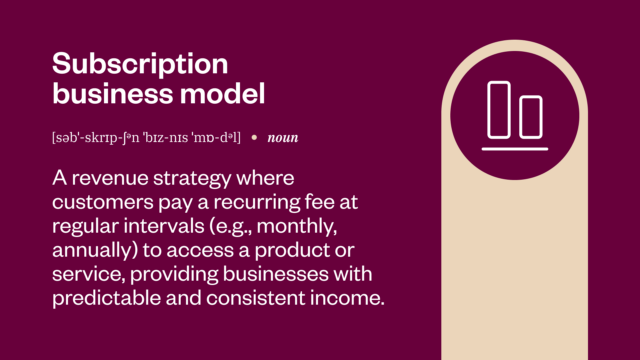
This departure from traditional one-time transactions has resulted in a new era of ongoing relationships between businesses and consumers.
For customers, the subscription business model can offer convenience, as they can set and forget their payments and know they will always have access to the latest services. Additionally, subscription models often come with discounts or other perks, which can make them more affordable in the long run.
For businesses, the subscription model can provide a predictable and stable source of income, as customers are typically locked in for a certain period. This can help businesses to better forecast their cash flow and budget for future growth.
Additionally, subscription business models prioritize nurturing customer relationships by attracting new subscribers, retaining the existing ones, and presenting businesses with opportunities to increase income through upselling or cross-selling.
Subscriptions can also help to build customer loyalty, as customers are more likely to stick with a service that they’re already paying for monthly or annually.
The exciting thing about the subscription business model is that any business can adopt a subscription business, from health to fashion, software to consumables—literally any kind of business.
How does the subscription business model work?
At its core, the subscription business thrives on an unwavering commitment to consumer-centricity.
Subscribers sign up online or through a sales rep to purchase the product or service. After that, they are charged based on the business’s pricing model for as long as they want.
As a consumer, as long as you haven’t canceled or upgraded the subscription, the business will continue to provide you with the value of the services or products offered. At agreed intervals, subscriptions are automatically renewed or activated via the chosen payment methods—this provides convenience to subscribers and recurring revenue for the business.
Data is a crucial part of subscription business models, providing businesses with insights about how customers use and consume products. Businesses must use this data to refine their offerings to meet customer’s expectations and the evolving market dynamics.
Subscription business model example
The following are examples of subscription business models across industries.
Streaming services
Streaming services provide customers unlimited access to entertainment content on their smart devices or television using an internet connection whenever they want and wherever they are.
According to recent studies, 83% of US consumers were using a subscription video-on-demand service in 2023 — Netflix being the most used video streaming service.
Home maintenance
Home maintenance services provide efficient and convenient ways to care for the home. Professional companies are contracted to offer seasonal or routine maintenance services for a monthly or yearly fee.
Consumables
Consumables subscription businesses focus on essential products used daily, ranging from vitamins, toiletries, dairy products, and food.
Subscription boxes
Often considered a “surprise and delight” business model, subscription boxes are designed to save customers the stress of looking for new products. A box of healthcare beauty products, home goods, snacks, vegetables, and dog toys is curated for customers.
Each subscription box typically caters to a specific niche. While subscribers may not have the option to choose individual items, they do have the flexibility to customize their plans.
Software subscriptions
Software subscriptions, popularly known as SaaS (Software as a Service), allow customers to pay for software products yearly or monthly instead of paying a huge sum to install and access the tool all at once.
Previously, the software industry relied on the traditional one-time payment system to sell their product to users. This one-time payment provided users with a perpetual license to use the products or tools.
With software subscriptions, subscribers are charged in exchange for access to the latest updates, customer support, and bug fixes. However, the program becomes inaccessible once the subscription expires or is canceled.
Newspaper and magazine subscriptions
Arguably the oldest form of a subscription-based model, newspaper and magazine subscriptions give subscribers access to top news and the latest magazine publications, often now in a digital format. This is a recurring subscription of chosen news content daily, weekly, monthly, or bimonthly.
Food or meal-kit services
Food services give subscribers various healthy recipes and fresh ingredients to make their favorite meals. This model may also include regular delivery of cooked meals and freshly baked snacks.
Health and wellness
The health and wellness subscription business started with gym memberships and sports clubs. However, a wide range of health services have now been incorporated.
Types of subscription business models
There are several types of subscription business models. But we will be looking at these 3 popular ones. They include:

Renewal subscriptions
Subscribers on this model make recurring payments to enjoy continuous access to the product without interruption as long as they have enough funds in their cards. The subscription renewal can either be automated on the platform or processed manually.
Access subscriptions
This subscription business model is often used for health services, software subscriptions, and fashion services. Access subscriptions allow users to purchase the product at a discounted rate monthly or yearly.
Subscribers do not only get access to new products, but also special deals. Exclusivity is a key feature of this subscription type, as users get access to certain privileges. This includes early access to new features, members-only events or opportunities to purchase limited edition products or services inaccessible to the public.
Curation subscriptions
In a curated subscription, items packed in each box are carefully selected to suit the customer’s taste. This subscription type is well-suited for food, beauty, and fashion services. Flexibility and personalization are largely associated with curation subscriptions.
Subscription business model pros and cons
Pros: Benefits of subscription business models
The subscription business model is popular because it benefits both businesses and consumers.
Stable and predictable revenue
Businesses with subscription business models have a more stable and predictable source of generating revenue. This helps businesses with budget planning, resource allocation, and financial resilience.
Easier demand forecasting
Businesses can easily and accurately forecast the demand for their products with the help of historical data and trends. Understanding metrics, such as renewal and retention rates, helps businesses anticipate future demands.
Opportunities for upselling/cross-selling
A huge benefit of the subscription business model is its opportunity for cross-selling and upselling services. Customers can be notified of the available options or new features. They can upgrade to a higher package, add other features, or remain on their current plan.
Continuous value delivery
Consumers now care more about the value of the services they receive so businesses must ensure continuous value delivery to subscribers. There is a correlation between the value received and the payment ratio. People will only pay for what they get value from.
Low entry cost for customers
For most subscription-based businesses, the entry barriers are lower than traditional businesses. A subscription model depends on recurring payment, unlike a traditional-based business, which is often a one-time transaction.
As time passes, subscribers can opt for new products or features without paying an additional entry fee. Once they purchase a basic plan and are satisfied with the services rendered, they can choose a premium plan.
Reduce piracy and unauthorized users
Unauthorized users are restricted from accessing subscription services. For example, the per-user pricing model only grants a specific number of people access to the services provided. The piracy rate is reduced, especially in the SaaS sector, where software programs can be duplicated.
Cons: Challenges in subscription business models
Navigating subscriptions comes with some challenges.
Ensuring continuous value
If you think of your subscription business as a sprint, then your brand’s value might suffer. A subscription business model is a marathon, and the perennial challenge is to provide continuous value to subscribers. Most businesses focus on the initial offers and fall short with subsequent ones.
For a subscription business, you have to keep your subscribers hooked, and the challenge lies in consistently meeting or exceeding expectations, fostering a sense of loyalty throughout the customer lifecycle.
Scalability issues
Scaling is a necessary part of business growth, but it can bring its own difficulties. As you scale every part of your business can be tested—from customer support to the delivery of your services. Ensure the foundation of your business, such as technology or logistics, is setting you up for success. Tackling scalability requires strategic planning and an agile mindset.
Customer acquisition and retention
The twin pillar of every subscription business is acquiring customers and retaining customers. You have to consistently create an experience that not only attracts customers but also makes them unwilling to churn or leave for your competition.
Subscription models vs. one-time payment models
When deciding between a subscription-based model and a traditional one-time payment model, businesses need to consider their long-term goals, customer relationships, and revenue needs. Below, we compare the two approaches to highlight the advantages of subscriptions, particularly in terms of recurring revenue, customer loyalty, and scalability.
| Factor | Subscription Model | Traditional Sales Model |
|---|---|---|
|
Revenue predictability |
Recurring, predictable cash flow |
Volatile, dependent on new customers |
|
Customer loyalty |
Stronger, long-term relationships, higher CLV |
Lower, transactional, lower CLV |
|
Scalability |
Highly scalable with minimal incremental costs |
Requires significant upfront investment to scale |
|
Customer acquisition |
Higher initial CAC, lower churn, long-term profitability |
Lower initial CAC, but higher churn |
|
Demand forecasting |
Easier due to predictable subscriptions |
More challenging, subject to market fluctuations |
Ultimately, the subscription business model offers clear advantages for companies looking to build stable revenue streams, develop customer loyalty, and scale their operations efficiently.
While the traditional one-time sales model can still be effective in certain industries, it lacks the recurring revenue and customer retention benefits that subscriptions provide. For businesses that can adopt a subscription model, the long-term payoff can be substantial in terms of customer retention, financial stability, and growth.
Types of subscription pricing models
Choosing the best subscription pricing model for your business is a crucial step in launching a new subscription offering or maintaining long-term profitability. Subscription pricing models include:
Flat rate
Flat rate, or fixed pricing, is the simplest and easiest to understand among all pricing models. Customers pay a fixed amount for unlimited access to a product or service at regular intervals. The products have a fixed set of features at a fixed rate. It is well suited for businesses with a single product or limited features.
Tiered
The tiered pricing model, sometimes referred to as “good, better, best” pricing, is flexible and targeted at different audiences or markets. Customers can choose from multiple subscription levels or tiers with different features and capabilities at different prices. Every added feature costs an additional fee.
Tiered pricing models are often subdivided into basic, standard, and premium.
Per-user
This payment model charges based on the number of active product users or seats. The lower the number of users, the lower the fee; the higher the number, the higher the fee. For every additional user, you incur a cost.
Usage-based
Usage-based pricing allows customers to pay based on how much they’ve consumed of a service. This means that customers don’t need to buy everything upfront and they can start where they are comfortable and then pay for more if they need it.
4 common subscription pricing strategies
Deciding on the right pricing strategy for your subscription business requires testing and research—as well as the ability to be flexible and make changes when necessary. It’s essential to get right, as it influences your customer perception, revenue generation, and market positioning.
Let’s dive into the four common strategies to help you determine your subscription pricing strategy.
1. Cost-plus pricing
This is a more traditional pricing strategy that’s a function of production cost, profit margin, and market research. This strategy determines your product or service price by covering all operational costs and adding a profit margin.
Cost-plus pricing offers a stable foundation commonly used in a market where production costs are essential. While cost is important, ensure it’s not the sole driver of your strategies if you want to stay competitive. Also, pay close attention to marketing dynamics.
Note: this model is not suitable for enterprise software.
2. Competitive pricing
This strategy revolves around setting your pricing based on what similar offerings in the market are charging. This is common when launching a new product or service in an existing category — you want to explore your competitor’s product bundles and prices.
When navigating the competitive landscape, the goal is not to be the cheapest option. It’s about offering unique value that justifies the price point. Constantly remind your subscribers what makes your subscription business stand out.
Competitive pricing would be less effective and practical when pricing details are not easily accessible via market research. Beware of the fine line between trying to adjust your pricing due to comparison and missing the chance to capture additional value if customers are willing to pay.
3. Demand-based pricing
As the name implies, this strategy taps into the market’s pulse, allowing businesses to optimize revenue based on real-time demand fluctuations. This works by adjusting your product and service pricing according to market and external forces. Simply, when the demand is high, the pricing goes up. Likewise, when the demand is low, the pricing goes down.
Businesses that adopt this strategy need agility and a deep understanding of market dynamics. They should also be wary of customer dissatisfaction due to price fluctuations.
4. Value-based pricing
Businesses that use a value based pricing strategy charge based on the reflection of the perceived value subscribers have for their offering. Pricing is not about undercutting your competitors’ offerings but about capturing the true worth of your product and service.
Regardless of your pricing strategy, ensure you’re customer-centric, strategic, and adaptable.
How to get your subscription pricing model right
Effective subscription pricing strategy is crucial to the success of any subscription-based business. These strategies will help you find the sweet spot between your business costs and pricing.
Research your market
Does your business target small businesses or enterprise clients? You want enough data to understand the current market and your competitors, as well as see what trends are emerging to find the balance between value and price. The goal is not to be the cheapest, but the best in value.
Know your costs
Any business that doesn’t factor in fixed and variable costs will never get its pricing strategy right. When setting your subscription price, factor in your production, distribution, operational, and customer acquisition costs.
While some costs are fixed, others change. So, it’s crucial to constantly monitor and factor these fluctuations into your pricing for your business to be profitable.
Factor in your competition’s pricing
You want to know your competitors’ offerings and what they charge for a similar product to understand how much customers are willing to pay. Benchmark your pricing against their price because your customers will likely compare your pricing against your competitors.
Avoid charging or copying your competitor’s pricing, as your value proposition and cost of production can be different. As you gather more solid data and your product and services improve, update and optimize your pricing.
Segment your audience
Now that you understand your costs, it’s equally essential to segment your audience. Your customer needs and preferences are not linear or static— instead, they’re continuously evolving.
Segment your audience based on usage patterns and preferences, then tailor pricing plans, offers, and messaging to each segment. The willingness to pay varies widely across different customer segments and their unique needs.
Diversify subscription plans
Customers can choose from multiple subscription tiers with varying features, benefits, and pricing levels. You can adopt seat-based, consumption-based, or tiered pricing with different price points depending on what fits your business model and competitive landscape.
This strategy enhances customer segmentation, appeals to varied budgets, and maximizes revenue. This way, businesses can tap into different market segments and deliver tailored value propositions.
Ensure transparent pricing without hidden charges
Want to reduce your sales cycle? Make your pricing transparent. It helps build trust with customers and reduces friction in the purchasing process. There have been ongoing debates on whether to keep pricing behind the “contact us” form — and many businesses follow this approach. However, nobody likes surprises, especially concerning money.
Forbes shows that pricing transparency has many benefits, such as building trust, reducing sales and marketing costs, and gaining quality leads. Clearly communicating the costs associated with each subscription tier and avoiding surprising subscribers with hidden charges can go a long way in building customer loyalty.
Provide free trial or freemium options
Depending on your go-to-market strategy, offering a free trial or freemium model is an effective way to give your customers a taste of what you’re offering them. These two customer acquisition models allow customers to experience your product or services before committing. They can then upgrade to a full subscription since they only have access to the basic features and functionality through a trial.
What are the essentials to run a successful subscription business?
The following are essential to running and building a sustainable subscription business that stands the test of time.
Clear value proposition
A clear value proposition tells your customers why they should do business with you. It pinpoints the specific pain point your product or service exclusively solves to make customers’ lives easier. Your value proposition answers the eternal customer question: “Why should I subscribe?” Nail it and you’ll have loyal subscribers.
Seamless onboarding process
First impressions matter. Your onboarding process sets the tone for the entire subscriber relationship. A seamless process creates a positive first impression and fosters customer satisfaction, while a complex or cumbersome experience creates friction.
A successful onboarding process:
Accelerates time-to-value: it facilitates the subscriber journey from sign-up to using core features — this ensures subscribers start getting value for their subscriptions immediately.
Reduces churn risk: When subscribers experience difficulties due to the complexity of your onboarding process they’re more likely to churn. However, a smooth onboarding creates a positive perception, which could reduce the risk of early cancellation.
Enhances user engagement: An effective onboarding goes beyond user training. It also encourages users to explore various product or service features, improving engagement.
Product-market fit
Poor product-market fit is the biggest reason most startups fail. A subscription-based business looks promising and exciting, but the excitement won’t last without a good product-market fit. Before starting any subscription business, you need to identify the problem/solution and the audience.
The more you can define and break it down so everyone understands, the better. Do three things to ensure you’re not building a product or services that nobody wants:
Talk to your audience.
Consider the value your product would add as a solution to their problem.
Consider how often your product can add that value.
Have a recurring payment system
A recurring payment system ensures a frictionless and seamless transaction between you and your subscribers. An effective recurring revenue system transforms your business from one-time payments to a steady revenue stream.
Flexible payment models
How flexible is your payment system? Provide your subscribers with either a weekly, monthly or yearly payment option as well as several payment types–card, bank transfers, and more. Regardless of your pricing structure, model or system, your customer wants an easy way to pay for and manage their subscription.
Relationships over transactions
Subscribers aren’t just a transaction. Long-term success for your subscription business will be built on meaningful relationships with your customers.
Engaging content and products
Businesses that get the best out of the subscription economy consider their subscribers a community — and to keep this community alive and thriving, they craft specific, relevant and engaging content in various forms, such as blog posts, newsletters, or webinars. The goal is to keep the value flowing and the offering fresh.
Personalization and customization
When subscribers get tailored recommendations with a customizable service it elevates your business and makes your subscribers feel seen and understood. 61% of consumers expect brands to tailor experiences based on their preferences.
Exceptional customer service
How proactive, responsive, and attentive are you to your subscribers’ problems? Developing a solid customer relationship is central to customer retention. Every subscriber’s interaction with your customer service team is an opportunity to reinforce your business value and build a strong relationship.
Subscription revenue tech stack
Subscription businesses need to be supported by the right technology. Your subscription management system, CRM, billing and invoicing, and payment gateway systems are essential parts of your business.
No matter which stage you’re in, what industry you’re in, or where you’re located, the subscription business model strategies and tactics covered here can help you build a subscriber-centric business that’s ready for today, tomorrow—and for decades to come.
In conclusion, the subscription business model presents immense advantages, including predictable revenue, stronger customer relationships, and scalability—key factors for long-term growth. However, to fully leverage the power of this model, it’s essential to choose the right tools and strategies. That’s where Zuora stands out. Ranked #1 in the 2024 ISG Research Subscription Management Buyer’s Guide, Zuora is recognized for its comprehensive, reliable, and scalable solutions that support both B2B and B2C subscription businesses.
Whether you’re navigating the complexities of recurring revenue, billing, or customer management, Zuora’s platform offers the technology and expertise to help you succeed.
FAQs: Subscription Business Model
How do subscription businesses retain customers?
To keep subscribers engaged and reduce churn, businesses should focus on:
Delivering consistent value: Ensuring that customers always get what they expect—and more.
Personalization: Tailoring services and recommendations to each customer’s preferences.
Exceptional customer support: Offering easy ways for customers to manage their subscriptions and resolve issues quickly.
Regular communication: Keeping subscribers informed with updates, new features, and exclusive offers.
What tools do I need to run a subscription business?
Running a successful subscription business requires the right technology stack, including:
Subscription management software: For handling billing, renewals, and customer data.
Customer Relationship Management (CRM) tools: To manage customer interactions and track engagement.
Analytics and reporting: To measure retention, acquisition, and customer lifetime value.
Payment gateway: For processing recurring payments securely.
Can a traditional business switch to a subscription model?
Yes, many businesses are successfully transitioning to a subscription-based model. To do this, you’ll need to:
Identify recurring products or services that could be delivered regularly.
Offer flexible subscription plans that suit different customer needs.
Adapt your marketing and sales strategies to focus on long-term relationships rather than one-time sales.
How do I prevent subscription cancelations (churn)?
To reduce churn, subscription businesses can:
Provide excellent customer service and quick resolutions to problems.
Use data to personalize experiences and offer tailored recommendations.
Offer flexible plans that make it easier for customers to upgrade, downgrade, or pause their subscriptions.
Engage subscribers regularly with relevant content and promotions.
What is the difference between a subscription model and a membership model?
While similar, subscription and membership models differ mainly in the type of value they provide:
Subscription model: Typically offers access to products or services (e.g., software, streaming services, or subscription boxes).
Membership model: Usually involves access to a community, special content, or exclusive events (e.g., loyalty programs or fitness club memberships).
How can I measure the success of my subscription business?
Key metrics to track include:
Customer Lifetime Value (CLTV): The total revenue you expect to earn from a subscriber during their relationship with your business.
Churn Rate: The percentage of subscribers who cancel within a given period.
Subscriber Growth Rate: The rate at which new subscribers are joining.
Monthly Recurring Revenue (MRR): The predictable monthly income from subscriptions.