
Frequently Asked Questions

Customer Acquisition, Retention & Expansion

What is the Subscription Economy Index (SEI) and what does it reveal about recurring revenue businesses?

The Subscription Economy Index (SEI) is a report by Zuora that tracks the performance of over 600 companies using recurring revenue models. According to the 2023 SEI, these companies achieved 10.4% revenue growth compared to 6% among S&P 500 companies, demonstrating the resilience and growth potential of recurring revenue models even during economic instability. Read the SEI report.

How do recurring revenue models help companies balance growth and resilience?

Recurring revenue models focus on ongoing customer relationships rather than one-time transactions. This approach enables companies to retain customers and expand revenue per account, compensating for slower new customer acquisition during challenging economic periods. The SEI report shows that companies with these models experienced lower churn and higher ARPA (annual revenue per account) growth in 2023.

What are the three main drivers of recurring growth according to Zuora's SEI?

The SEI identifies three drivers of recurring growth: 1) New customer acquisition (account growth), 2) Customer retention (inverse of churn), and 3) Expansion (increased annual revenue per account). In 2023, SEI companies saw slower acquisition but improved retention and ARPA growth.

How did customer acquisition and retention rates change for SEI companies in 2023?

In 2023, SEI companies experienced a slowdown in customer acquisition rates, dropping from 2.22% in Q1 to 1.12% in Q4. However, customer retention improved significantly, with quarterly churn rates reaching their lowest since 2019.

Why is focusing on existing customers important for growth?

It costs more to acquire new customers than to retain existing ones. Most annual recurring revenue (ARR) growth comes from current customers. For accounts with over 0M in annual revenue, 84% of ARR growth is attributed to existing customers, making retention and expansion critical for sustainable growth. Source.

How do flexible monetization models impact customer retention and expansion?

Flexible monetization models, such as hybrid and consumption-based pricing, allow companies to adapt to customer needs and market changes. According to Zuora and BCG, companies with hybrid consumption models outperformed others in ARR growth. 80% of consumers prefer tiered models with flexible pricing, which helps prevent churn. Source.

What strategies can companies use to improve customer retention?

Companies can improve retention by continuously delivering value, regularly assessing customer experience, and offering flexible pricing or billing options. Alternatives to churning, such as changing tiers, billing frequency, or pausing accounts, also help retain customers. Zuora calls this approach 'Total Monetization.' Learn more.

How does the rise of generative AI affect monetization strategies?

Generative AI technologies have marginal costs that scale with usage and often reduce the number of human users, making traditional user-based pricing less effective. As a result, consumption-based pricing models are becoming more important for customer retention and expansion in AI-driven businesses. Read more.

What is Total Monetization and how does it help companies grow?

Total Monetization is Zuora's strategy for continuously evolving monetization in a customer-centric feedback loop. It enables companies to retain customers and expand ARPA growth rates even when acquisition is slow, making businesses more resilient and able to outperform benchmarks like the S&P 500. Learn more.

How can companies use flexible pricing to prevent churn?

Companies can offer flexible pricing options such as tiered plans, pay-as-you-go billing, or temporary account pauses. These alternatives give customers choices beyond cancellation, helping to reduce churn and improve retention. 80% of consumers prefer flexible pricing over flat-fee subscriptions. Source.

What is the role of the Subscribed Institute at Zuora?

The Subscribed Institute is Zuora’s think tank, providing research, content, events, and advisory services to help business leaders succeed with recurring revenue models. Strategists from the Institute support customers in building capabilities and navigating the journey to user-centric business models. Learn more.

How does Zuora support companies facing economic instability?

Zuora enables companies to implement recurring revenue models that focus on customer retention and expansion, helping them remain resilient during economic downturns. The SEI report shows that these models outperform traditional approaches in both growth and retention metrics.

What are the main challenges companies face with customer acquisition today?

Companies face slower customer acquisition rates due to economic uncertainty, rising inflation, and reduced digital transformation initiatives. However, recurring revenue models help offset these challenges by improving retention and expanding revenue from existing customers.

How does Zuora help companies adapt to changing customer needs?

Zuora enables businesses to regularly assess customer experience and adjust offerings, such as adding flexible pricing, billing options, or new services. This adaptability is key to retaining customers and driving growth, especially during periods of market change.

What is the impact of hybrid consumption models on ARR growth?

Hybrid consumption models, which combine usage-based and recurring revenue, have been shown to outperform other models in year-over-year ARR growth. This flexibility allows companies to better match customer value and drive expansion. Source.

How can companies use data to optimize monetization strategies?

Companies can leverage real-time product performance metrics, such as profitability, conversion rates, and discounting rates, to identify effective pricing strategies and respond quickly to market trends. Zuora’s integration between CRM and CPQ tools ensures data visibility for analysis. Learn more.

What is the business impact of using Zuora's platform?

Zuora’s platform helps businesses achieve recurring revenue growth, operational efficiency, improved customer retention, faster time-to-market, and global compliance. For example, Swiftpage saw a 140% increase in subscription customers and 131% ARR growth, while Hudl saved over 100 hours per month by automating processes. See case studies.

Which industries benefit from Zuora's solutions?

Zuora supports a wide range of industries, including SaaS, communications, consumer goods, retail, energy, finance, healthcare, high tech, manufacturing, media, entertainment, telecommunications, and more. See all industries.

Who are some notable Zuora customers?

Zuora serves over 1,000 companies worldwide, including Zoom, Box, Zendesk, Asana, The Financial Times, GoPro, Siemens Healthineers, Schneider Electric, Ford, Toyota, and General Motors. See more customers.

Features & Capabilities

What products and services does Zuora offer?

Zuora offers a suite of products for managing the entire subscription lifecycle, including Zuora Billing, Zuora Revenue, Zuora Payments, Zuora CPQ, Zephr, Zuora Platform, Zuora Collections, and Accounts Receivable automation. These solutions support pricing, quoting, billing, payments, revenue recognition, and analytics. Learn more.

What are the key capabilities and benefits of Zuora's platform?

Zuora’s platform supports over 50 pricing models, automates billing and revenue recognition, scales to millions of users, enables personalized subscription journeys, ensures global compliance, and provides real-time analytics. Benefits include monetization agility, operational efficiency, improved retention, and faster time-to-market. See details.

Does Zuora support integration with other business systems?

Yes, Zuora provides over 60 pre-built connectors (e.g., Salesforce, HubSpot, NetSuite), APIs (REST and SOAP), warehouse connectors (Databricks, BigQuery, RedShift), and payment gateway integrations (over 40 gateways). The Connect Marketplace features nearly 100 apps for extended functionality. Learn more.

Does Zuora offer APIs for integration and development?

Yes, Zuora provides REST and SOAP APIs for integration with external systems. Developers can access API references, SDKs, and guides via the Zuora Developer Center. Explore developer resources.

What technical documentation is available for Zuora's platform?

Zuora offers comprehensive technical documentation, including platform docs, API references, SDK guides, and integration tutorials. Resources are available at the Docs Portal, Developer Center, and Knowledge Center.

How does Zuora help companies with real-time product performance metrics?

Zuora provides real-time metrics on profitability, conversion rates, and discounting rates, enabling l businesses to respond quickly to market trends, optimize pricing, and improve sales velocity. Integration with CRM and CPQ tools ensures data visibility for analysis. Learn more.

Pain Points & Solutions

What common pain points does Zuora address for its customers?

Zuora addresses slow, manual close cycles, ASC 606/IFRS 15 compliance, scaling usage-based monetization, multi-entity and multi-currency challenges, revenue leakage, data quality issues, spreadsheet dependency, quote-to-cash misalignment, and forecasting difficulties. Automation and integration are core to solving these problems.

What core problems does Zuora solve for subscription businesses?

Zuora automates financial close cycles, ensures compliance with accounting standards, supports diverse pricing models, simplifies global operations, reduces revenue leakage, provides unified reporting, and prepares businesses for IPO or PE readiness. These solutions enable innovation and scalability in the Subscription Economy.

Implementation & Support

How long does it take to implement Zuora and how easy is it to start?

Implementation timelines vary: focused scopes can be completed in as little as 30 days, typical projects take 30–90 days, and multi-product programs may take several months. Pre-built connectors enable faster integrations. Extensive training, 24x5 support, and developer resources make onboarding” straightforward. See training options.

What support and training resources does Zuora provide?

Zuora offers Quick Start Tutorials, Zuora University (500+ courses), 24x5 live global support, email and ticketing, premium support options, and a community portal for peer engagement. Visit the Support Portal.

Security, Compliance & Trust

What security and compliance certifications does Zuora hold?

Zuora is certified for PCI DSS Level 1, SSAE 16 SOC1 Type II, SOC2 Type II, ISO 27001, HHS HIPAA, and SOC 3. These certifications validate Zuora’s commitment to enterprise-grade security and regulatory compliance. See details.

How does Zuora ensure data security and privacy for its customers?

Zuora employs enterprise-grade security measures, including data encryption, role-based access controls, regular audits, and built-in compliance features for GDPR, PCI DSS, and SOX. Audit trails and global compliance support are included by default. Learn more.

Customer Success & Proof

What feedback have customers given about Zuora's ease of use?

Customers like Mindflash, TripAdvisor, FireHost, Briggs & Stratton, Buildium, and AppFolio have praised Zuora for its flexibility, ease of use, rapid pricing changes, improved reporting, and reduced manual workloads. Read case studies.

Can you share specific case studies or success stories of Zuora customers?

Yes. Zoom scaled from 10M to 300M users, The Financial Times grew digital subscriptions, Asana scaled its business, Hudl saved 100+ hours/month, and The Seattle Times improved conversions by 30% and retention by 25% after adopting Zuora. See all case studies.

Target Audience & Use Cases

Who is the target audience for Zuora's platform?

Zuora is designed for finance professionals, IT leaders, product managers, operations teams, and sales/customer success teams in industries such as technology, media, healthcare, retail, manufacturing, and telecommunications. See more.

Why should a customer choose Zuora over other solutions?

Zuora offers flexibility (50+ pricing models), scalability (proven by Zoom’s growth), AI-powered tools (Zephr), hybrid monetization, compliance (SOC 2, PCI DSS), and a track record of success with leading brands. These strengths make Zuora a top choice for subscription businesses. See customer stories.

BENCHMARKS / INSIGHTS

Customer acquisition, retention, and expansion: Striking the balance for growth and resilience

Data from the latest SEI report
White Toggles

From rising inflation and interest rates to layoffs and banking challenges, the technology industry faced significant instability in 2023. 

Yet even as new digital transformation initiatives declined and business leaders struggled to figure out the best way to grow, one set of companies significantly outperformed the S&P 500 — businesses that use various monetization models designed to provide recurring growth. Collectively, these companies experienced 10.4% revenue growth in 2023 compared to 6% among S&P companies, according to Zuora’s Subscription Economy Index (SEI) Report.

The question is: how? As a growing number of companies offer subscription pricing for an increasing array of products and services, experts have cautioned businesses about consumer “subscription fatigue.” But despite these warnings, recurring revenue models continue to drive outsized business impact. 

The SEI measures the change in the volume of business for more than 600 companies that leverage recurring revenue models of monetization. Composed of anonymized, aggregated, system-generated activity on the Zuora Billing service, the SEI provides insight into businesses that are committed to evolving monetization, defined as how a business matches what it values with what its customers value and uses that to generate revenue.

The 2023 SEI report reveals that while these businesses faced the same challenges to customer acquisition that roiled the rest of the tech sector, their business models allowed them to more easily retain customers and expand revenue per account. 

In a macro-environment that demands adaptability and customer-centricity, recurring revenue models are proving inherently resilient because they focus on ongoing customer relationships rather than one-time transactions.

Let’s take a closer look at the data to understand how this works.

Key findings on customer acquisition and retention

Companies in the SEI can achieve recurring growth in three ways:

  1. New customer acquisition (account growth) 
  2. Customer retention (inverse of churn)
  3. Expansion (increased annual revenue per account)

By the first measure — account growth — SEI companies experienced a slowdown in 2023, with customer acquisition rates dropping from an average 2.22% in Q1 to 1.12% in Q4. In this respect, their experience reflects the broader economic climate.
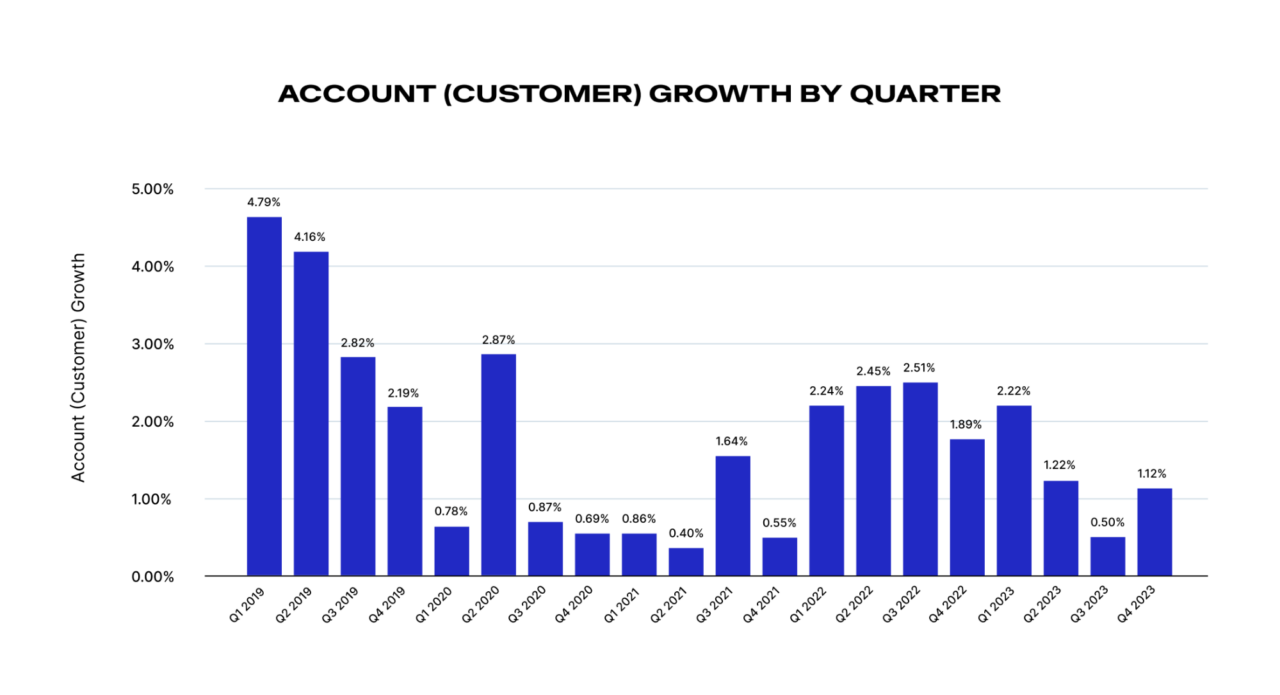
Bar chart titled "Account (Customer) Growth by Quarter" showing percentage growth from Q1 2019 to Q4 2020. Highest growth is 4.93% in Q1 2019, lowest is 0.01% in Q2 and Q3 2020.

However, companies in the SEI also experienced lower churn. Flying in the face of predictions of a “great unsubscribe,” customer retention improved significantly in 2023, with average quarterly churn rates dipping lower than anytime since 2019.
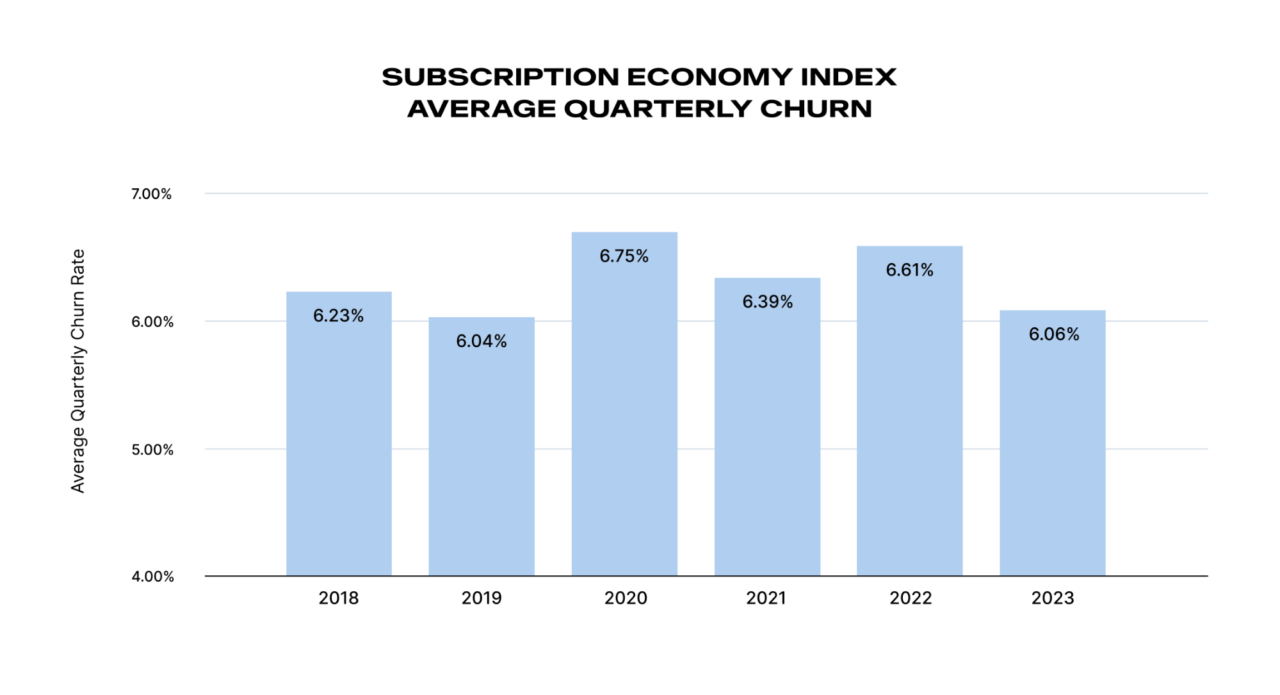
Bar chart showing average quarterly churn rates from 2018 to 2023 for the Subscription Economy Index. Rates are 6.23% in 2018, 6.04% in 2019, 6.75% in 2020, 6.39% in 2021, 6.61% in 2022, and 6.06% in 2023.

Finally, SEI companies were able to capitalize on low churn rates by increasing annual revenue per account (ARPA), which is on a slight upward trend over the past 20 quarters. In 2023, ARPA growth among SEI companies was 1.5%, up from 1.29% in 2022.
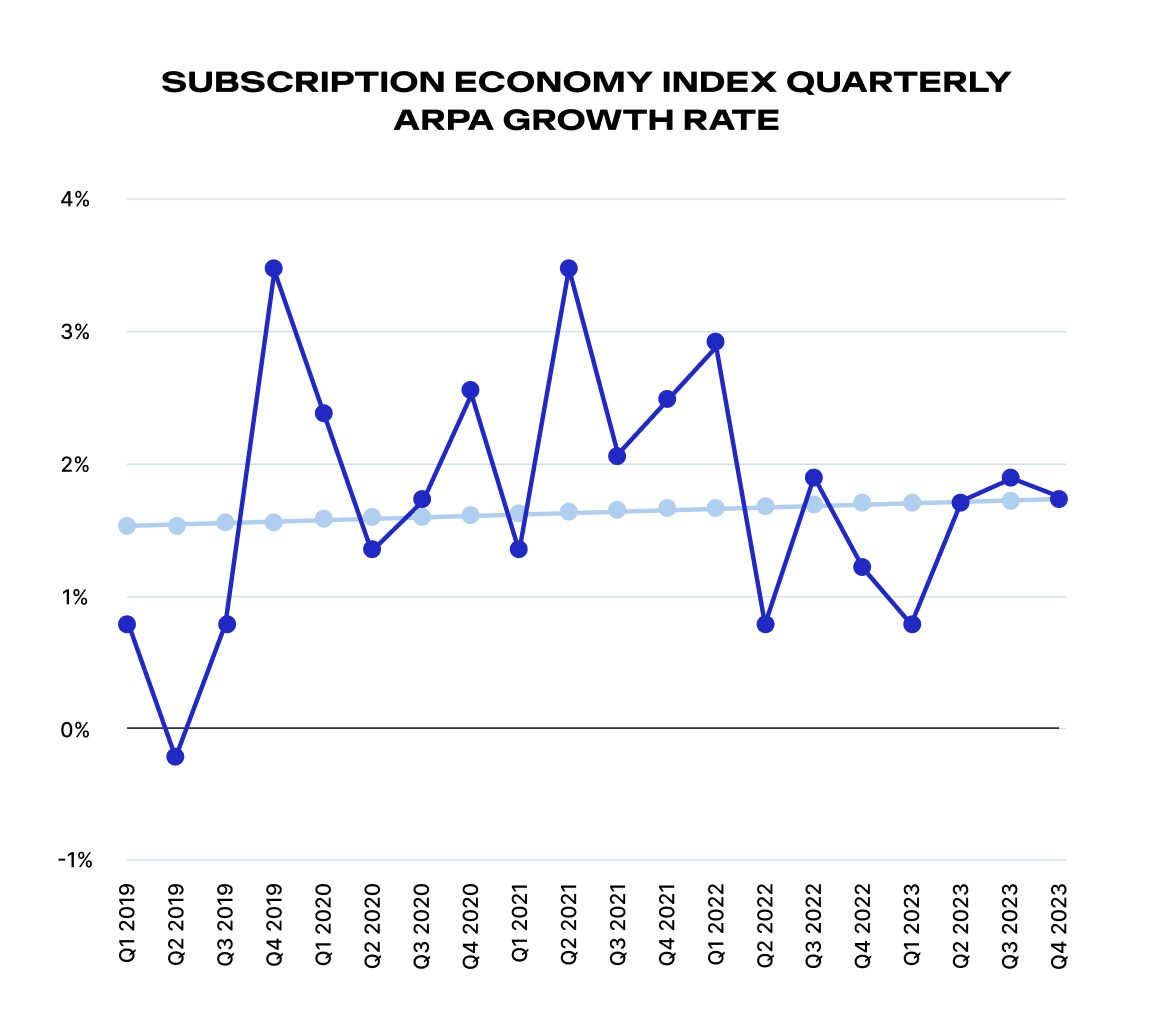
A line graph showing the Subscription Economy Index Quarterly ARPA Growth Rate from Q1 2019 to Q4 2023, with fluctuating percentages between 0% and 4%.

Taken together, these three trends illustrate how companies with recurring revenue business models were able to compensate for difficulty acquiring new customers in 2023 by retaining current customers and expanding revenue per account.


Behind the numbers: Why retention and expansion matter

The key takeaway for business leaders in the current economic environment is that growth matters, but the way to grow is to concentrate on existing customers rather than new business. Because it costs more to acquire than retain customers, growth during challenging times can be achieved by nurturing and growing current customers — and flexible monetization models offer a prime opportunity to do exactly that.

Most annual recurring revenue (ARR) growth comes from existing customers. According to a 2023 report from Zuora Subscribed Institute and Boston Consulting Group, in the case of accounts with greater than 500M in annual revenues, existing customers are responsible for 84% of ARR growth. These accounts have the most significant retention and expansion rates and are less dependent on new business as a revenue growth source.
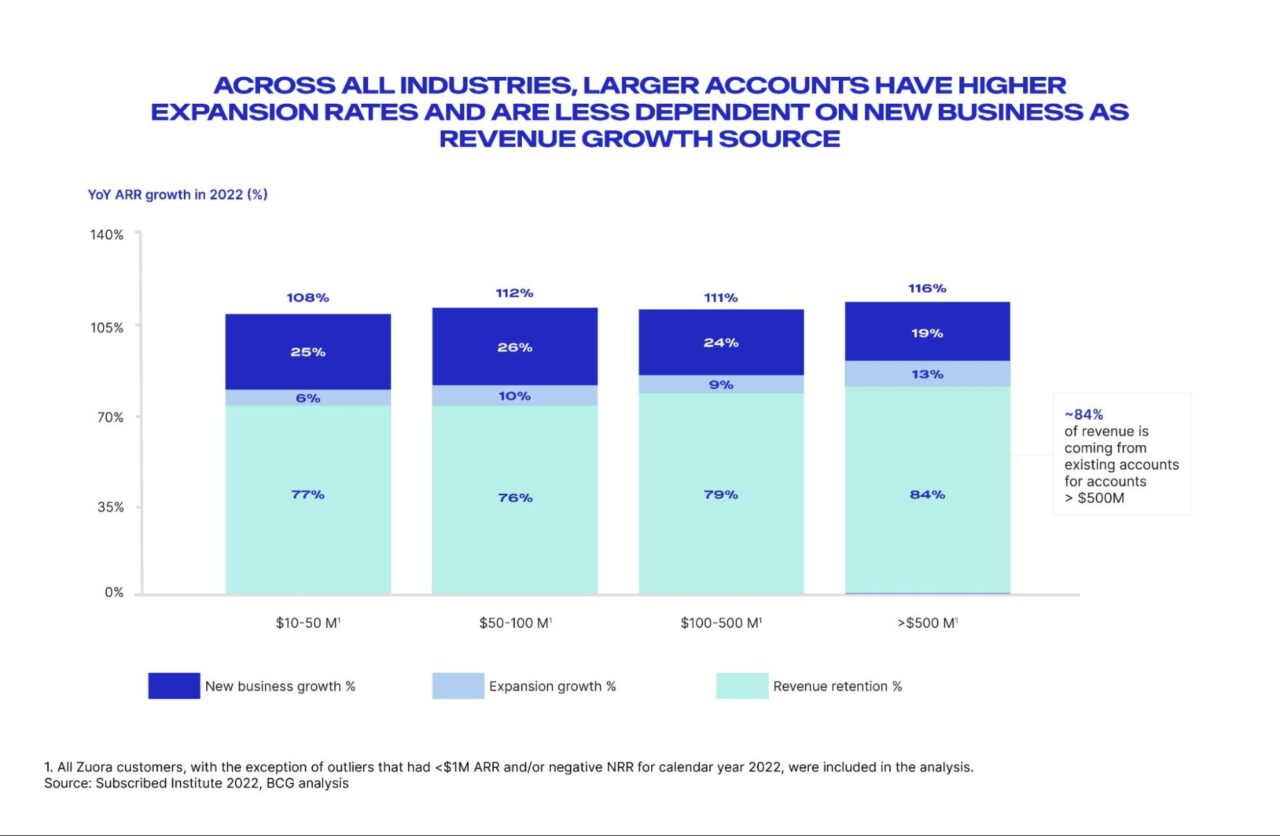
Bar chart showing year-over-year ARR growth in 2022 by account size. Accounts over $500 million lead with 116% growth, largely from expansions. Smaller accounts rely more on new business.

The data also show that a key factor in this growth is the rise of consumption pricing models, which are inherently flexible. Companies with hybrid consumption models (consisting of both usage-based revenue billed in arrears and recurring revenue billed in advance) outperformed all other businesses in the Zuora/BCG study when it came to year-over-year ARR growth. 


Other data show that 80% of consumers prefer tiered models with flexible pricing vs. traditional flat-fee subscriptions, and that such offers can help prevent churn.
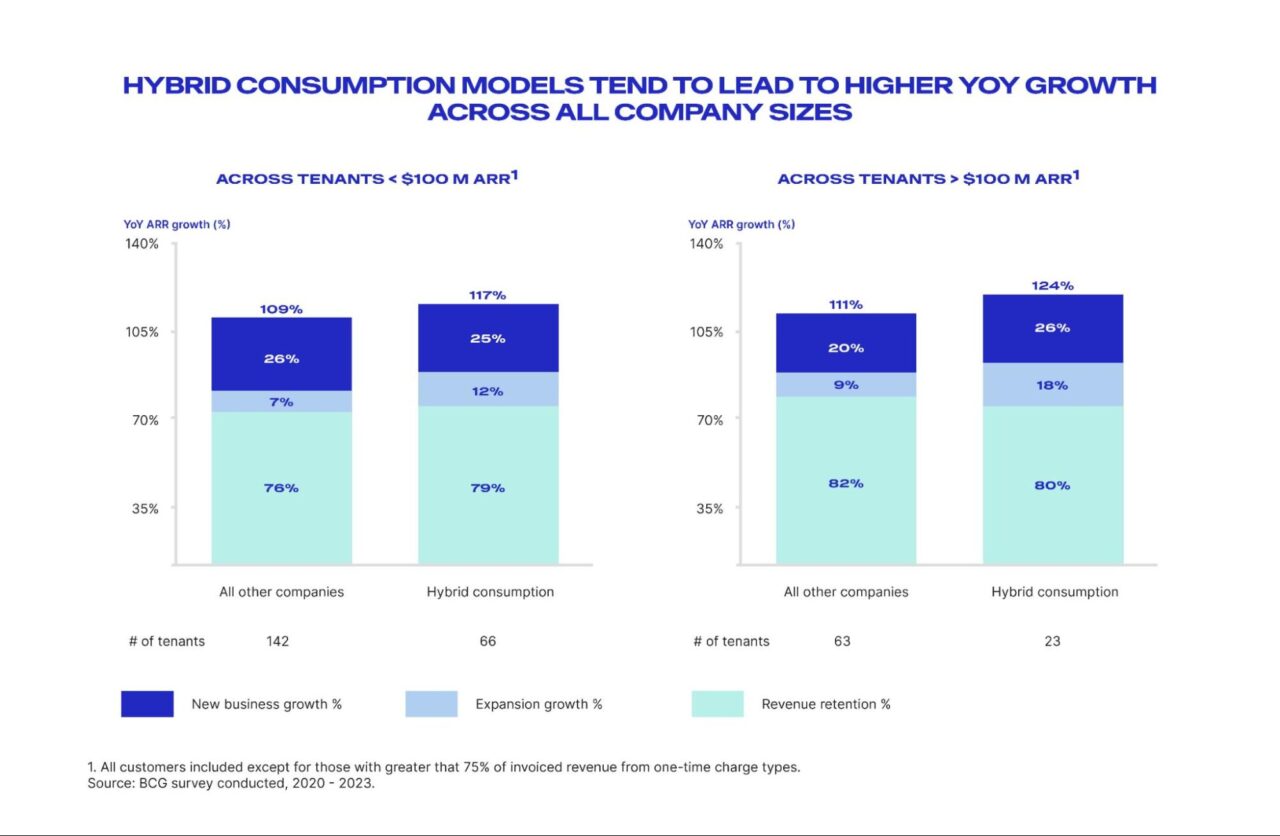
Bar charts comparing year-over-year growth, new business, expansion, and revenue retention across tenants with >$100M ARR, highlighting higher growth rates in hybrid consumption models.

In addition to its ability to support growth, consumption pricing’s surging popularity is related to the rise of generative AI technologies, which demand new monetization strategies. Not only do generative AI models have marginal costs that can scale with usage, they also enable a reduction in the number of human users, making it difficult to capture value with user-based subscription pricing. 

As generative AI continues to expand, consumption pricing models will become an even more important part of customer retention and expansion.

How companies can improve customer retention

The SEI report makes a strong case for recurring revenue models, but it’s not enough to simply launch a new model and hope customers react favorably. Consumers tend to keep subscriptions that provide value, but they churn when they don’t get what they expect. Continuously delivering value, therefore, is crucial to retention.

This means regularly assessing customer experience and adjusting to it, often by providing services or products beyond what customers originally signed up for. For example, if customers are feeling budgetary strain, companies can add more flexible pricing or billing options to meet their needs. 

They can also give customers alternatives to churning, such as changing tiers, changing billing frequency, moving from a flat-fee subscription plan to pay-as-you-go billing, or putting the account on temporary pause.

At Zuora, we refer to this strategy of continuously evolving monetization in a customer-centric feedback loop as Total Monetization. Total Monetization is an end-to-end process for creating value and generating revenue that recognizes change in customer demand over time and the need to stay in tune and monetize accordingly.

Total Monetization gives companies the flexibility to retain customers and expand ARPA growth rates even when customer acquisition is slow. It’s the secret to how SEI companies outperform the S&P 500 and it’s what makes them resilient. Growth during challenging times relies on nurturing and growing existing customers, and the recurring revenue models employed by SEI companies are pointing the way to retention for best-in-class growth in any market.

For more information on the growth and resilience of businesses leveraging various monetization models, read the full SEI report

Learn more about the authors

Michael Mansard

EMEA Chair, the Subscribed Institute 

Principal Director of Subscription Strategy, Zuora

Yann Toutant

CEO and Founder

Black Winch

The Subscribed Institute

The Subscribed Institute is Zuora’s dedicated think tank that cultivates and serves a community of business leaders through research, content, events, and advisory services. Strategists from the Subscribed Institute are a resource for our customers to help them chart strategic, tailored paths toward recurring revenue business model success, build internal capabilities, and navigate an accelerated Journey to Usership.

Interested in learning more?

Talk to one of our experts today or speak to your account executive about scheduling a conversation.