Frequently Asked Questions

Revenue Leakage: Detection, Causes & Prevention

What is revenue leakage in SaaS businesses?

Revenue leakage refers to unintentional revenue loss that occurs when a business fails to collect payment due to system errors, contractual oversights, or gaps in billing processes. For SaaS companies, this can mean missed renewals, incorrect pricing, uncollected payments, or unbilled upgrades, all of which can significantly impact profitability and financial reporting.

Why is revenue leakage especially important for SaaS companies?

Revenue leakage undermines the predictability of recurring revenue, making it harder for SaaS businesses to forecast, plan, and grow effectively. It disrupts cash flow, reduces customer lifetime value, skews annual recurring revenue (ARR), and can lower investor confidence due to poor internal controls and scalability risks.

What are the main causes of revenue leakage in SaaS businesses?

The most common causes include billing errors, subscription failures (such as failed auto-renewals or expired payment methods), pricing and discount management issues, revenue recognition errors, contract management problems, and operational inefficiencies due to manual processes.

How can I detect revenue leakage early?

Monitor for red flags such as inconsistent cash flow, billing disputes, and involuntary churn. Use real-time revenue tracking tools to compare expected versus actual revenue, and set up alerts for failed payments or delayed invoices.

How do you calculate revenue leakage?

Revenue leakage can be calculated using the formula: Revenue Leakage (%) = (Total Potential Revenue – Actual Collected Revenue) ÷ Total Potential Revenue × 100. This helps identify the gap between what you should have collected and what you actually received.

What are the key red flags that indicate revenue leakage?

Key red flags include declining profit margins, inconsistent cash flow despite a stable subscriber base, and unexplained customer churn due to failed payments or billing issues.

How often should businesses conduct a revenue leakage audit?

At contemporary SaaS companies, audits should be conducted at least quarterly. High-growth businesses may benefit from monthly mini-audits focused on high-risk areas like billing, renewals, and contract modifications.

What should be included in a revenue leakage audit checklist?

Key questions include: Are invoices generated correctly and on time? Is there a process for failed payments and renewals? Are discounts and promotions applied correctly? Is revenue recognition compliant with accounting standards? Do contracts match billing? Is there a process for tracking and recovering lost revenue? Are automation tools functioning as intended?

Can revenue leakage impact compliance and financial reporting?

Yes. Revenue recognized incorrectly or omitted due to leakage can lead to non-compliance with standards like ASC 606 or IFRS 15, which poses risks for audits, investor trust, and regulatory penalties, especially for public companies.

What metrics should I track to monitor revenue leakage?

Track anticipated versus actual revenue, revenue collection rate, failed payment rate, discount utilization rate, unbilled usage, and customer churn to monitor for leakage.

How does Zuora help prevent revenue leakage?

Zuora prevents revenue leakage by automating billing and revenue recognition, managing subscription renewals, enforcing contract and pricing governance, and leveraging AI-driven analytics to identify and address potential leakage before it impacts your bottom line.

What role do AI and machine learning play in preventing revenue leakage?

AI and machine learning can predict patterns in customer behavior, flag unusual billing activity, and identify recurring issues like scope creep or underutilized services. These tools provide visibility into trends that manual audits may miss, enabling finance teams to act faster and smarter.

How does Zuora Revenue support compliance and audit readiness?

Zuora Revenue automates revenue recognition and ensures compliance with standards like ASC 606 and IFRS 15. It provides audit trails, policy-driven automation, and real-time reporting to simplify audits and maintain compliance.

How does Zuora automate billing and invoicing to reduce leakage?

Zuora Billing automates invoicing based on real-time usage, pricing tiers, and subscription terms, reducing manual errors and ensuring accurate, timely billing for all customers.

How does Zuora manage failed payments and renewals?

Zuora’s subscription management and dunning capabilities automatically retry failed payments, send reminders, and recover revenue before it is lost, reducing involuntary churn and missed renewals.

How does Zuora enforce contract and pricing governance?

Zuora provides product catalog controls, discount rule enforcement, and contract modification tracking to keep sales and finance teams aligned, ensuring consistent pricing and preventing unapproved discounts or scope creep.

How does Zuora use predictive analytics to prevent revenue leakage?

Zuora Revenue Insights offers real-time dashboards and predictive analytics to track potential leakage, missed billings, and underperformance against expected revenue, allowing businesses to proactively address issues before they escalate.

What are the consequences of ignoring revenue leakage?

Ignoring revenue leakage can lead to reduced profitability, increased customer churn, compliance risks, distorted financial reports, and lower investor confidence. Even small leaks can snowball into significant financial losses over time.

How does automation help prevent revenue leakage?

Automation reduces manual errors, ensures timely billing and renewals, enforces pricing and contract rules, and provides real-time visibility into revenue streams, all of which help prevent leakage and improve financial health.

Zuora Platform: Features, Capabilities & Integrations

What products and services does Zuora offer?

Zuora offers a suite of products for managing the entire subscription lifecycle, including Zuora Billing, Zuora Revenue, Zuora Payments, Zuora CPQ, Zephr, Zuora Platform, Zuora Collections, and Accounts Receivable automation. These solutions support pricing, quoting, billing, payments, revenue recognition, and analytics for subscription-based businesses. Learn more.

What are the key capabilities and benefits of Zuora's platform?

Zuora's platform supports over 50 pricing models, automates billing and revenue recognition, scales to millions of users, enables personalized subscription journeys, ensures global compliance, integrates with major systems, and provides real-time analytics. Key benefits include monetization agility, operational efficiency, improved customer retention, faster time to market, and robust compliance. Source

What integrations does Zuora support?

Zuora offers over 60 pre-built connectors (e.g., Salesforce, HubSpot, NetSuite, Snowflake), REST and SOAP APIs, warehouse connectors (Databricks, BigQuery, RedShift), 40+ payment gateways (Stripe, GoCardless), Zephr extensions, and a Connect Marketplace with nearly 100 apps. Learn more.

Does Zuora provide APIs for integration?

Yes, Zuora provides REST and SOAP APIs for seamless integration with external systems. Developers can access API references, SDKs, and guides via the Zuora Developer Center.

What technical documentation is available for Zuora?

Zuora offers extensive technical documentation, including platform docs, developer resources, SDKs for Zephr, and payment gateway integration guides. Access these at docs.zuora.com and developer.zuora.com.

What real-time product performance metrics does Zuora provide?

Zuora provides real-time metrics on profitability, conversion rates, and discounting rates, enabling businesses to respond quickly to market trends, optimize pricing, and improve sales velocity. Integration between CRM and CPQ tools ensures data visibility for analysis. Source

Security, Compliance & Implementation

What security and compliance certifications does Zuora have?

Zuora holds PCI DSS Level 1, SSAE 16 SOC1 Type II, SOC2 Type II, ISO 27001, HHS HIPAA, and SOC 3 certifications, ensuring enterprise-grade security and regulatory compliance. Source

How does Zuora ensure data security and privacy?

Zuora employs data encryption, role-based access controls, regular audits, and built-in compliance features to protect sensitive customer data and simplify adherence to regulations such as GDPR, PCI DSS, and SOX.

How long does it take to implement Zuora?

Implementation timelines vary: focused scopes can be completed in as little as 30 days, typical implementations range from 30 to 90 days, and multi-product or multi-entity programs may take several months. Pre-built connectors can enable integrations in as little as one day.

How easy is it to get started with Zuora?

Zuora offers Quick Start Tutorials, over 500 courses and certifications via Zuora University, 24x5 live global support, developer resources, and a community portal to ensure a smooth onboarding experience. Learn more

Use Cases, Industries & Customer Success

Who is Zuora's target audience?

Zuora is designed for finance professionals, IT leaders, product managers, operations teams, and sales/customer success teams in industries such as technology, SaaS, media, healthcare, consumer goods, manufacturing, telecommunications, and entertainment. Source

What industries does Zuora serve?

Zuora serves a wide range of industries, including SaaS, communications, consumer goods, retail, energy, finance, healthcare, high tech, home services, HR technology, manufacturing, media, OTT/entertainment, software, telecommunications, and video games. See case studies

Who are some of Zuora's notable customers?

Zuora is trusted by over 1,000 companies worldwide, including Zoom, Box, Zendesk, Asana, The Financial Times, The Guardian, Siemens Healthineers, GoPro, Fender, Schneider Electric, Caterpillar, Dell, Ford, Toyota, and General Motors. Explore more

Can you share specific case studies or success stories of Zuora customers?

Yes. For example, Zoom scaled from 10 million to 300 million users with Zuora, The Seattle Times improved new subscription conversions by 30% and retention by 25% in 6 months, and Hudl saved over 100 hours per month by automating processes. Read more case studies

What business impact can customers expect from using Zuora?

Customers can expect recurring revenue growth, operational efficiency, improved retention, faster time-to-market, streamlined financial operations, scalability, and global compliance. For example, Swiftpage saw a 140% increase in subscription customers and 131% ARR growth, while Asana reduced SSP analysis time by over 90% and closed books in 4–5 days.

What feedback have customers given about Zuora's ease of use?

Customers like Mindflash, TripAdvisor, FireHost, Briggs & Stratton, Buildium, and AppFolio have praised Zuora for its flexibility, ease of use, rapid pricing changes, improved reporting, and reduced manual workloads. See testimonials

What core problems does Zuora solve for SaaS and subscription businesses?

Zuora solves slow, manual close cycles, ASC 606/IFRS 15 compliance challenges, scaling usage-based/hybrid monetization, multi-entity/currency compliance, cash flow and collections inefficiencies, data quality issues, spreadsheet dependency, quote-to-cash misalignment, forecasting pipeline gaps, and IPO/PE readiness obstacles.

Why should a customer choose Zuora over other solutions?

Zuora offers flexibility with 50+ pricing models, proven scalability (e.g., Zoom's growth), AI-powered tools for engagement, hybrid monetization, robust compliance, and a track record of success with leading brands. It is suitable for entry-level, mid-market, and enterprise users seeking to innovate and scale in the subscription economy.

Guides / How to detect and prevent revenue leakage in your SaaS business

How to detect and prevent revenue leakage in your SaaS business

Monochrome image of a stock market graph on a computer screen, showcasing financial data trends.

Recurring revenue is the lifeblood of any SaaS business. While predictable income is essential for projecting business health and planning for the future, not all anticipated revenue makes it into your bank account. This revenue leakage results from many potential problems, such as billing errors, underpriced contracts, and missed renewals.

These and other issues can lead to silently eroding profits and distorting financial reports. The better a SaaS business manages these issues, the less likely it is to struggle with cash flow problems or inaccurate financial forecasts.


TL;DR

This guide defines revenue leakage as the silent loss of income from issues like billing errors, discounts, and failed or missed charges that quietly erode profits, distort financial reports, and create cash flow and forecasting problems—then explains why it’s such a critical risk for SaaS businesses in particular.

It breaks down the most common sources of leakage, with a focus on manual billing mistakes and gaps in revenue recognition, and then covers how to detect leakage using financial audits and revenue tracking tools that compare expected versus actual revenue in real time.

Finally, it outlines practical strategies to prevent leakage, emphasizing the need to move beyond spreadsheets to smart, scalable systems built for recurring revenue models.

What is revenue leakage?

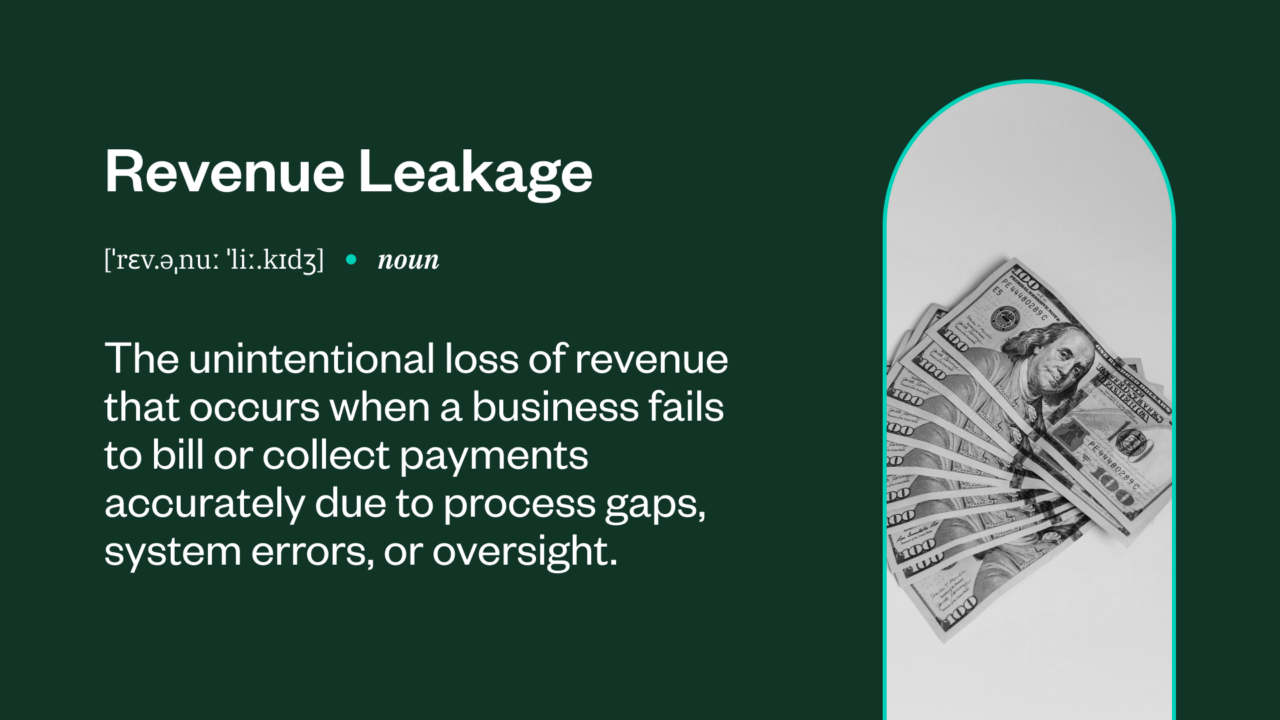
Revenue leakage refers to unintentional revenue loss. Most leakage happens when a business fails to collect payment because of system errors, contractual oversights, or gaps in its billing processes. It’s particularly devastating to subscription-based companies, which can lead to missed renewals, incorrect pricing, uncollected payments, or unbilled upgrades.

revenue leakage definition

Left unchecked, even small leakage can snowball into significant financial losses over time, leading to consequences such as:

  • Reduced profitability: Revenue leakage directly cuts margins because you deliver services or features without payment. 
  • Customer churnBilling errors or mismatched invoices can frustrate customers, increasing the likelihood of canceling or failing to renew.
  • Compliance risks: Inaccurate revenue reporting can lead to regulatory problems, especially for public companies or those under financial scrutiny. 

Why revenue leakage is important for SaaS businesses

Revenue leakage is an issue for any business, but it’s especially harmful to SaaS or subscription-based companies. Predictable, recurring revenue is a must for SaaS businesses. However, revenue leakage undermines this predictability, making it harder to forecast, plan, and grow effectively. It causes multiple issues, including:


  • Disrupted cash flow: Subscription models thrive on stable cash flow. When revenue goes uncollected due to missed renewals, incorrect billing, or usage overages, it hurts operational reliability.
  • Poorer financial performance: Every dollar lost to leakage directly reduces customer lifetime value (CLV). Likewise, revenue leakage also skews and inflates annual recurring revenue (ARR) if you base it on expected revenue rather than actual earnings.
  • Lower investor confidence and scalability: Investors seek strong unit economics and operational discipline. Uncollected revenue signals poor internal controls, which reduces investor confidence and hinders scalability.


Main causes of revenue leakage

Recurring billing is complex, opening businesses to more potential errors and revenue leakage. The most common causes of revenue leakage are:

  • Billing errors: Incorrect invoices, missed charges, or outdated billing details can cause significant loss. Even minor errors, like omitting a usage-based fee, can add up.
  • Subscription failures: Auto-renewals that fail to trigger, expired payment methods, or system glitches can lead to involuntary churn. When this happens, customers leave not because they want to, but because their payment didn’t go through.
  • Pricing and discount management: Unapproved discounts, outdated pricing tiers, or inconsistent pricing model application can erode revenue without anyone noticing, especially in decentralized sales environments.
  • Revenue recognition errors: When accounting doesn’t align with service delivery or contract terms, it can result in overstated or understated revenue, creating compliance risks and misleading financials.
  • Contract management issues: Scope creep, missed upsells, or incorrect interpretations of contract terms often lead to underbilling, especially in usage-based SaaS agreements.
  • Operational inefficiencies: Manual processes, like hand-written invoices or spreadsheets, are prone to human error. Without automation, it’s easy to overlook charges, delay billing cycles, or lose track of renewals.


How to identify revenue leakage

Revenue leakage has many causes, making it challenging to identify and mitigate, especially in enterprise environments. Fortunately, the right processes and approaches can make it easier for finance teams to stop revenue leakage. 

Know how to calculate leakage

Organizations should aim to have zero leakage in their billing processes. Finance teams should regularly calculate leakage with this formula:

Revenue Leakage (%) = (Total Potential Revenue – Actual Collected Revenue) ÷ Total Potential Revenue × 100

This formula requires understanding your total potential revenue and your collected revenue to identify gaps. For example, if you have 1,000 customers paying $100 a month, you can expect to earn $100,000 a month. However, 25 accounts have expired credit cards, 50 are billed late after a plan upgrade, and 10 have manual invoices your team failed to collect. In this case, your actual revenue is $94,000, giving you a revenue leakage percentage of six percent, or $72,000 lost annually for just a few minor oversights. 

Look for key red flags

Calculating differences in actual versus expected revenue will help you clarify whether you’re experiencing revenue leakage. Other telltale signs also indicate a need to dig deeper:

  • Declining profit margins: If your costs stay flat but profits dip, uncollected revenue could be to blame.
  • Inconsistent cash flow: Unexpected fluctuations in your cash flow, especially with a stable subscriber base, can signal leakage.
  • Unexplained customer churn: Churn due to failed payments or billing issues can go unnoticed if not closely monitored.

Follow proper audit methods

It’s important to identify that revenue leakage is occurring, but organizations must also pinpoint its exact cause. A thorough financial audit will help you determine the precise cause, allowing you to take action to prevent revenue leakage in the future. Every organization has different audit methods, but some of the most popular include:

  • Revenue tracking tools: Use SaaS analytics or finance platforms like Zuora to compare expected versus actual revenue in real time.
  • Contract audits: Review contracts for discrepancies between promised results and what’s being billed or delivered.
  • Billing reconciliations: Match invoices to usage, plans, and payment logs to uncover missing or incorrect charges.

Create a revenue leakage audit checklist

Regular audits ensure financial health, but consistency is key. If you don’t have one already, work with your finance team to create a unified revenue leakage audit checklist. Not only will this ensure consistency across all audits, but it will also ensure your team leaves no stone unturned.

Consider adding these questions to your audit checklist:

  • Does the system generate invoices correctly and on time?
  • Is there a system in place for failed payments and renewals?
  • Does the system apply discounts and promotions correctly?
  • Is revenue recognition compliant with accounting standards?
  • Do customer contracts match the work scope and billing?
  • Is there a process for tracking and recovering lost revenue?
  • Are automation tools working correctly?  

How to prevent revenue leakage with Zuora

Preventing revenue leakage in a SaaS business means going beyond spreadsheets and manual processes. It requires systems that are smart, scalable, and built for recurring revenue models. That’s where both strategy and the right tools, like Zuora Revenue, come into play.

Automate billing and revenue recognition

Manual billing errors are one of the most significant sources of leakage. Platforms like Zuora Billing automate invoicing based on real-time usage, pricing tiers, and subscription terms. With built-in compliance for ASC 606 and IFRS 15, Zuora Revenue ensures that every dollar is recognized correctly and consistently. 

Conduct proper subscription and renewal management

Failed renewals and outdated payment methods can lead to involuntary churn. Zuora’s subscription management and dunning capabilities automatically retry payments, send reminders, and recover revenue before it’s lost. 

Improve contract and pricing governance

Scope creep, unapproved discounts, and inconsistent pricing policies can quietly drain revenue. Zuora offers product catalog controls, discount rule enforcement, and contract modification tracking to keep sales and finance aligned while protecting revenue. 

Leverage AI and predictive analytics

Advanced tools like Zuora Revenue Insights provide real-time dashboards to track potential leakage, missed billings, and underperformance against expected revenue. Predictive analytics can identify trends and red flags that manual audits may miss. 

Secure every dollar you’ve earned

Revenue leakage is a subtle threat that, left unmanaged, can wreak havoc on SaaS businesses. Every subscription-based company must prevent revenue leakage to preserve financial health, customer trust, and scalability. Whether from billing errors or failed renewals, revenue leakage has many causes — and all are preventable.


The right platform makes all the difference. Zuora Revenue supports financial health through baked-in automations, compliance, audits, and analytics to proactively monitor for revenue leakage red flags. Recover what’s rightfully yours: Explore Zuora Revenue now

Frequently asked questions

How can I detect revenue leakage early?

Start by monitoring for red flags like inconsistent cash flow, billing disputes, and involuntary churn. Implement real-time revenue tracking tools that compare expected versus actual revenue, and set up alerts for failed payments or delayed invoices. 

How often should businesses conduct a revenue leakage audit?

At a minimum, conduct audits quarterly, especially if you’re scaling or managing multiple subscription tiers. High-growth SaaS companies may benefit from monthly mini-audits focused on high-risk areas like billing, renewals, and contract modifications.

Can revenue leakage impact compliance and financial reporting?

Absolutely. Revenue recognized incorrectly or omitted due to leakage can lead to non-compliance with standards like ASC 606 or IFRS 15, which poses risks for audits, investor trust, and regulatory penalties, especially for public companies.  

What metrics should I track to monitor revenue leakage?

Many metrics indicate revenue leakage, including:

  • Anticipated versus actual revenue
  • Revenue collection rate
  • Failed payment rate
  • Discount utilization rate
  • Unbilled usage
  • Customer churn

What role do AI and machine learning play in preventing revenue leakage?

AI and ML can predict patterns in customer behavior, flag unusual billing activity, and identify recurring issues like scope creep or underutilized services. These tools bring visibility into trends that human teams might overlook, helping finance leaders act faster and smarter.