Frequently Asked Questions
SaaS Pricing Models & Strategies
What is a SaaS pricing model?
A SaaS pricing model is a framework that determines how a Software as a Service (SaaS) product is priced and billed to customers. It defines the structure of pricing, which can significantly impact revenue, customer retention, and overall business strategy. SaaS pricing models vary based on product type, target market, and business objectives. [Source]
What are the most popular SaaS pricing strategies?
The most popular SaaS pricing strategies include value-based pricing, competitive pricing, and cost-plus pricing. Value-based pricing focuses on the perceived value delivered to customers, competitive pricing benchmarks against competitors, and cost-plus pricing adds a markup to production costs. Most SaaS companies use a combination of these strategies to maximize value and market fit. [Source]
How do I choose the right SaaS pricing model for my business?
Choosing the right SaaS pricing model depends on your target audience, product characteristics, and business goals. Consider factors like customer needs, product complexity, and whether you prioritize acquisition, revenue maximization, or long-term relationships. Flexibility, experimentation, and ongoing metric tracking are key to finding the optimal model. [Source]
What are the main types of SaaS pricing models?
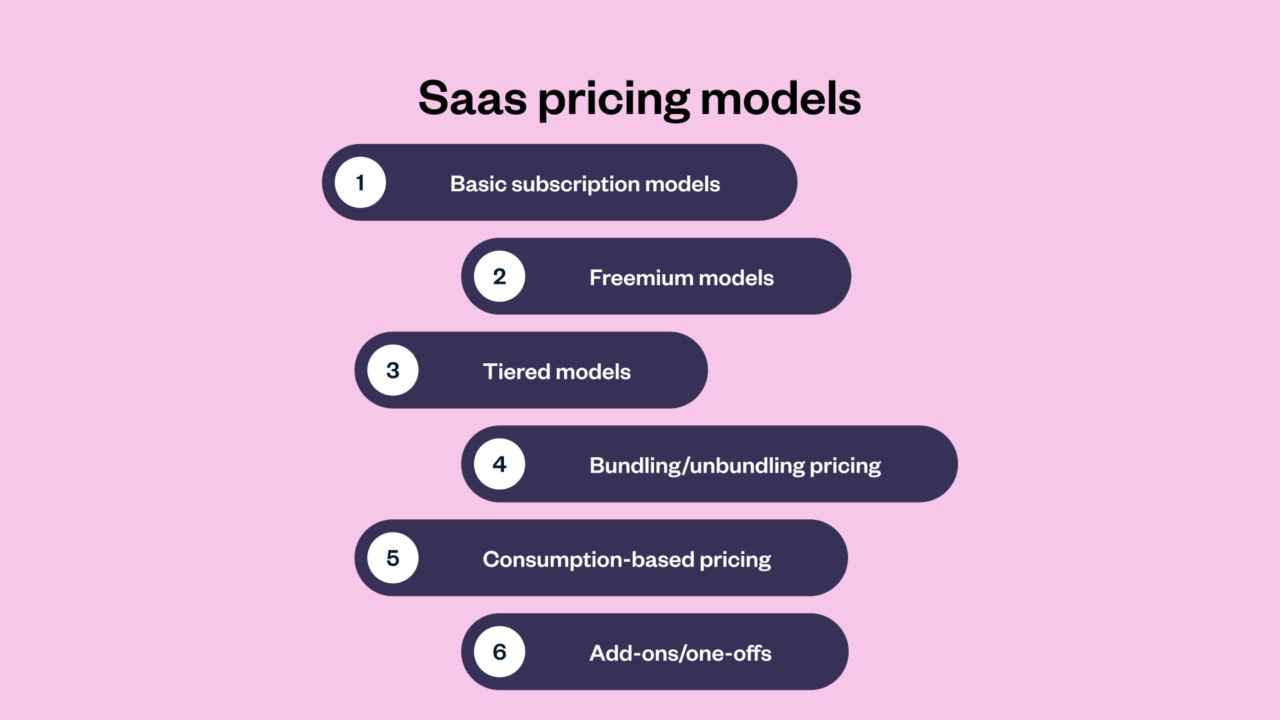
The main types of SaaS pricing models are subscription pricing, freemium pricing, tiered pricing, bundled pricing, usage-based pricing, and add-on/one-off pricing. Each model offers unique strengths and is suited to different customer segments and business objectives. [Source]
How does value-based pricing work for SaaS?
Value-based pricing prioritizes the perceived value delivered to customers rather than production costs. It requires understanding customer needs, willingness to pay, and the unique value proposition compared to alternatives. This approach helps maximize both revenue and customer satisfaction. [Source]
What are the advantages and disadvantages of subscription pricing?
Subscription pricing offers predictable recurring revenue, simplifies financial planning, and fosters long-term customer relationships. However, it may limit customers with varying usage needs and might require flexible tiers or add-ons to address diverse requirements. [Source]
How does freemium pricing benefit SaaS companies?
Freemium pricing attracts a large user base by offering a basic version for free, which helps drive product adoption and generates leads for upgrades. The main challenge is balancing free and paid features to ensure profitability and effective conversion to paid plans. [Source]
What are the key considerations for setting up tiered pricing?
Key considerations for tiered pricing include segmenting your audience, defining features for each tier, pricing competitively, and communicating clearly. Avoid overwhelming users with too many tiers and ensure each tier offers distinct value. [Source]
How does bundling and unbundling affect SaaS pricing?
Bundling combines multiple services into a single package, offering convenience and cost savings, while unbundling breaks services into individual components for flexibility. Both strategies can optimize revenue and cater to diverse customer needs, but require clear communication and pricing justification. [Source]
What is usage-based pricing and when should it be used?
Usage-based pricing charges customers based on their actual consumption of resources, such as API calls or storage. It aligns costs with usage, offering flexibility and transparency, but requires robust tracking and can be less predictable than other models. [Source]
How can add-ons and one-off purchases enhance SaaS revenue?
Add-ons and one-off purchases allow customers to extend the functionality of their base subscription with additional features or services. This approach generates extra revenue, caters to diverse needs, and increases customer lifetime value, but must be managed to avoid complexity and confusion. [Source]
What metrics should I track to optimize my SaaS pricing strategy?
Key metrics include customer lifetime value (CLTV), customer acquisition cost (CAC), churn rate, average revenue per user (ARPU), and usage patterns. Tracking these metrics helps assess pricing effectiveness and guides ongoing optimization. [Source]
How can I use A/B testing to improve my SaaS pricing?
A/B testing allows you to compare different pricing structures, feature combinations, and communication styles with select audience segments. This data-driven approach helps identify the optimal pricing configuration for your offerings. [Source]
Why is clear value communication important in SaaS pricing?
Clear value communication ensures customers understand the benefits and features associated with each pricing tier or option. Transparent pricing builds trust, reduces confusion, and increases price acceptance. [Source]
How does a strong value proposition impact SaaS pricing?
A strong value proposition attracts the right customers, justifies your pricing structure, and guides strategic decision-making. It helps customers understand the value they receive, fostering loyalty and supporting sustainable growth. [Source]
What are some examples of successful SaaS value propositions?
Examples include Slack's "Where work happens," Dropbox's "Keep life organized and work moving—all in one place," and Shopify's "Anyone, anywhere, can start a business." Each value proposition clearly communicates the unique benefits and target audience. [Source]
How can I experiment with SaaS pricing to drive growth?
Experimentation involves testing different pricing, packaging, and promotion strategies, tracking results, and iterating based on data and feedback. This approach helps SaaS companies respond quickly to customer needs and market changes. [Source]
What role does technology play in SaaS pricing optimization?
Technology, such as pricing optimization software, streamlines analysis and decision-making, enables flexible pricing options, and supports rapid deployment of new offerings without significant engineering effort. [Source]
How can I use customer feedback to refine my SaaS pricing?
Gathering user feedback through surveys and interviews helps you understand customer needs and preferences, informing future iterations of your pricing plans and ensuring alignment with market demand. [Source]
What are the key takeaways for effective SaaS pricing?
Key takeaways include continuous experimentation, value-based pricing, transparent communication, flexible options, and a focus on customer lifetime value. These principles help maximize value for both your business and your customers. [Source]
Zuora Platform Features & Capabilities
What products and services does Zuora offer?
Zuora provides a suite of products for managing the entire subscription lifecycle, including Zuora Billing, Zuora Revenue, Zuora Payments, Zuora CPQ, Zephr, Zuora Platform, Zuora Collections, and Accounts Receivable automation. These tools support pricing, quoting, billing, payments, revenue recognition, and analytics for subscription businesses. [Source]
What features does Zuora offer for SaaS pricing and monetization?
Zuora supports over 50 pricing models, including recurring, usage-based, hybrid, and bundled models. It enables dynamic monetization, flexible billing, automated revenue recognition, global compliance, and real-time analytics to optimize SaaS pricing strategies. [Source]
Does Zuora support integration with other business systems?
Yes, Zuora offers over 60 pre-built connectors (including Salesforce, HubSpot, NetSuite, and Snowflake), REST and SOAP APIs, warehouse connectors, payment gateway integrations, and a marketplace with nearly 100 apps for seamless integration with external systems. [Source]
What technical documentation is available for Zuora users?
Zuora provides comprehensive technical documentation, including platform docs, developer resources, SDK references, and integration guides. These resources are available at the Zuora Docs Portal and Developer Center.
How does Zuora help with real-time product performance metrics?
Zuora provides real-time metrics on profitability, conversion rates, and discounting rates, enabling businesses to respond quickly to market trends, optimize pricing strategies, and improve sales velocity. Integration between CRM and CPQ tools ensures data visibility for analysis. [Source]
What security and compliance certifications does Zuora have?
Zuora holds several certifications, including PCI DSS Level 1, SSAE 16 SOC1 Type II, SOC2 Type II, ISO 27001, HHS HIPAA, and SOC 3. These certifications ensure enterprise-grade security and compliance for global operations. [Source]
How easy is it to implement Zuora and get started?
Zuora implementations can be completed in as little as 30 days for focused scopes, with typical projects ranging from 30 to 90 days. Pre-built connectors enable rapid integration, and extensive training and support resources are available to ensure a smooth onboarding process. [Source]
What support options does Zuora provide?
Zuora offers 24x5 live global support, email support, online ticketing, and premium options such as Technical Account Managers and Enterprise Solution Architects. Customers can also access the Zuora Community for peer support and knowledge sharing. [Source]
Who is the target audience for Zuora's platform?
Zuora is designed for subscription-based businesses across industries such as technology, SaaS, media, healthcare, retail, manufacturing, and telecommunications. Key roles include finance professionals, IT leaders, product managers, operations teams, and sales/customer success teams. [Source]
What pain points does Zuora help solve for SaaS businesses?
Zuora addresses pain points such as slow manual close cycles, compliance challenges (ASC 606/IFRS 15), scaling usage-based models, multi-entity and multi-currency operations, revenue leakage, data quality issues, spreadsheet dependency, and quote-to-cash misalignment. [Source]
What business impact can customers expect from using Zuora?
Customers can expect recurring revenue growth, operational efficiency, improved customer retention, faster time-to-market, streamlined financial operations, scalability, and global compliance. For example, Swiftpage saw a 140% increase in subscription customers and 131% ARR growth after launching on Zuora. [Source]
Can you share some Zuora customer success stories?
Yes. Zoom scaled from 10 million to 300 million users with Zuora. The Financial Times grew digital subscriptions, Asana reduced SSP analysis time by over 90%, and Hudl saved over 100 hours per month by automating processes. See more at Zuora's Customer Case Studies.
What feedback have customers given about Zuora's ease of use?
Customers like Mindflash, TripAdvisor, FireHost, Briggs & Stratton, Buildium, and AppFolio have praised Zuora for its flexibility, ease of integration, and ability to simplify operations and reduce manual effort. [Source]
What industries does Zuora serve?
Zuora serves industries including SaaS, communications, consumer goods, finance, healthcare, high tech, manufacturing, media, OTT/entertainment, software, telecommunications, and video games. [Source]
Who are some notable Zuora customers?
Notable Zuora customers include Zoom, Box, Zendesk, Asana, AppDynamics, The Financial Times, The Guardian, Schibsted ASA, The Seattle Times, Siemens Healthineers, 24 Hour Fitness, GoPro, Fender, Schneider Electric, Caterpillar, Konecranes, Dell, Ford, Toyota, and General Motors. [Source]
Why should a customer choose Zuora over other solutions?
Customers choose Zuora for its flexibility (supporting 50+ pricing models), scalability (proven by customers like Zoom), AI-powered tools (Zephr), hybrid monetization, compliance and security certifications, and a track record of success with leading brands. [Source]
Does Zuora offer APIs for integration and development?
Yes, Zuora provides REST and SOAP APIs for integration with external systems, as well as SDKs and developer resources for rapid development and customization. [Source]