
Crafting a successful SaaS pricing model is a crucial component of any SaaS company’s growth journey. It directly influences factors like revenue, customer acquisition, and churn, making it a strategic lever rather than just a financial consideration.
What is a SaaS pricing model?
A SaaS pricing model is a framework that determines how a SaaS (Software as a Service) product will be priced and billed to customers. It defines the structure of pricing, which can significantly impact revenue, customer retention, and the overall business strategy.
SaaS pricing models are not one-size-fits-all; they vary depending on factors such as the type of product, target market, and business objectives.
Popular SaaS pricing strategies
Value based pricing
A value based pricing strategy prioritizes the perceived value your company delivers to customers instead of solely relying on production costs. This approach requires understanding your target audience’s needs, how your solution solves their problems, and the unique value proposition you offer compared to alternatives.
By understanding their willingness to pay, you can determine a price that both covers your costs and maximizes perceived value.
Competitive pricing
While value-based pricing remains your core focus, keeping an eye on competitor pricing is crucial. Analyzing competitor offerings, features, and pricing structures helps you position your company strategically.
You can benchmark your prices competitively while ensuring you stand out through your unique value proposition.
Cost-plus pricing
Adding a markup to your production costs can provide a baseline for pricing consideration. However, relying solely on this method can undervalue your offering and neglect customer perceptions. This pricing strategy is less common with SaaS companies and can sometimes have a negative perception.
Use cost-plus pricing as a foundation, then adjust based on market demand, competitor analysis, and value proposition.
Choosing the right SaaS pricing model
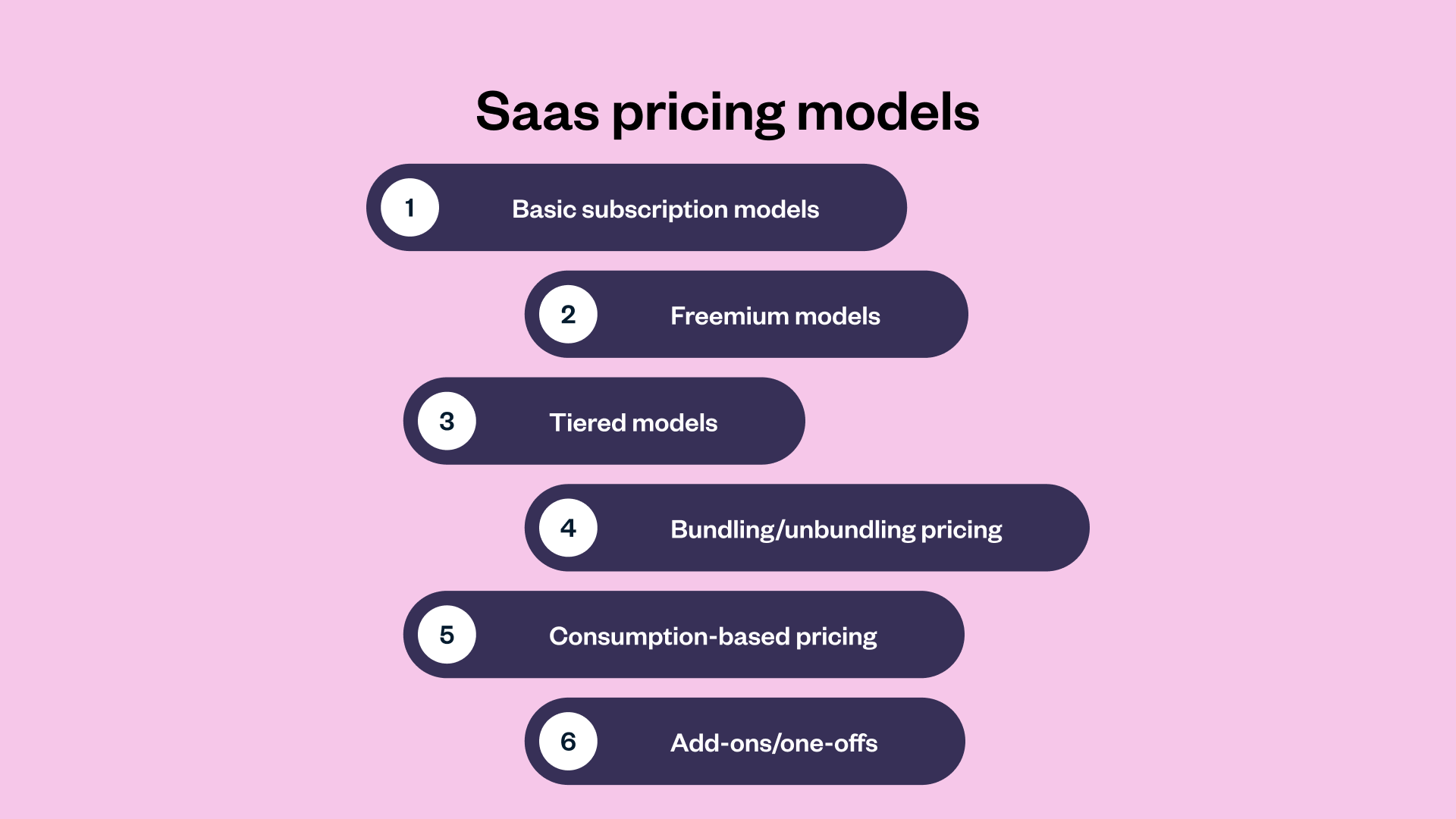
Each SaaS pricing model offers unique strengths and caters to different needs, so the best choice depends on your target audience, product characteristics, and overall business goals.
Types of SaaS pricing models
- Subscription pricing
- Freemium pricing
- Tiered pricing
- Bundled pricing
- Usage-based pricing
- Add-on pricing
Let’s explore the common options and their features:
1. Basic subscription models:
Subscription pricing, beloved for its predictable recurring revenue and long-term customer relationships, demands a strategic approach.
- Features: Fixed weekly, monthly, or annual fees, offering predictability for both the business and customer
- Advantages: Predictable recurring revenue streams, simplifies financial planning, fosters long-term relationships
- Disadvantages: May limit customers with varying usage needs. Might require flexible tiers or add-ons
- Examples: Netflix, Spotify, Salesforce
Subscription-specific considerations
- Subscription length: Offer various subscription lengths (monthly, annually) catering to different customer preferences and budget cycles. Consider offering discounts for longer commitments.
- Tiered options: Develop tiered pricing structures with different feature sets at different price points. Ensure clear differentiation between tiers and avoid overwhelming complexity. A common approach is “good, better, best” pricing.
- Free trial strategies: Define clear trial length, limitations, and conversion goals. Use your trial to showcase product value and nurture leads.
2. Freemium models
Freemium pricing models offer a basic version of your service for free, helping to attract a large user base, convert a portion into paying customers, and cultivate brand loyalty.
- Advantages: Attracts a large user base, drives product adoption, and generates leads for upgrades
- Disadvantages: Balancing free and paid features is crucial. Profitability depends on conversion rates and retention needs careful attention
Understanding freemium
- Core offering vs. premium features: Clearly define what’s included in the free version and what premium features entice users to upgrade.
- User acquisition and conversion: Freemium primarily aims to attract users, with conversion to paid plans being secondary but crucial for long-term sustainability.
- Benefits and drawbacks: Free plans attract users and foster brand awareness, but managing a large free user base and ensuring conversion can be challenging.
Setting effective freemium pricing
- Free plan limitations: Strategically limit features, storage, or usage in the free plan to incentivize upgrades without hindering core functionality.
- Freemium conversion tactics: Offer compelling upgrade paths, highlight the value of premium features, and leverage freemium users for testimonials and social proof.
- Monetization options: Consider advertising within the free plan, offering freemium plans with limited support, or introducing paid add-ons within the free version.
Advanced strategies
- Tiered freemium models: Provide multiple free tiers with increasing limitations to nudge users towards paid plans gradually.
- Time-based limitations: Offer free trials with expiring features to showcase premium value and encourage conversion before access disappears.
- Freemium to usage-based models: Allow freemium users to pay only for features they use, seamlessly transitioning them to a usage-based model.
Examples and case studies
- Spotify: Offers a free, ad-supported tier with limited features, converting users to premium for ad-free listening and offline playback.
- Dropbox: Provides a free 2GB storage plan, enticing users to upgrade for more storage and advanced features like file sharing and password protection.
- Slack: Offers a free plan with limited channels and message history, driving upgrades for larger teams and advanced features like integrations and guest access.
Actionable tips
- Track key metrics: Monitor free user acquisition, conversion rates, average revenue per user (ARPU), and churn rate to assess the effectiveness of your freemium model.
- Implement marketing automation: Automate targeted messaging and upgrade prompts to nurture freemium users and guide them towards conversion.
- Gather user feedback: Conduct surveys and user interviews to understand freemium user needs and preferences, informing future iterations of your plan.
3. Tiered models:
Tiered pricing models provide multiple pricing tiers with different feature sets and price points. By offering multiple subscription plans with varying features and price points, you cater to diverse customer needs and budgets, maximizing your reach and revenue potential.
- Advantages: Caters to diverse needs and budgets, allows upselling to higher tiers and simplifies pricing communication
- Disadvantages: Designing optimal tiers is challenging. Too many tiers can be confusing and balancing value across tiers is crucial
Understanding tiered pricing
- Multiple subscription plans: Offer distinct plans with different feature sets and price points, catering to various customer segments and usage levels.
- Value-based pricing: Each tier should offer clear value propositions and justify its price point through the features and benefits included.
- Balancing complexity and clarity: Avoid overwhelming users with too many tiers, while ensuring each tier offers distinct value to avoid confusion.
Setting effective tiered pricing
- Identify customer segments: Segment your target audience based on needs, usage patterns, and budget constraints.
- Define features for each tier: Carefully select features for each tier, ensuring clear differentiation and progression in value across tiers.
- Price each tier competitively: Conduct competitor analysis and price each tier competitively while considering your costs and profit margins.
- Communicate clearly: Clearly communicate features, benefits, and pricing of each tier on your website and marketing materials.
Advanced strategies
- Hybrid tiered pricing: Combine tiered pricing with other models like freemium or usage-based pricing for added flexibility and user acquisition potential.
- Dynamic tier adjustments: Based on usage data or customer feedback, dynamically adjust pricing or features within tiers to optimize value and revenue.
- Tier migration incentives: Encourage upgrades to higher tiers with targeted promotions, discounts, or exclusive features.
Examples and case studies
- HubSpot: Offers various marketing automation tiers, from a free basic plan to enterprise plans with advanced features and integrations.
- Shopify: Provides different e-commerce plans with varying store size limits, product features, and transaction fees, catering to businesses of all sizes.
- Zoom: Offers free, pro, and enterprise plans with increasing meeting capacities, recording features, and integrations, suitable for individual users and large organizations.
Actionable tips and resources
- Conduct A/B testing: Test different pricing structures and tier configurations to identify the optimal approach for your audience and objectives.
- Explore pricing tools: Use software to analyze competitor pricing and optimize your own tiered structure.
- Offer freemium to paid tier migration paths: Provide clear upgrade paths from freemium plans to paid tiers to guide users towards higher value options.
4. Bundling/unbundling pricing
The art of presenting your offerings lies not just in its features, but also in how you package and deliver them. Product bundling and unbundling offer strategic approaches to tailor your offerings to specific customer needs and optimize your revenue potential by grouping services or products.
- Advantages: Enhances core offerings with additional features (bundling) or caters to specific needs (unbundling), increases flexibility and potentially revenue
- Disadvantages: Product bundling can lead to feature bloat, while unbundling requires clear communication and pricing justification
Understanding service bundling
- Grouping services: Combine multiple related services into a single package at a discounted price, appealing to customers who need them all.
- Value proposition: Bundles offer convenience, cost savings, and a streamlined experience, justifying their price premium compared to individual services.
- Suitability: Bundling works well for services that are naturally complementary and often used together.
- Unbundling services: Break down a comprehensive service into individual components priced separately, offering flexibility and affordability to budget-conscious customers. Unbundling caters to diverse needs and budgets, allowing customers to pay only for what they use and avoid unnecessary features.
Choosing the right approach
- Consider your target audience: Analyze customer needs, usage patterns, and budget constraints to determine if bundling or unbundling resonates better.
- Evaluate service relationships: Assess how your services complement or overlap to inform an effective bundling or unbundling strategy.
- Experiment and track results: A/B test different bundling/unbundling configurations and closely monitor their impact on customer acquisition, conversion, and revenue.
Advanced strategies
- Hybrid approach: Combine bundling and unbundling to offer flexibility, with core services bundled and optional add-ons priced separately.
- Tiered bundling: Provide different bundle tiers with varying service combinations and price points to cater to diverse customer needs.
- Dynamic bundling/unbundling: Adjust your approach based on customer feedback, usage data, and market trends to optimize value and revenue.
Examples and case studies
- Adobe Creative Suite: Bundles multiple design and creative software applications at a discounted price, appealing to professionals who need them all.
- Microsoft Office 365: Offers various subscription plans with different combinations of productivity applications, catering to individual and organizational needs.
- Amazon Web Services (AWS): Provides a vast array of cloud computing services that can be individually accessed and priced based on usage, offering flexibility for developers and businesses.
5. Usage-based pricing
With usage-based pricing, customers pay directly for the resources they consume, aligning costs with actual usage.
- Advantages: Aligns costs precisely with resource usage, offers flexibility, caters to high-volume users
- Disadvantages: Requires robust usage tracking and complex pricing structures, can be less predictable than other models
Understanding usage-based pricing
- Focus on specific metrics: Charge based on predefined metrics like API calls, storage used, active users, or transactions processed.
- Flexibility and transparency: Customers only pay for what they use, offering cost-effectiveness and clear cost predictability.
- Potential complexity: Managing multiple pricing metrics and ensuring clear communication becomes crucial.
Setting effective usage-based pricing
- Identify relevant metrics: Select metrics that accurately reflect customer value and align with your service’s core functionality.
- Determine unit pricing: Carefully calculate the price per unit of usage, considering costs, profit margins, and market competitiveness.
- Minimum spend requirements and overage charges: Implement them cautiously to avoid customer churn and ensure cost recovery.
- Communicate clearly: Transparent communication about pricing metrics, unit costs, and potential overage charges fosters trust and avoids surprises.
Advanced strategies
- Tiered usage models: Offer tiered pricing structures with varying unit prices based on consumption volume, catering to diverse usage patterns.
- Dynamic pricing based on usage patterns: Adjust unit prices based on real-time usage patterns (e.g., peak vs. off-peak hours) to optimize revenue and resource allocation.
- Free tiers with usage overage charges: Attract users with a free tier that transitions to usage-based pricing once usage exceeds a certain limit.
Examples and case studies
- Twilio: Charges developers based on the number of API calls made to their communication platform.
- Amazon Web Services (AWS): Offers a wide range of cloud computing services with pay-as-you-go pricing for storage, compute, and other resources used.
- Dropbox: Provides a free basic plan with limited storage and offers paid plans with increased storage based on usage.
Actionable tips and resources
- Track usage data diligently: Use tools and platforms to accurately track and analyze customer consumption patterns.
- Leverage pricing automation: Employ software to automate pricing calculations and billing based on real-time consumption data.
- Provide usage insights: Offer customers transparent dashboards and reports to track their consumption and optimize their spending.
Related: Guide to usage-based pricing
6. Add-ons/one-offs
Add-ons extend the functionality of a base subscription plan with additional features or services priced separately, while one-off purchases offer standalone products or services not included in subscription plans, often addressing specific customer needs.
Understanding your value proposition for effective SaaS pricing
Crafting a successful pricing strategy hinges on one crucial element: your compelling value proposition. This concise statement encapsulates the core benefits and unique value your solution delivers to customers, serving as the guiding light for your pricing decisions.
A well-defined value proposition does more than attract ideal customers; it fosters loyalty, establishes the basis for pricing justification, and informs broader business strategies – all contributing to long-term success.
Let’s explore the impact of a strong value proposition:
Choosing the right monetization mix
There’s no one-size-fits-all answer to choosing a pricing model for your business. No singular pricing model is enough to ensure growth, maintain market share, or foster brand loyalty. Instead, businesses need a strategy that aligns their needs with the demands of their customers and prospects.
Nowadays that means offering a range of pricing and packaging options to tap a large swath of customer demand.
Consider these factors:
- Target audience: Understand their needs, budget constraints, and value expectations.
- Product complexity: Is your product simple or does it require ongoing usage?
- Business goals: Do you want to prioritize customer acquisition, revenue maximization, or long-term relationships?
Remember:
- Be flexible: Adapt your model as your business and customer needs evolve.
- Monitor and adapt: Track key metrics (CAC, LTV) to assess effectiveness.
- Embrace experimentation: A/B test different pricing options to discover what resonates best with your target audience.
Key metrics to measure
Implementing and optimizing your SaaS pricing strategy
SaaS pricing model FAQs
1.
How can I tell if our current SaaS pricing model is holding us back?
Look for signals like: high win rates but low ACV, strong adoption of low tiers with weak upgrade motion, frequent discounting by sales, prospects confused by plans, or churn concentrated in specific segments. If you see these patterns—and your best customers keep asking for “something in between” your current tiers—it’s a strong sign the model or packaging doesn’t map well to how different customers get value.
2.
How do I choose a good primary value metric (seat, usage, feature, etc.)?
A good value metric should (1) correlate closely with customer value, (2) be easy to measure and explain, and (3) naturally scale as customers succeed. For some products that’s seats; for others it’s transactions, data volume, locations, or revenue processed. Test candidates by asking: “If this metric doubled, would the customer feel they’re getting roughly twice the value—and would they accept paying more?”
3.
What’s a practical sequence for evolving from simple to more advanced pricing?
A common path is: start with a simple tiered subscription (good/better/best), then layer in measured components (overages, add‑ons, or light usage tiers) once you have reliable telemetry. Over time, you can shift more of the bill toward usage for power users or specific modules, while keeping a base subscription for predictability. The key is to add complexity only when you can support it operationally and explain it clearly.
4.
How should pricing decisions connect to our SaaS product catalog design?
Catalog design and pricing are two sides of the same coin. You want a catalog that separates product, plan, and charge so you can reuse the same capabilities across different segments and price points without creating SKU sprawl. That structure makes it much easier to test new bundles, regional price books, or usage metrics without breaking your billing or reporting every time you tweak a plan.
5.
How can we experiment with SaaS pricing without destabilizing existing customers?
Use a “test at the edges” approach: pilot new structures on new customers, new regions, or new add‑ons first. Keep existing customers grandfathered on their current plan, but give them clear, optional upgrade paths into the new model. Track cohorts (pre‑change vs. post‑change) on win rate, ARPU, expansion, and churn before rolling anything out broadly.
6.
What’s the best way to align Sales, Product, and Finance on pricing changes?
Start with a shared brief that answers: who this change is for, what problem it solves, how it will be measured, and what constraints Finance and RevOps need (e.g., discount guardrails, margin targets). Involve Sales early to sanity‑check buyer narratives and common negotiation patterns, and ensure Product understands which features anchor each tier. Finally, make one owner accountable for the end‑to‑end rollout—positioning, enablement, billing configuration, and analytics—so it doesn’t fragment across teams.