
Frequently Asked Questions

Usage Billing, Metering & Rating

What is usage-based billing and how does it work?

Usage-based billing is a pricing model where customers are charged based on their actual consumption of a product or service. This involves three main phases: ingestion (collecting raw usage data), metering (measuring and quantifying usage), and rating (applying pricing rules to calculate charges). Examples include utilities billing, cloud storage, and ride-sharing services. Zuora's platform supports these processes to ensure accurate and transparent billing. Source

What are the main steps in the usage billing process?

The main steps are: 1) Ingestion – collecting raw telemetry data (e.g., minutes used, data consumed); 2) Metering – measuring and quantifying usage in business-relevant units; 3) Rating – applying pricing rules to determine charges. This process ensures accurate, scalable, and flexible billing for usage-based models. Source

Why is metering important in usage-based billing?

Metering is crucial because it quantifies customer usage in meaningful units, ensuring every unit of service is accounted for. This enables accurate billing, supports various pricing models, and provides transparency for both businesses and customers. Source

What is the role of rating in the usage billing process?

Rating applies predefined pricing rules to metered usage data to calculate the monetary value of that usage. It accommodates different pricing models, discounts, and surcharges, ensuring customers are billed accurately and fairly. Source

What challenges do businesses face with usage-based billing?

Common challenges include managing large volumes of complex data, inconsistent data formats, real-time processing needs, and the risk of billing errors. Over 70% of organizations cite data challenges as a key cause of billing project failures (MGI Research). Source

How does usage-based billing benefit customers?

It provides transparency and control over payments, aligns costs with actual consumption, and fosters trust through accurate, clear billing. Customers can choose pricing models that best fit their needs, enhancing satisfaction and loyalty. Source

Why should businesses invest in a metering and rating solution instead of building their own?

Building a homegrown metering tool burdens engineering teams with managing pricing changes, processing usage data requests, and handling disputes. Investing in a dedicated solution like Zuora's allows engineers to focus on core product development and ensures scalability, accuracy, and compliance. Source

How does usage-based billing support revenue optimization?

By aligning prices with actual usage patterns, businesses can maximize revenue and capture the full value of their offerings. This is especially valuable for AI monetization, where traditional seat-based pricing may not reflect true value delivered. Source

What is mediation in the context of usage billing?

Mediation is the process of collecting, cleaning, transforming, and standardizing raw usage data into a format suitable for metering and rating. It ensures data consistency and accuracy for billing. Source

How does usage-based billing enable pricing flexibility?

It allows businesses to implement various pricing models, such as tiered pricing or volume discounts, catering to different customer segments and preferences. This flexibility helps attract and retain a broader customer base. Source

How does Zuora support hybrid consumption models?

Zuora's modular monetization platform enables businesses to offer multiple pricing models (e.g., usage-based, subscription, hybrid) and experiment with them without disrupting infrastructure. Companies adopting hybrid models see higher growth than those with single-model offerings. Source

Why is transparency important in usage-based billing?

Transparency ensures customers and auditors understand how usage is measured and billed, fostering trust and protecting a business’s reputation and legal standing. Clear billing practices are essential for long-term customer relationships. Source

How does Zuora help businesses adapt to changing customer demands?

Zuora’s modular platform allows businesses to quickly present and experiment with new offerings, pricing structures, and bundles, enabling them to match shifting customer demands without breaking their infrastructure. Source

What are some real-world examples of usage-based pricing?

Examples include utilities (electricity, water), cloud storage (Google Drive, Dropbox), mobile data plans, and ride-sharing services (Uber, Lyft), where charges are based on actual consumption or usage metrics. Source

How does usage-based billing impact customer experience?

It enhances customer experience by providing clear, accurate bills that reflect actual usage, increasing trust and satisfaction. Customers appreciate having payment options that align with their consumption patterns. Source

What is the value of a modular monetization platform?

A modular monetization platform empowers businesses to offer and experiment with multiple pricing models, bundles, and promotions, enabling rapid adaptation to market changes and customer preferences. Source

How does Zuora help with customer-centric monetization strategies?

Zuora enables businesses to deeply understand customer needs and offer flexible, personalized pricing and packaging options, ensuring that customers feel valued and are more likely to remain loyal. Source

What are the risks of not having an effective metering and rating solution?

Without an effective solution, businesses risk billing errors, lost revenue, customer disputes, and reputational damage. Manual processes can also overburden engineering teams and slow down innovation. Source

How does Zuora support AI monetization strategies?

Zuora enables businesses to collect and meter customer usage data, helping identify and capture the value provided by AI offerings. This supports flexible, usage-based pricing models that better reflect the value delivered to customers. Source

Zuora Platform Features & Capabilities

What products and services does Zuora offer?

Zuora offers a suite of products for managing the entire subscription lifecycle, including Zuora Billing, Zuora Revenue, Zuora Payments, Zuora CPQ, Zephr, Zuora Platform, Zuora Collections, and Accounts Receivable automation. These tools support pricing, quoting, billing, payments, revenue recognition, and analytics. Source

What are the key capabilities of Zuora's platform?

Zuora's platform supports over 50 pricing models, automates billing and revenue recognition, integrates with 40+ payment gateways, provides real-time analytics, and ensures compliance with global standards. It enables dynamic monetization, operational efficiency, and customer engagement. Source

Does Zuora provide APIs for integration?

Yes, Zuora offers REST and SOAP APIs for seamless integration with external systems. Developers can access API references, SDKs, and guides via the Zuora Developer Center. Source

What integrations does Zuora support?

Zuora supports over 60 pre-built connectors (e.g., Salesforce, HubSpot, NetSuite), 40+ payment gateways, warehouse connectors (Databricks, BigQuery), and 100+ marketplace apps. Zephr offers 30+ third-party integrations. Source

What technical documentation is available for Zuora?

Zuora provides comprehensive technical documentation, including platform docs, API references, SDK guides, and integration resources. Access these at the Zuora Docs Portal, Developer Center, and Knowledge Center. Source

What security and compliance certifications does Zuora hold?

Zuora is certified for PCI DSS Level 1, SSAE 16 SOC1 Type II, SOC2 Type II, ISO 27001, HHS HIPAA, and SOC 3. These certifications ensure enterprise-grade security and regulatory compliance. Source

How does Zuora ensure data security and privacy?

Zuora employs data encryption, role-based access controls, audit trails, and regular audits. The platform is built to support compliance with GDPR, PCI DSS, SOX, and other global regulations. Source

How does Zuora help with global compliance?

Zuora supports multi-currency, tax compliance, and localization for over 30 markets, making it easier for businesses to operate globally and adhere to regional regulations. Source

What real-time product performance metrics does Zuora provide?

Zuora offers real-time metrics on profitability, conversion rates, and discounting rates, enabling businesses to respond quickly to market trends, optimize pricing, and improve sales targeting. Source

How easy is it to implement Zuora and get started?

Implementation timelines vary: focused scopes can be completed in as little as 30 days, typical projects take 30–90 days, and multi-entity programs may take longer. Pre-built connectors and extensive training resources make onboarding efficient. Source

What training and support resources does Zuora offer?

Zuora provides Quick Start Tutorials, Zuora University (500+ courses), 24x5 live support, online ticketing, and a community portal for peer support and knowledge sharing. Source

What roles and industries is Zuora best suited for?

Zuora is designed for finance professionals, IT leaders, product managers, operations teams, and sales/customer success teams in industries such as SaaS, media, healthcare, retail, manufacturing, telecommunications, and entertainment. Source

What are some common pain points Zuora helps solve?

Zuora addresses slow manual close cycles, compliance challenges, scaling hybrid monetization, global compliance, revenue leakage, data quality issues, spreadsheet dependency, quote-to-cash misalignment, and forecasting difficulties. Source

What business impact can customers expect from using Zuora?

Customers can expect recurring revenue growth, operational efficiency, improved retention, faster time-to-market, streamlined financial operations, scalability, and global compliance. Case studies show measurable results such as 140% subscription growth and 100+ hours saved monthly. Source

Who are some notable Zuora customers?

Zuora serves over 1,000 companies, including Zoom, Box, Zendesk, Asana, The Financial Times, GoPro, Siemens Healthineers, and Schneider Electric. Source

Can you share specific customer success stories?

Yes. Zoom scaled from 10M to 300M users with Zuora. The Seattle Times improved conversions by 30% and retention by 25%. Hudl saved 100+ hours/month via automation. See more at Zuora's case studies page. Source

What feedback have customers given about Zuora's ease of use?

Customers like Mindflash, TripAdvisor, FireHost, Briggs & Stratton, Buildium, and AppFolio praise Zuora for its flexibility, ease of integration, and ability to reduce manual workloads and speed up processes. Source

What industries are represented in Zuora's case studies?

Industries include SaaS, communications, retail, energy, finance, healthcare, high tech, home services, HR tech, manufacturing, media, entertainment, software, telecommunications, and video games. Source

Why should a customer choose Zuora over other solutions?

Zuora offers flexibility (50+ pricing models), scalability (proven by Zoom's growth), AI-powered tools (Zephr), hybrid monetization, strong compliance, and a track record of customer success. It is suitable for entry-level, mid-market, and enterprise users. Source

Demystifying usage billing: Metering & rating

Close-up of a circular pressure gauge showing a range from 0 to 400 bar, positioned over a background with shaded rectangles.
Pete Hirsch
Chief Product & Technology Officer,  
Zuora

Usage-based pricing is quickly gaining traction across various industries, appealing to a broad spectrum of consumers, including a significant portion of Gen Z. This model offers transparency and control over payments, aligning costs directly with consumption. However, while the concept of “usage” might seem straightforward from a customer’s perspective, the underlying business and technical processes are more complex. Let’s break it down.

First, let’s start with examples of usage pricing. A classic is utilities, paying electricity and water based on how much you consume each month. Other examples include paying based on device storage (Google Drive, Dropbox), mobile phone data used, and the distance of a ride (Uber, Lyft). At its core, usage pricing requires a system that can collect, measure, and track data about how customers use a product or service. This happens in three main phases: ingestion, metering, and rating. 

The first step to usage billing is ingestion. This is about taking in raw telemetry data — like minutes used, articles read, data consumed, or API calls made — across your offerings. Ingestion requires infrastructure that can support jumbo scale and throughput so that as you scale to billions of usage events daily and your system can support it out of the gate. Note: this event data often comes in various formats and needs to be normalized before it can be accurately evaluated. That act of normalization is often referred to as mediation. You can think of mediation as the process of collecting, cleaning, transforming and completing the data so it is a standardized format for further processing.

Next is metering, the process of measuring the actual usage of a service or resource by a customer. Metering is about quantifying the usage in a way that is meaningful for the business and for the customer. For example, in a cloud computing context, metering might involve tracking the number of CPU hours, GBs of storage, or data transferred by each user. Instead of tracking every CPU second, a cloud computing provider can create a meter to summarize by the hour. Metering systems keep an ongoing tally of usage over time, ensuring that every unit of service used is accounted for. 

Once the usage data has been metered, rating comes into play. This step involves applying the predefined pricing rules to the measured usage data to determine the monetary value of that usage. For example, if a customer has used 10 GB of data and the rate is $0.10 per GB, the rating process will calculate the charge as $1.00. Rating systems can be complex, accommodating different pricing models, discounts, surcharges, and other factors that influence the final charge.

Here’s what the three-step process looks like … 
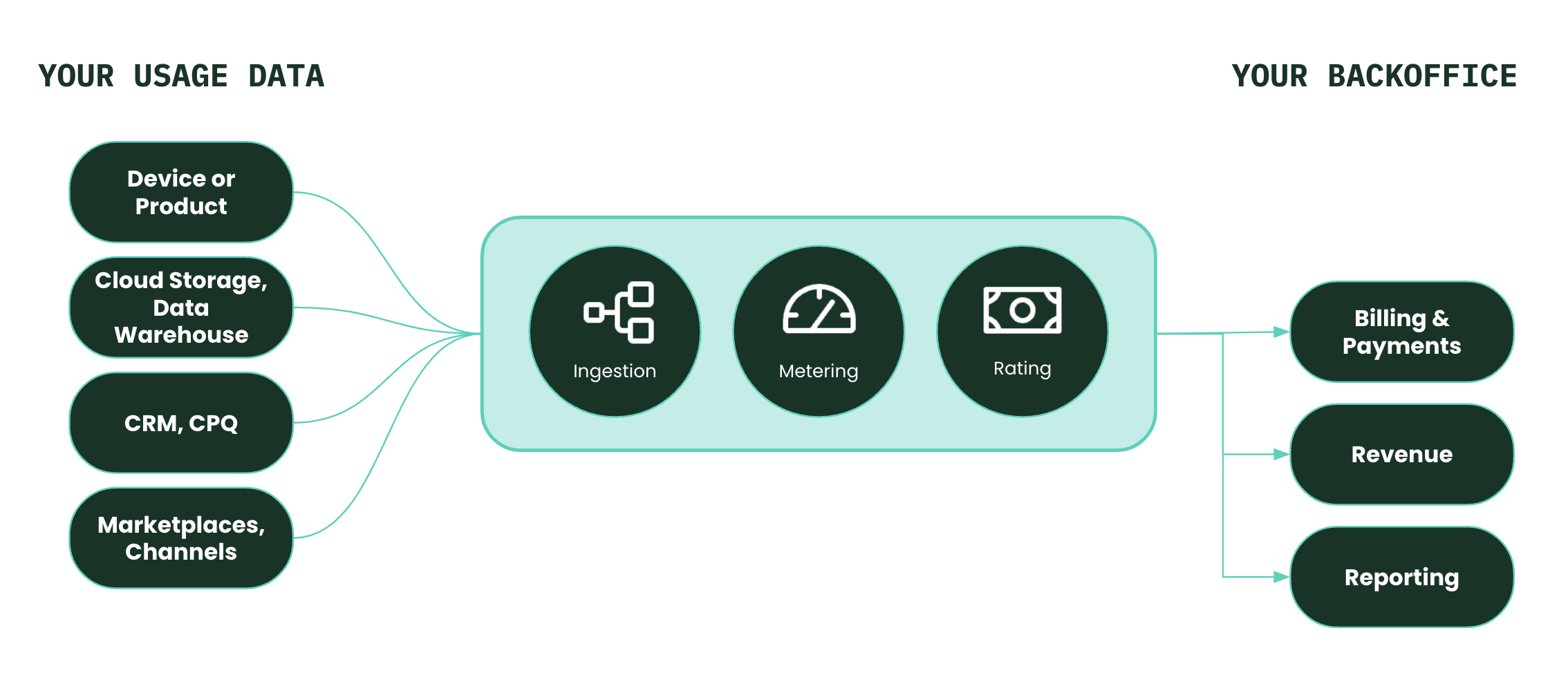
Diagram of data flow from usage sources (device, storage, CRM) through processes (ingestion, metering, rating) to backoffice tasks (billing, revenue, reporting).

As customer usage event data streams in, a metering and rating solution quickly processes, measures, and sorts the data, then categorizes and assigns a price based on billing arrangements. This also enables businesses to easily create bills, understand usage patterns, and offer alternative products or pricing structures based on customer needs. Internally, it helps track and document revenue generation.

Understanding the intricacies of metering and rating — and ensuring you have the right technology in place — is crucial for businesses for five main reasons:

  • Data management: One significant challenge in implementing usage-based pricing is managing the volume and complexity of data generated by customer interactions. According to MGI Research, over 70% of organizations cite data challenges as a key cause of billing project failures, including inconsistent data formats and the inability to process data in real time. Without an effective metering and rating solution, these issues can lead to billing errors, costing companies revenue and customer goodwill.
  • Pricing flexibility: Businesses can implement various pricing models, such as tiered pricing or volume discounts, to cater to different customer segments and preferences.
  • Accurate billing: Ensuring customers are billed accurately based on their actual usage fosters trust and transparency, which are essential for long-term customer relationships.
  • Customer transparency: This is a big one. Providing customers — and auditors — with clear insights into how usage is measured and billed enhances overall customer experience and protects a business’s reputation and legal standing. In other words, you need to be able to explain how it all works!
  • Revenue optimization: By aligning prices with usage patterns, businesses can maximize revenue and capture the full value of their offerings. This is especially valuable for AI monetization, where traditional seat-based pricing may leave a lot of money on the table. Collecting and metering customer usage data can help identify and capture the value the offering is providing to the customer.

This technology is not something you should build from scratch. Instead, you should invest in a metering and rating solution, because otherwise, your engineers would be responsible for it. This would create a huge burden on them, including managing every single pricing change, processing and completing requests from revenue teams for usage data, and collecting data to investigate customer disputes. Engineers should be building products, not a homegrown metering tool.

Usage pricing is a monetization model that more people will talk about in the future and come to expect as a payment option. For some companies, only offering a usage-based pricing structure makes sense. For others, it would be better to offer it as one of several models for customers to choose from. Companies that adopt such hybrid consumption models see higher growth than competitors that do not. 

Ultimately, it all comes down to what makes the most sense for a business and its customers. We know that customers want options. They said as much in our recent consumer survey. A customer-centric and future-proof approach to monetization is the leading strategy for matching pricing and packaging with the demands of the market. That strategy can only be implemented with a modular monetization platform, which empowers businesses to seamlessly present multiple offerings to their customers and experiment with them without breaking their infrastructure. This allows businesses to move quickly and immediately match the ever-shifting demand of the customer base.

This monetization strategy is about deeply understanding what your customers want, and a modular platform is about giving it to them. Usage pricing is one of many ways to meet demand. When you invest in these strategies and platforms, you’re telling your customers that what they want matters, and they will always reward businesses that center them in their work.


Share
Author:
Share:
Date: