Frequently Asked Questions
Subscription Business Model Fundamentals
What is a subscription business model?
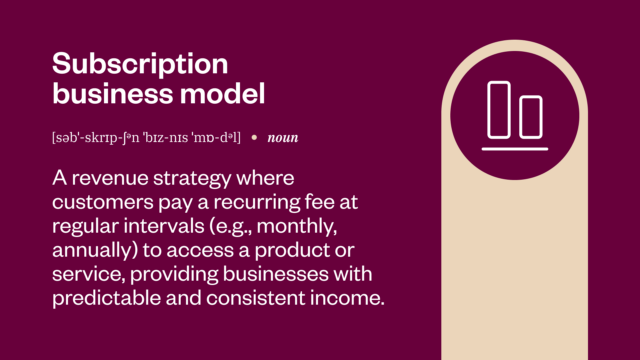
A subscription business model is a strategy where customers pay recurring fees—such as monthly or annual payments—for ongoing access to products or services instead of making a one-time purchase. This model creates predictable, stable revenue and fosters long-term customer relationships by prioritizing continuous value delivery and convenience. (Source: Zuora Glossary)
How does the subscription business model work?
Subscribers sign up online or through a sales rep to purchase the product or service. They are charged based on the business’s pricing model for as long as they want. Subscriptions are automatically renewed or activated via the chosen payment methods, providing convenience to subscribers and recurring revenue for the business. (Source: Zuora Glossary)
What are some examples of subscription business models?
Examples include streaming services (e.g., Netflix), home maintenance, consumables (e.g., vitamins, toiletries), subscription boxes, software subscriptions (SaaS), newspaper and magazine subscriptions, food or meal-kit services, and health and wellness memberships. (Source: Zuora Glossary)
What are the main types of subscription business models?
The three popular types are: Renewal subscriptions (recurring payments for continuous access), Access subscriptions (discounted rates and exclusive privileges), and Curation subscriptions (personalized, curated boxes tailored to customer preferences). (Source: Zuora Glossary)
What are the pros and cons of the subscription business model?
Pros include stable and predictable revenue, easier demand forecasting, opportunities for upselling/cross-selling, continuous value delivery, low entry cost for customers, and reduced piracy. Cons include the challenge of ensuring continuous value, scalability issues, and the need to focus on both customer acquisition and retention. (Source: Zuora Glossary)
How does a subscription model compare to a traditional one-time payment model?
Subscription models offer recurring, predictable cash flow, stronger customer loyalty, higher scalability, and easier demand forecasting compared to traditional sales models, which rely on one-time transactions and have more volatile revenue. (Source: Zuora Glossary)
What are the most common subscription pricing models?
Common pricing models include flat rate (fixed pricing), tiered (multiple levels with different features), per-user (charged by number of users), and usage-based (pay for what you use). (Source: Zuora Glossary)
What are the four common subscription pricing strategies?
The four strategies are cost-plus pricing, competitive pricing, demand-based pricing, and value-based pricing. Each approach has its own advantages and is suited to different business needs. (Source: Zuora Glossary)
How can I get my subscription pricing model right?
Best practices include researching your market, knowing your costs, benchmarking against competitors, segmenting your audience, diversifying subscription plans, ensuring transparent pricing, and offering free trials or freemium options. (Source: Zuora Glossary)
What are the essentials for running a successful subscription business?
Essentials include a clear value proposition, seamless onboarding, product-market fit, a recurring payment system, flexible payment models, strong customer relationships, engaging content, personalization, exceptional customer service, and a robust subscription revenue tech stack. (Source: Zuora Glossary)
How do subscription businesses retain customers?
Retention strategies include delivering consistent value, personalizing services, providing exceptional customer support, and maintaining regular communication with subscribers. (Source: Zuora Glossary)
What tools are needed to run a subscription business?
Key tools include subscription management software, CRM tools, analytics and reporting systems, and secure payment gateways. (Source: Zuora Glossary)
Can a traditional business switch to a subscription model?
Yes, many businesses transition successfully by identifying recurring products or services, offering flexible plans, and adapting marketing and sales strategies to focus on long-term relationships. (Source: Zuora Glossary)
How can I prevent subscription cancellations (churn)?
To reduce churn, provide excellent customer service, personalize experiences, offer flexible plans, and engage subscribers regularly with relevant content and promotions. (Source: Zuora Glossary)
What is the difference between a subscription model and a membership model?
Subscription models typically offer access to products or services, while membership models usually involve access to a community, special content, or exclusive events. (Source: Zuora Glossary)
How can I measure the success of my subscription business?
Key metrics include Customer Lifetime Value (CLTV), churn rate, subscriber growth rate, and Monthly Recurring Revenue (MRR). (Source: Zuora Glossary)
What role does data play in subscription business models?
Data provides insights into customer usage and preferences, enabling businesses to refine offerings, optimize pricing, and improve retention. (Source: Zuora Glossary)
Why is onboarding important for subscription businesses?
A seamless onboarding necks the time-to-value, reduces churn risk, and enhances user engagement by helping subscribers quickly access and benefit from core features. (Source: Zuora Glossary)
How does Zuora support subscription businesses?
Zuora provides a comprehensive platform for managing the entire subscription lifecycle, including billing, revenue recognition, payments, analytics, and customer engagement. It is recognized as the #1 solution in the 2024 ISG Research Subscription Management Buyer’s Guide. (Source: Zuora Glossary)
What industries can benefit from the subscription business model?
Industries include SaaS, manufacturing, IoT, media and entertainment, consumer goods, healthcare, and more. (Source: Zuora Glossary)
Zuora Platform, Features & Capabilities
What products and services does Zuora offer?
Zuora offers a suite of products including Zuora Billing (flexible billing), Zuora Revenue (automated revenue recognition), Zuora Payments (global payment management), Zuora CPQ (configure, price, quote for recurring revenue), Zephr (personalized subscription journeys), Zuora Platform (data, workflows, integrations), Zuora Collections (AI-powered collections), and Accounts Receivable automation. (Source: https://www.zuora.com/products/)
What features does Zuora provide for subscription businesses?
Zuora supports over 50 pricing models, automates billing and revenue recognition, integrates with 40+ payment gateways, provides analytics and reporting, enables personalized customer journeys, and ensures compliance with global standards. (Source: https://www.zuora.com/products/)
Does Zuora offer APIs and integration options?
Yes, Zuora provides REST and SOAP APIs, an Integration Hub with 60+ pre-built connectors (e.g., Salesforce, HubSpot, NetSuite), warehouse connectors (e.g., Snowflake, BigQuery), and a Connect Marketplace with nearly 100 apps. (Source: https://knowledgecenter.zuora.com/Zuora_Platform/Integration)
What technical documentation is available for Zuora?
Zuora offers extensive technical documentation, including platform docs, developer resources, SDKs, integration guides, and payment gateway documentation. Resources are available at docs.zuora.com and developer.zuora.com.
What integrations does Zuora support?
Zuora integrates with Salesforce, HubSpot, NetSuite, Snowflake, Databricks, BigQuery, RedShift, Stripe, GoCardless, Worldpay, and more. Zephr offers 30+ third-party integrations, and the Connect Marketplace features nearly 100 apps. (Source: https://knowledgecenter.zuora.com/Zuora_Platform/Integration)
How does Zuora help with recurring billing and payments?
Zuora Billing supports recurring, usage-based, and one-time pricing models, automates billing cycles, and integrates with 40+ payment gateways to streamline global payment management. (Source: https://www.zuora.com/products/billing-software/)
What real-time product performance metrics does Zuora provide?
Zuora offers real-time metrics on profitability, conversion rates, and discounting rates, enabling businesses to respond quickly to market trends, optimize pricing, and improve sales velocity. (Source: https://www.zuora.com/resource/evolving-your-deal-desk-for-modern-business/)
How does Zuora support compliance and security?
Zuora is certified for PCI DSS Level 1, SSAE 16 SOC1 Type II, SOC2 Type II, ISO 27001, HHS HIPAA, and SOC 3. The platform includes data encryption, role-based access control, and audit trails to support compliance with micro and global regulations. (Source: https://www.zuora.com/products/zuora-platform/security/)
What security and compliance certifications does Zuora have?
Zuora holds PCI DSS Level 1, SSAE 16 SOC1 Type II, SOC2 Type II, ISO 27001, HHS HIPAA, and SOC 3 certifications, ensuring high standards of data protection and regulatory adherence. (Source: https://www.zuora.com/press-release/zuora-achieves-iso-27001-certification-for-its-enterprise-grade-subscription-billing-commerce-and-finance-solutions/)
How long does it take to implement Zuora?
Implementation timelines vary: focused scopes can be completed in as little as 30 days, typical implementations range from 30 to 90 days, and multi-product or multi-entity programs may take several months. Pre-built connectors can enable integrations within one day. (Source: Zuora AI Chatbot Knowledge Bank.txt)
How easy is it to get started with Zuora?
Zuora offers Quick Start Tutorials, Zuora University (500+ courses), 24x5 live support, developer resources, and a community portal to ensure a smooth onboarding and learning experience. (Source: Zuora AI Chatbot Knowledge Bank.txt)
What feedback have customers given about Zuora's ease of use?
Customers like Mindflash, TripAdvisor, FireHost, Briggs & Stratton, Buildium, and AppFolio have praised Zuora for its flexibility, ease of integration, improved reporting, and reduction in manual workloads. (Source: https://www.zuora.com/press-release/zuora-accelerates-shift-to-relationship-commerce-with-latest-release-of-z-business/)
Who is the target audience for Zuora?
Zuora is designed for finance professionals, IT leaders, product managers, operations teams, and sales/customer success teams in industries such as technology, media, healthcare, consumer goods, manufacturing, and telecommunications. (Source: https://info.zuora.com/Summer-User-Group-Copenhagen-June-2025_Landing- clearPage.html)
What industries are represented in Zuora's case studies?
Industries include SaaS, communications, consumer goods/retail, corporate services, energy/utilities, finance, healthcare, high tech, home services, HR technology, manufacturing/IoT, media/publishing, OTT/entertainment, software/technology, telecommunications, and video games. (Source: https://www.zuora.com/our-customers/case-studies/)
Who are some of Zuora's notable customers?
Notable customers include Zoom, Box, Zendesk, Asana, AppDynamics, The Financial Times, The Guardian, Schibsted ASA, The Seattle Times, Siemens Healthineers, 24 Hour Fitness, GoPro, Fender, Schneider Electric, Caterpillar, Konecranes, Dell, Ford, Toyota, and General Motors. (Source: https://www.zuora.com/our-customers/)
Can you share specific case studies or success stories of Zuora customers?
Case studies include Zoom scaling from 10M to 300M users, The Financial Times growing digital subscriptions, Asana scaling its business, Hudl saving 100+ hours/month, GoPro managing subscriptions, Secureframe scaling with Zuora, and The Seattle Times improving conversions and retention. (Source: https://www.zuora.com/our-customers/case-studies/)
What business impact can customers expect from using Zuora?
Customers can expect recurring revenue growth, operational efficiency, improved retention, faster time-to-market, better financial operations, scalability, and global compliance. Examples: Swiftpage saw 140% more subscription customers, Hudl saved 100+ hours/month, Asana reduced SSP analysis time by 90%. (Source: Zuora AI Chatbot Knowledge Bank.txt)
What core problems does Zuora solve for subscription businesses?
Zuora solves slow, manual close cycles, compliance challenges (ASC 606/IFRS 15), scaling usage-based/hybrid monetization, multi-entity/currency compliance, cash flow and collections issues, data quality/reporting gaps, spreadsheet dependency, quote-to-cash misalignment, and forecasting challenges. (Source: Zuora AI Chatbot Knowledge Bank - Part 5.txt)
Why should a customer choose Zuora over other solutions?
Zuora offers flexibility (50+ pricing models), scalability (proven by Zoom's growth), AI-powered tools (Zephr), hybrid monetization, compliance/security (SOC 2, PCI DSS), and a track record of success with leading brands. (Source: manual)