Minimum Commitment Pricing: Flexible Usage, Predictable Revenue.
Minimum commitment pricing lets a company keep the flexibility of usage-based pricing and still forecast its revenue. Customers want to pay for what they use, especially for AI, where consumption is hard to predict. Finance teams want a number they can plan around. Can both be true? Yes, and it takes deliberate design.
This guide explains how minimum commitments work, why AI products make them more relevant, how cloud providers structure them and how to set one that sales, product and finance can all support. It is written for CFOs, CROs and product leaders who share the pricing decision.
Key Takeaways
- A minimum commitment sets a floor for spend and keeps usage-based pricing on top of it, so customers get flexibility and the seller gets a forecastable base.
- Cloud agreements show the pattern. Typical AWS private pricing agreements commit a customer to spend over one to five years in return for a discount.
- Commitments can take several forms: minimum with true-up, prepaid drawdown, ramped commitments and committed spend with overage.
- Set the commitment from durable usage, not from hoped-for growth, and agree the rules for shortfalls and rollovers in advance.
- Finance needs tracking, alerts and revenue accounting that handle commitments, prepayments and rollovers without manual spreadsheets.
What minimum commitment pricing is
A minimum commitment is an agreement where a customer promises to spend at least a set amount over a period. The seller bills usage against that amount. If the customer uses less, the contract defines what happens, often a true-up invoice for the shortfall. If the customer uses more, the extra usage is billed at the agreed rates.
The structure sits between two familiar models. A flat subscription gives the seller predictable revenue but ignores how much the customer uses. Pure pay-as-you-go matches price to usage but makes revenue hard to forecast. A commitment combines the two, which is why it appears in most hybrid pricing designs. For background, see our explanation of hybrid monetization.
The basic parts
- The committed amount, stated in currency or in units such as credits.
- The term, such as a year or several years.
- The rates that apply to usage, including any discounts for higher commitments.
- The rules for shortfalls, overages and unused balances.
Why AI products need both flexibility and predictability
AI offers make the old trade-off sharper. Usage varies widely between customers and between months, and the cost of serving that usage is real. Sellers need a pricing model that covers variable cost. Buyers, in turn, ask for protection from unpredictable charges, because a spike in usage can turn into a budget problem.
Each side holds a legitimate position. A pure usage model gives buyers flexibility and gives sellers uncertain revenue. A flat plan gives sellers predictability and may leave heavy users underpriced or light users overpaying. Commitments let both sides take part of what they want.
Our seven AI pricing best practices treat predictability and flexibility as two of the tests a buyer applies to any model. The AI monetization strategy guide for CFOs describes the common pattern: a subscription or commitment base for predictability, plus consumption or credits that absorb variable cost.
How cloud commitments work as a model
Large cloud providers have used commitments for years, and many of your customers already buy this way. Looking at how they work helps you design your own.
According to one guide to AWS private pricing agreements, an enterprise customer commits to a set amount of spend over one to five years and receives a percentage off nearly every service. The guide notes that customers who qualify have typically spent $1 million or more a year, and that AWS does not publish discount levels.
The same source describes how the contract treats usage on each side of the commitment. Spend above the commitment is billed at the agreed rate. Spend below it does not reduce the amount owed, and unused amounts do not roll into the next term.
Two lessons carry over. First, the buyer gives up some flexibility, and the seller pays for that with a lower price or added value. Second, the contract’s rules for shortfalls and rollovers matter as much as the committed number.
Four ways to structure a commitment
Commitment models vary. These four cover most designs.
Minimum commitment with true-up
The customer is billed for usage as it happens. At the end of a period, if total spend is below the minimum, the customer pays the difference. This is simple to explain and protects the seller’s baseline.
Prepaid drawdown
The customer pays upfront for a balance of credits or currency, and usage draws it down. Sellers get cash and predictability. Buyers get a clear budget line and often a better rate.
Ramped commitments
The committed amount increases over the term, for example from a lower first-year amount to a higher third-year amount. Ramps suit AI products where adoption grows after launch.
Committed spend with overage
A committed amount covers a defined set of usage, and anything beyond it is billed at overage rates. Add alerts so customers see their position before an invoice arrives. Our usage-based pricing guide covers how minimum commitments and prepaid models fit into hybrid pricing.
How to set the right commitment level
The commitment is where flexibility and predictability meet, so size it with care. Use this process.
- Start from durable usage. Base the committed amount on usage the customer already has or has contracted, not on a launch or a growth plan that is not yet approved.
- Test against several scenarios. Check what the customer pays if usage is 50% lower and what the seller earns if usage doubles.
- Decide how shortfalls work. A true-up, a rollover into the next period or a credit all change the buyer’s risk. Write the rule down before you quote.
- Offer tiers. Give customers a few commitment levels with better rates at higher levels, so they can pick the one that matches their confidence.
- Agree who owns what. Sales owns the conversation, product owns the usage meter and finance owns the accounting treatment. Align all three before launch.
Revisit commitment levels at renewal, using the usage data from the last term.
What finance needs to run commitments
A commitment is a contract term, and the systems behind it have to track it. Finance teams that run commitments by spreadsheet usually hit trouble within a few quarters.
Track spend against the commitment
Someone needs to see, at any time, how much of each customer’s commitment is used. Sales needs the same view for expansion conversations, and customers expect alerts before they hit a threshold.
Bill shortfalls and overages correctly
True-up invoices, overage charges and prepaid balances all follow contract rules. Each exception becomes manual work if the system cannot apply the rules.
Handle the accounting
Commitments, rollovers and prepayments affect revenue recognition under ASC 606. In a conversation between Zuora and PwC on usage-based models, the speakers described commitments that roll over between periods and prepayments that must be accounted for over time as especially complicated parts of the order-to-cash process.
Design the catalog to match
Product catalog structure affects how easily you can launch and change commitment models. See our guide to designing a hybrid product catalog.
How Zuora helps with commitments
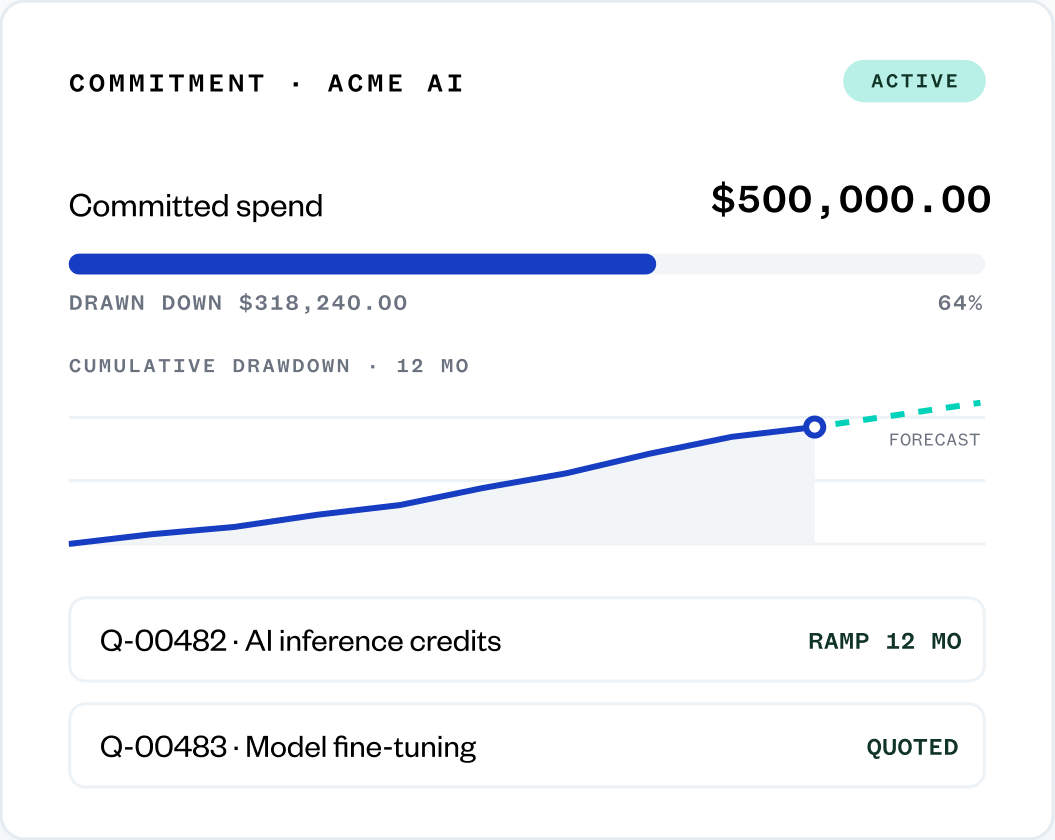
Zuora Commitments is native commitment management in Zuora Billing. It unifies the applicable charges into a single committed amount, tracks under-spend and overages over time, and gives sales, billing, finance and customer success a shared view of each deal. You can set postpaid commitments with true-up invoices, prepaid commitments settled against usage invoices, and ramped schedules, with a full audit trail for changes.
Our AI Monetization Suite supports credits, tokens, prepaid drawdown, tiers, overage and commitments on one platform. Read the Zuora Commitments documentation or talk to our team.
FAQs
1.
What is minimum commitment pricing?
Minimum commitment pricing is a model where a customer agrees to spend at least a set amount over a period, and usage is billed against it. If usage falls short, the contract usually requires a true-up payment. If usage exceeds the commitment, the extra is billed at agreed rates. It combines usage-based flexibility with predictable revenue.
2.
How is a minimum commitment different from prepaid drawdown?
With a minimum commitment, the customer is billed as usage happens, and any shortfall is settled at the end of the period. With prepaid drawdown, the customer pays upfront for a balance and usage reduces it. Drawdown brings cash earlier. A commitment keeps billing in arrears. Many sellers offer both.
3.
What happens if a customer uses less than the commitment?
The contract decides. Common outcomes are a true-up invoice for the shortfall, a rollover of unused value into the next period, or forfeited prepaid balance. Cloud agreements often treat the commitment as owed even when usage falls short. Whatever you choose, state the rule clearly before signing so there are no surprises.
4.
How do you set a minimum commitment for an AI product?
Base it on durable usage the customer already has, then test the result against lower and higher usage scenarios. Offer several commitment tiers with better rates at higher levels. Agree shortfall and overage rules in advance, and review the level at renewal using actual usage data from the previous term.