
We did the manual revenue for two months, and that was two months too long. Having automation in place means I can spend time analyzing, improving, and building. My team's work is more strategic now. We're not just processing transactions.
Accounts receivable automation connects invoice delivery, collections, payments, cash application, AR accounting, and GL handoff so finance teams can manage invoice-to-cash work on current, auditable data. In a recurring-revenue business, the goal is not just faster collections; it is a clearer cash position, fewer manual reconciliations, and a better customer handoff across finance, sales, and support.
TL;DR: Key Takeaways for Finance Leaders
- Connected AR is an architectural decision, and not a tool purchase. A modern AR stack unifies billing, collections, payments, cash application, and AR accounting on a single subledger. That replaces the fragmented patchwork of standalone tools, which creates audit risk and a drag on customer experience.
- Fragmented AR costs you customers as much as it costs you cash. When collections operates separately from billing, CRM, and customer success, dunning emails go out at the worst possible time: while Sales is negotiating an upsell. The customer sees one company. You see three teams. CFO Dive, citing a Capchase report, found that median DSO increased from 31 to nearly 40 days since 2021, and the cash gap keeps widening.
- AI is reshaping AR, but only when it’s grounded in clean billing data. AI-assisted forecasting, AI-assisted cash application, and the emerging category of AI agents for AR depend on a billing system of record that gives them current, audit-ready data. When AI runs on stale or disconnected data, the AI’s recommendations and actions inherit the same data-quality limitations.
For most finance leaders, AR is the silent line item on the org chart. It isn’t strategic enough to attract executive attention, but it’s operational enough to consume hours of your best people every month. Invoices get sent, and payments come in. Spreadsheets get reconciled, and every quarter the cycle repeats, slightly worse than last time, because customer count keeps growing while the AR team doesn’t.
This is the AR trap of the Subscription Economy. You can’t scale recurring revenue with a transactional AR mindset. The deal isn’t done when the contract is signed. That’s the beginning of a 36-month relationship of upgrades, downgrades, mid-cycle changes, payment failures, and renewals. Your AR function has to keep up. If it doesn’t, cash flow, customer trust, and audit defense erode at the same time.
This playbook is for the finance leaders, AR directors, and controllers who recognize that fixing AR isn’t a tooling refresh. It’s a structural rethink.
It’s the cash discipline within the broader Accounting Automation playbook, the getting paid counterpart to the close-time reframe Accounting Automation tackles elsewhere. The two belong together architecturally, and they reward the leaders who treat both as architectural disciplines rather than tactical fixes.
What Is Accounts Receivable Automation?
Accounts receivable automation is the unification of billing, collections, payments, cash application, and AR accounting onto a single subledger that handles the full invoice-to-cash-to-close lifecycle. It replaces fragmented, spreadsheet-driven workflows with continuous, real-time cash visibility and audit-ready journal entries that automatically feed the general ledger.
In practical terms, it’s the difference between an AR team that spends two weeks every month chasing reconciliation discrepancies and one that spends those same two weeks analyzing what the discrepancies mean for cash flow, retention, and next quarter’s forecast.
AR Automation vs Collections Automation vs Invoice Automation
These three terms get conflated in vendor marketing, but they shouldn’t be.
- Invoice automation is the front of the cycle: generating accurate invoices on the right schedule, in the right currency, with the right tax treatment. This lives upstream in your billing system.
- Collections automation is the recovery layer: dunning workflows, payment retries, and customer outreach for overdue accounts. This is one function within AR.
- AR automation is the entire stack: billing handoff, payment processing, cash application, collections, aging, AR accounting, and GL reconciliation operating as a single integrated process, not four separate tools stitched together by nightly CSV exports.
Each piece matters. Solving the collections automation piece in isolation, which is the most common vendor pitch, leaves the upstream invoicing errors and downstream cash application bottlenecks unsolved. That’s why plenty of “AR automation” projects deliver disappointing returns.
The Connected AR Model
Modern AR architecture follows a five-stage flow, with one shared data model running through it.
- Billing & Invoices. Accurate, usage-aware invoices that capture every plan change, proration, and overage in real time.
- Collections. Intelligent dunning, prioritized outreach, disputes, and promise-to-pay tracking, all tied to live invoice state.
- Payments. Flexible rails and gateways with smart retries, reconciliation mapped to the right customer and invoice.
- Cash Application. Automated matching for cards, ACH, and bank files, plus AI-assisted suggestions for remittance edge cases.
- AR Accounting. Real-time trial balance, roll-forwards, write-offs, FX gains and losses, and auditable journals into the general ledger.
The hero visual below is the architectural blueprint that the rest of this guide builds on.
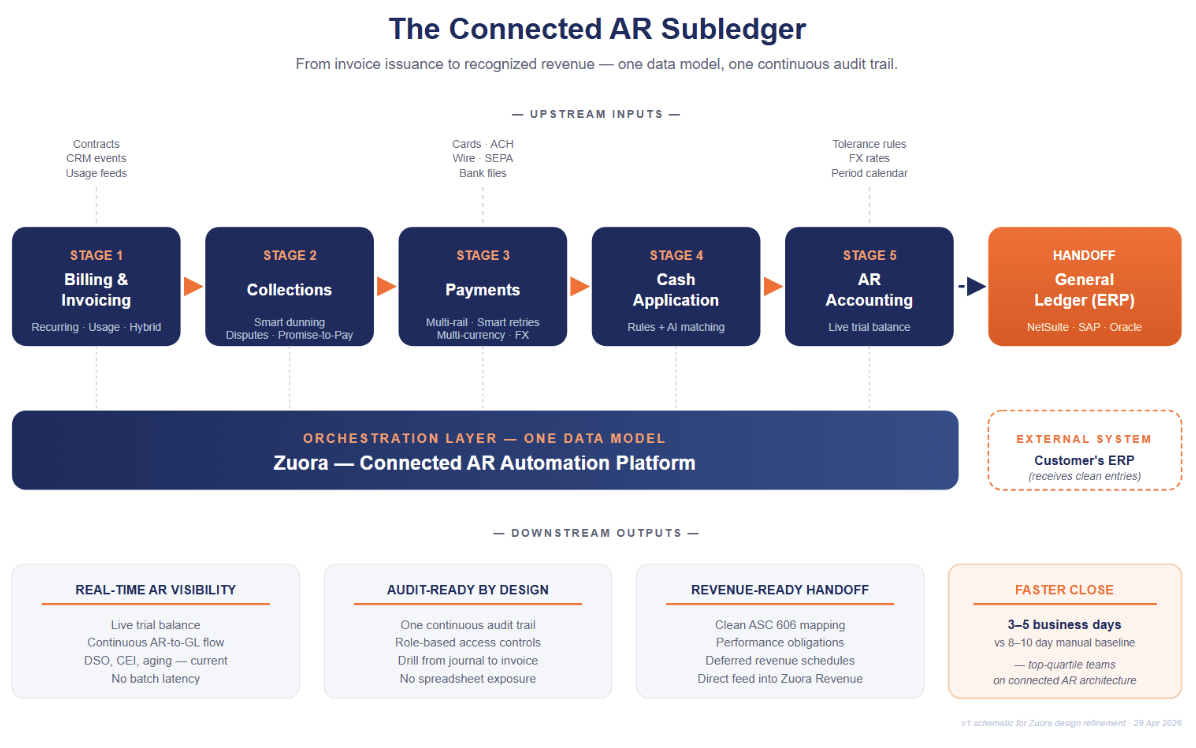
When the stages share one data model, the AR team has a live, continuous view of cash. When they don’t, the team is reconciling four separate tools into a fifth (namely, the spreadsheet) every month, which is what most finance teams are still living through.
Why Disconnected AR Costs You More Than Cash
The traditional case for AR automation is about working capital. Collect cash faster, reduce DSO, and free up the team. Those benefits matter, and they also understate what’s actually at stake in a recurring-revenue business.
In recurring revenue, every collections interaction is part of the customer journey. A collections touchpoint that ignores open disputes, sales activity, or account context can create avoidable friction in a renewal or expansion motion — and damaging a high-value renewal over a minor administrative issue is a measurable cost most finance teams underestimate. The point our earlier collections-strategy analysis made still holds: “You can’t grow a relationship with a customer you don’t understand.” And you can’t understand a customer when the collections team is working from data that’s three days stale, with no visibility into the open support ticket, the upsell conversation in the CRM, or the contract amendment still sitting in draft.
Here is what disconnected AR is actually costing modern finance teams.
Fragmented Systems Create Blind Spots
Your billing data is in one tool, collections are in another, while AR aging is in a third, and your GL is in a fourth. Reconciliation between them becomes the AR team’s full-time job, and it scales linearly with customer count. That’s exactly the scaling problem subscription businesses can’t afford.
“We decommissioned a large number of extremely complicated Excel spreadsheets. We toned down and removed a number of giant risks to the financial statements. And we made our people able to do high-value work instead of double- and triple-checking Excel functions.”
Jane Koltsova, Senior Director, Global Revenue Controller, PagerDuty
Manual Reconciliation Is Audit Risk
Spreadsheets weren’t designed to be auditable systems. They lack version control, role-based access, and any record of who changed what when. Spreadsheet audit research has consistently found high error rates in operational spreadsheets used at scale. Every month, your AR team spends two weeks running automated revenue reconciliation by hand in Excel, that is two weeks in which a single broken formula can cause a material misstatement. As Jane Koltsova puts it: “If you don’t have it right, eventually the CFO’s going to come and ask, ‘Isn’t this going to be a problem?’ and then you have to rework everything.”
Disconnection From the Customer Journey Erodes Retention
This is the cost most finance teams underestimate. When the collections team has no visibility into what Sales is pushing, what Customer Success is fixing, and what Support is escalating, dunning emails arrive at the worst possible moments. To the customer, they signal a company that doesn’t talk to itself. In recurring revenue, that perception is a churn signal, and disconnected AR is what produces it.
The market data backs the pattern. CFO Dive, citing a Capchase report, found that median DSO increased from 31 to nearly 40 days since 2021, even as many companies have tightened their payment terms. The cash gap is widening, and connected AR is the structural fix.
How AI Is Transforming Accounts Receivable
AI in AR has moved from aspirational to operational. Established AR vendors and a wave of newer entrants are deploying AI against specific, measurable AR pain points: automated cash application matching, predictive cash flow forecasting, account scoring for collections prioritization, and the early shoots of fully autonomous AR agents. The question for finance leaders is no longer whether to engage with AI in AR. It’s where to engage, with which vendor, and on what data foundation.
Zuora is moving forward in this space, too. The launch of Zuora AI, announced in our Zuora AI press release, brings AI capabilities natively into the same data model that runs billing, collections, and AR accounting. We believe that integration matters. The AI finance data trust gap, as our research describes it, is the difference between AI’s promise and the data quality finance teams need to trust the output. AI grounded in the billing system of record narrows that gap. AI bolted on top of nightly exports widens it.
The AI conversation is also where some of the more expensive mistakes are being made. Layering an AI agent on top of a legacy, fragmented AR stack doesn’t fix the underlying data problems. It can amplify existing errors at a higher speed. The platforms we expect to earn finance teams’ trust are the ones whose AI runs on clean, real-time billing data, on a governance model that an auditor can defend.
Here is where AI is delivering value across the AR cycle today.
AI in Cash Application
Rules-based matching engines handle the bulk of clean payment matching. AI-assisted matching can help interpret edge cases like multi-invoice remittances, short-pays, ambiguous reference numbers, and partial payments, surfacing a candidate match with a confidence score for the AR Operations team to confirm or reject under approval controls. The exact lift depends on payment mix, remittance quality, bank connectivity, and the starting baseline. Read the deep dive on how to automate cash application and AR reconciliation.
AI in Collections
The shift here is from blanket dunning to prioritized, context-aware outreach. AI can help score accounts to identify which overdue accounts need human attention versus which are likely to pay on their own. AI can also help draft the first version of each reminder, sized to the customer’s history and tone, with collector review before sending for high-value accounts. AI-assisted classification of inbound replies can help route complex disputes to a human while keeping routine follow-ups on the automated workflow, which is the operating pattern Zuora’s AI for Collectors capabilities support. Read the deep dive on smart collections strategy.
AI in Forecasting
Predictive cash inflow modeling has moved from a quarterly FP&A exercise to a real-time AR capability. AI trained on historical payment behavior can help flag at-risk accounts before they age, model the likely month-end cash position, and update forecasts as collections actions land. Read the deep dive on AR cash flow forecasting.
AI in Aging Analysis
Risk signals before invoices age. AI examines payment-behavior patterns, dispute likelihood, and customer-relationship signals to flag accounts heading toward 60+ days delinquent before they get there. Combined with prioritized work queues, this turns the aging report from a backward-looking artifact into a forward-looking action plan.
Read the deep dive on managing aging invoices with AR automation.
AI Agents for AR: The Next Frontier
Fuller autonomous agentic AR is an emerging category across the AR vendor landscape. Zuora’s current public position is AI-powered AR embedded in the finance system of record, with governed AI experiences that respect permissions and approval workflows. The agentic shift is real, but finance teams should evaluate it through the same lens they use for every financial workflow: data quality, controls, auditability, and human oversight. Read the deep dive on AI agents for accounts receivable.
The Connected AR Subledger
The architectural pattern that makes everything discussed here work is the connected AR subledger: a unified accounting layer that processes the high-volume, high-complexity transactions of subscription AR and passes summarized, audit-ready journal entries into the general ledger.
One Vendor for Billing and AR
This is the structural distinction in Zuora’s architecture. When billing and AR share a data model, the collections team sees current invoice state, the cash application engine knows which subscription, plan, and term a payment belongs to, the aging report reflects up-to-date billing data, and the audit trail is a connected line from invoice through to recognized revenue.
When evaluating AR automation software, ask whether the platform works from live billing and invoice data or relies on batch exports and reconciliation between systems. Data freshness matters most in recurring-revenue environments where amendments, prorations, usage overages, and cancellations land continuously. The unified-platform pattern Zuora deployed at the launch of Zuora Collections was designed for these dynamics.
Live AR Trial Balance and Roll-Forwards
Continuous reporting complements the period-end close. The AR trial balance reflects current transaction state, and roll-forwards can run on demand rather than only as a month-end exercise. CFOs and controllers get a view of cash position throughout the period rather than only at period-end. This can compress the continuous close timeline and feeds upstream into more reliable cash flow forecasting.
Revenue-Ready by Design
The downstream payoff is a clean handoff to ASC 606 revenue recognition. When detailed invoice and payment data flows from a connected AR subledger directly into Zuora Revenue, there are no manual tie-outs at month-end, no late reclasses, and no “we’ll figure that out at audit time” entries. Each transaction in AR maps cleanly to a performance obligation, an SSP allocation, and a deferred revenue schedule. The audit defense surface contracts, and the close compresses meaningfully.
Architecturally, this is what we mean by revenue subledger: a layer that does the heavy financial-logic work before journal entries hit the general ledger, so the GL stays clean, fast, and audit-defensible.
AR Glossary: Core Terms Every Finance Leader Should Know
A shared vocabulary for modern AR. Use this as a quick reference; the linked guides go deeper on each term.
Core AR Terms
- AR (Accounts Receivable). The total amount owed to the business by customers for goods or services delivered but not yet paid for. Tracked on the balance sheet as a current asset.
- DSO (Days Sales Outstanding). The average number of days it takes to collect payment after a sale. Lower is better. Subscription benchmark: under 35 days.
- CEI (Collection Effectiveness Index). A measure of how much of the available, collectible cash was actually collected in a given period. A score of 80% or higher is considered best-in-class. Unlike DSO, which measures speed, CEI measures completeness.
- Aging Schedule. The classification of outstanding invoices by how long they’ve been overdue (typically 30 / 60 / 90 / 120+ day buckets).
- Bad Debt. Receivables that the company has determined to be uncollectible and has written off.
- Write-off. The accounting action of removing an uncollectible receivable from the books.
AR Automation Terms
- Cash Application. The process of matching incoming payments to the correct customer invoices.
- Reconciliation. The process of verifying that AR records match payment records and GL entries.
- Smart Collections. Segmented, automated, AI-assisted collections workflows that adapt to customer behavior and value tier (vs blanket dunning).
- Dunning Management. The automated process of communicating with customers about overdue payments. One workflow within smart collections.
- Promise-to-Pay. A documented customer commitment to pay an overdue invoice by a specific date, tracked through resolution.
Analytics & Forecasting Terms
- Cash Flow Forecasting. Predicting future cash inflows based on AR aging, historical payment behavior, and risk signals.
- At-Risk Receivables. Open AR is identified by predictive analytics as likely to age, dispute, or become bad debt.
- Cohort Analysis. Grouping customers by characteristic (size, segment, payment history) to detect payment-behavior patterns.
Architecture & Integration Terms
- Billing System of Record. The authoritative source for invoice, subscription, and payment data. In a connected AR architecture, the AR subledger lives on the same data model as the billing system.
- ERP. Enterprise Resource Planning system (NetSuite, SAP, Oracle, etc.). Contains the General Ledger.
- Payment Gateway. The processing layer that handles credit card, ACH, and other payment method transactions.
- APIs. Application Programming Interfaces that connect billing, AR, payment, and ERP systems.
AR KPIs That Matter for Modern Finance Leaders
The metrics that distinguish a well-run AR function from a struggling one. Set targets, track them monthly, and hold the team accountable.
Cash Velocity Metrics
Track DSO, CEI, and the aging profile monthly. The right targets depend on industry, customer mix, payment terms, and historical baseline:
- DSO (Days Sales Outstanding). A lower DSO is generally better for cash conversion; the right target depends on industry norms and contracted payment terms.
- CEI (Collection Effectiveness Index). A higher CEI indicates more complete recovery of collectible cash within the period.
- Aging profile. The share of total AR in older buckets (60+, 90+ days) is a portfolio-health indicator; what counts as concerning varies by segment and credit policy.
Read the deep dive on how to reduce DSO.
Quality Metrics
- Bad debt %. A lower bad-debt rate relative to revenue indicates healthier credit policy and collections execution.
- Dispute cycle time. Faster median dispute resolution reduces working-capital tied up in unresolved AR.
- Forecast accuracy. Lower variance between forecasted and actual cash inflow indicates a more reliable cash-position view.
Read the deep dive on AR cash flow forecasting.
Productivity Metrics
- Cash application rate. A higher share of payments auto-matched reduces the manual exception queue. The right target depends on payment mix and remittance quality.
- Unapplied cash aging. A lower median aging on items in the unapplied-cash holding account indicates cleaner matching and faster posting.
- Time-to-close. A shorter close cycle indicates that AR-to-GL reconciliation is running on connected data rather than period-end discovery work.
Read the deep dive on automate cash application and AR reconciliation.
How to Evaluate AR Automation Software
If you’re in vendor-evaluation mode, this is the checklist to bring to every demo.
The Capability Checklist
A modern AR automation platform should deliver:
- Unified subledger architecture. Billing, collections, payments, cash application, and AR accounting on one data model.
- AI-powered cash application. Automated matching for cards, ACH, and bank files, with AI suggestions for remittance edge cases.
- Predictive cash flow forecasting. Trained on historical payment behavior, updated in real time.
- Subscription and usage-aware collections. Workflows that understand plan, term, usage, and entitlement context.
- Audit-ready journal entries. Policy-driven accounting that posts clean entries to the GL.
- Multi-entity, multi-currency, FX. Without spreadsheet gymnastics.
- ASC 606 / IFRS 15 alignment. Clean handoff to revenue recognition.
- Modular activation. Turn on collections, cash application, and AR accounting incrementally without re-platforming.
Build vs Buy vs Integrate with Billing
Three architectural paths to choose from.
- Build. Custom development on top of your existing billing engine. Maximum flexibility, but high engineering opportunity cost. Best for unique requirements that no platform supports.
- Buy a standalone AR tool. Versapay, Tesorio, HighRadius, Billtrust, Quadient. These specialize in AR and integrate with the underlying billing system. Evaluate the data-integration model — whether the AR tool works from live billing data or batch exports — because data freshness affects collections, aging, and reconciliation in continuously changing recurring-revenue environments.
- Integrate with your billing platform. When the billing platform also offers AR, collections, and cash application as native capabilities (Zuora’s model), the result is one data model running across the AR cycle. The initial vendor decision may take longer, but the trade-off is fewer cross-system integrations to build and maintain. Evaluate TCO across both paths against your own integration, support, and reconciliation costs rather than relying on vendor TCO claims.
Multi-Entity, Multi-Currency, FX
Enterprise AR typically means multi-entity reporting, multi-currency invoicing, and FX gain/loss accounting. Tools that “support” these as bolt-ons can still require manual reconciliation across entities. Native multi-entity AR, where the subledger handles entity, currency, and FX as first-class concepts, is the difference between a quarterly fire drill and a continuous, audit-clean process.
Compliance & Audit-Readiness
Every AR automation evaluation should include the auditor’s perspective. Ask: Can my external auditor drill from a journal entry back to the original invoice and contract in your platform? If the answer involves CSV exports or screenshots, the tool isn’t audit-ready. Connected AR platforms provide one continuous audit trail from quote to recognized revenue.
Integration Patterns: CRM, Billing, AR, ERP
This is the four-system handshake that defines modern revenue operations. Strong integration patterns mean contract data flows from CRM into billing without re-keying. Billing events flow into AR without batch latency. AR transactions flow into ERP as summarized journal entries, not raw transaction noise. And customer context flows back into CRM, so collections doesn’t send dunning to a customer while Sales is mid-upsell or Support is mid-escalation.
The CFO + AR Director + IT Coalition
Modern AR isn’t a finance-only initiative. It requires three owners working as one team.
- Finance defines the cash policy. What gets dunned, when, with what tone, and which exceptions get human attention. The CFO and AR Director own this layer.
- Operations executes the process. Daily collections cadence, dispute resolution, and cash application exception handling. The AR Operations team owns this layer.
- IT integrates the systems. Connectivity between billing, AR, payment gateways, ERP, and CRM. The CIO and RevOps lead own this layer.
When these three work in lockstep, AR can shift from a back-office function into a strategic capability. When they don’t, AR is where good policy decisions stall because nobody can implement them end-to-end.
This pattern mirrors the CFO + CIO co-ownership thesis we’ve explored elsewhere. The same logic applies in AR: it’s a finance-led discipline that requires technical execution. In our experience, coalitions either compound the benefits across the three roles or they fragment the work into a multi-year, multi-million-dollar rebuild that should have been one project.
The data support the pattern. Our Modern Finance Leader Report found that 70% of finance leaders are held back by their tech stack, and only 50% of organizations close their books within six business days. The companion AI Paradox findings add that 79% say manual work still overwhelms their teams, even amid AI investment. The thread connecting these numbers is consistent. Tools alone don’t solve the problem when the operating model behind them stays fragmented.
As a Chief Accounting Officer, I want to be able to say 'yes' to things that make sense commercially, so we have to be able to handle new business models, products, and offerings. With Zuora Revenue, we're able to be more agile to support the business so we can evolve with customer demands and go to market quickly.
Common Pitfalls and How to Avoid Them
Three patterns we see repeatedly when finance teams try to build a connected AR strategy.
Pitfall 1: Bolting AR on Top of Legacy ERP
If the AR stack already runs on NetSuite, SAP, or Oracle, the vendor pitch is straightforward: an AR module that “extends” the ERP. The architectural problem is that ERPs are general ledgers, not subledgers. They are built for static, backward-looking records, not dynamic, forward-looking AR workflows. Pushing high-volume AR transactions through an ERP can create the “data pollution” pattern. The GL fills with raw transactions, the close slows, and reporting breaks. A defensible alternative is to deploy a dedicated AR subledger that handles the financial logic work before journal entries hit the GL. The ERP receives clean, summarized entries, and the AR team gets the operational depth required to do its job.
Pitfall 2: Treating Collections as Transactional Cash Recovery
When the collections team is measured solely on dollars collected this month, you implicitly authorize whatever tactics produce that number: aggressive dunning, service shutoffs, and high-pressure outreach. Tactics that perform in one-time-transaction businesses can damage recurring-revenue businesses. A more durable approach is to measure cash collected, customer retention impact, and dispute resolution speed together. That’s the multi-metric framing modern smart collections programs are built around.
Pitfall 3: Ignoring the AI Inflection
Waiting can feel safe. AI in AR is hype-heavy, the newer entrants are unproven, and the established AR vendors are repositioning faster than they are delivering. The cost of waiting, in our view, is rising. Competitors deploying AI-powered AR, even imperfectly, can pull ahead on cash velocity, forecast accuracy, and team productivity over the next 12 to 18 months. The decision is less about whether to invest in AI for AR, and more about the data foundation it sits on. AI grounded in clean billing data tends to compound benefits. AI layered on top of a legacy, fragmented stack risks amplifying existing errors at machine speed.
Where to Start: The 90-Day Connected AR Roadmap
Architectural shifts of this size can feel overwhelming. The pattern we recommend is a focused, sequenced rollout designed to deliver compounding value.
Days 1-30: Audit Your Current AR Stack
Map every system that touches AR: billing, payment gateway, collections tool, AR aging report, GL. Document the data flows between them. Catalog the manual work, including every CSV export, every spreadsheet, and every reconciliation step. The output is a single architecture diagram that shows where AR data lives, where it stalls, and where it leaks. This baseline becomes the business case.
Days 31-60: Pilot Connected Automation (Start with Cash Application)
Cash application is the highest-leverage starting point in the AR cycle. It delivers fast operational impact, measurable lift, and a low-risk way to prove the model before broader rollout. Pilot automated cash application on a single customer segment or business unit. Measure the lift in match rate, the reduction in unapplied cash, and the time saved. Use the pilot data to fund the broader program.
Days 61-90: Expand and Measure
Roll connected AR forward to smart collections, managing aging invoices, and DSO reduction. Set the KPI baseline: DSO, CEI, time-to-close, cash application rate, dispute cycle time. Report monthly and adjust as the data comes in. Use the first 90 days to baseline metrics, pilot one workflow, and decide where to expand based on results. Treat timeline and outcomes as planning guidance rather than guaranteed implementation results, and review with Services/PMM as part of the implementation plan.
Build the AR Stack Your Customers and Your CFO Have Been Asking For
Connected AR is the cash discipline of the subscription economy. When the AR team operates from one shared data model, collections become customer-aware, forecasting becomes reliable, cash application becomes largely invisible, and the audit trail becomes a single clean line from invoice to recognized revenue.
The opportunity is broader than collecting cash faster. It’s to turn AR into a function where retention, forecasting accuracy, and cash flow predictability reinforce each other rather than compete for the same scarce hours.
Ready to evaluate the Connected AR architecture?
FAQs
1.
What is accounts receivable automation?
Accounts receivable automation is the unification of billing, collections, payments, cash application, and AR accounting onto a single subledger that handles the full invoice-to-cash-to-close lifecycle. It replaces fragmented manual workflows with continuous, real-time cash visibility and audit-ready journal entries that feed the general ledger.
2.
What features should I look for in AR automation software?
Enterprise-grade AR automation software should include a unified subledger spanning billing through cash application, AI-powered cash application matching for edge cases, predictive cash flow forecasting, automated dunning workflows tied to invoice state, multi-entity and multi-currency support, audit-ready journal entries, ASC 606 and IFRS 15 compliance, and seamless integration with your billing system of record. When evaluating options, ask whether the platform works from live billing and invoice data or relies on batch exports and reconciliation between systems — data freshness matters most in recurring-revenue environments.
3.
Who provides AR automation solutions with built-in analytics?
Leading providers of AR automation with built-in analytics include Zuora (Connected AR Automation Platform with AI-powered forecasting, account scoring, and live AR trial balance), HighRadius, Billtrust, Versapay, and Quadient. Zuora differentiates by combining the billing system of record with collections, cash application, and AR accounting on one data model. That means analytics can run on current data from the same source of truth, rather than depending on reconciliation across exports and disconnected systems.
4.
What's the best accounts receivable automation software for enterprises?
The best AR automation software for enterprises depends on the billing model. For subscription, usage-based, and hybrid revenue businesses, the platform should natively understand recurring billing, mid-cycle amendments, and ASC 606 revenue recognition, rather than functioning as a standalone collections tool. Zuora’s Connected AR Automation Platform unifies billing, collections, cash application, and AR accounting on a single subledger. Zuora has been recognized as a Leader in the Forrester Wave™: Recurring Billing Solutions, Q1 2025 and the 2025 Gartner® Magic Quadrant™ for Recurring Billing Applications — note that these recognitions are for recurring billing and monetization, not specifically for AR Automation.
5.
Where can I compare AR automation vendors?
Independent vendor comparisons of AR automation platforms are available through Gartner Peer Insights, the Forrester Wave: Recurring Billing Solutions, the ISG Research Subscription Management Buyers Guides, and MGI Research’s Automated Revenue Management Ratings. Major vendors evaluated include Zuora, HighRadius, Billtrust, Versapay, Quadient, Tesorio, and Gaviti. When comparing, prioritize vendors that integrate with your billing system of record rather than reading exports from it.
6.
How do I select an AR platform that integrates with billing systems?
Selecting an AR platform that integrates with your billing system requires evaluating the data integration model, not just the integration list. Ask whether the AR tool works from live billing and invoice data or relies on periodic exports and reconciliation. Connected AR platforms like Zuora share the same data model with billing, so cash application, dunning, and aging can operate on current invoice context rather than batch-refreshed views. Prioritize: live data integration vs batch, unified subledger architecture, billing-system context for collections workflows (knowing which subscription, plan, term, and entitlement an overdue invoice belongs to), and clean handoff into ASC 606 revenue recognition.
7.
What is an AR subledger?
An AR subledger is a dedicated accounting layer that processes the high-volume, high-complexity transactions of subscription and usage-based AR (invoices, payments, credits, write-offs, FX gains and losses) and passes summarized, audit-ready journal entries into the general ledger. It sits between your billing system and your ERP, protecting the GL from raw transaction volume while maintaining a complete audit trail from the first invoice to recognized revenue.
8.
How does AR automation impact DSO?
AR automation reduces Days Sales Outstanding (DSO) through six levers: improved billing accuracy and timeliness, intelligent payment retries on failed cards, smart dunning workflows tied to invoice state, customer segmentation by risk and value, faster dispute resolution, and predictive intervention for at-risk accounts before they age. CFO Dive, citing a Capchase report, found that median DSO increased from 31 to nearly 40 days since 2021, and connected AR is the structural fix.
9.
What is the Collection Effectiveness Index (CEI)?
The Collection Effectiveness Index (CEI) measures how much of the available, collectible cash a finance team actually collected in a given period. The formula compares total receivables at the start of the period plus credit sales, against the ending total and the ending current receivables. A score of 80% or higher is considered best-in-class. Unlike DSO, which measures speed, CEI measures completeness, which makes it a stronger indicator of overall collections health.