Frequently Asked Questions
Accrued Revenue Basics
What is accrued revenue?
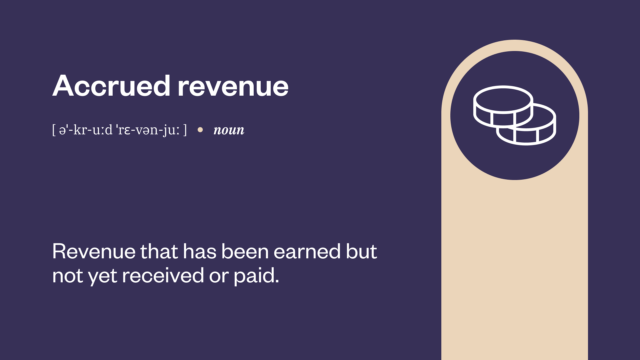
Accrued revenue is revenue that a business has earned by delivering goods or services but has not yet billed or received payment for within the accounting period. It is recognized as an asset on the balance sheet until invoiced, ensuring financial statements reflect revenue in the period it’s earned, not just when cash is collected. This is especially important for subscription and service-based models. Source
How does accrued revenue differ from unbilled revenue?
Accrued revenue is revenue that has been earned but not yet received and doesn’t necessarily require an invoice to be issued. Unbilled revenue is revenue that has been earned, but an invoice still needs to be issued to be paid. The main difference is whether an invoice is required for payment and the stage of recognition in the accounting system. Source
Why is accrued revenue important for businesses?
Accrued revenue ensures that financial statements accurately reflect the true performance of a business by recognizing revenue when it is earned, not just when cash is received. This supports accurate matching of revenue and expenses, improves financial visibility, compliance, and reporting accuracy under standards like ASC 606 and IFRS 15. Source
What is the difference between accrued revenue and deferred revenue?
Accrued revenue is revenue earned but not yet received in cash, recognized when it is earned regardless of payment. Deferred revenue is cash received but revenue not yet earned, recognized when payment is received regardless of service or product delivery. Accrued revenue is a current asset, while deferred revenue is a current liability. Source
How is accrued revenue recognized according to accounting standards?
Accrued revenue is recognized when there is persuasive evidence of an arrangement, delivery has occurred or services have been rendered, the price is fixed and determinable, and collectibility is reasonably assured. These criteria are set by the SEC and are essential for proper revenue recognition. SEC Guidance
What are some examples of accrued revenue?
Examples include interest on loans earned but not yet received, revenue from long-term projects recognized as milestones are achieved, and SaaS subscription add-ons or upgrades billed at the end of the period. For instance, a SaaS company recognizing additional payments for downloads during a subscription period as accrued revenue. Source
Why is accrued revenue considered an asset?
Accrued revenue is considered a current asset because it represents money that a company has earned for goods or services delivered but has not yet received payment for. The company has the right to collect this money, making it an asset on the balance sheet. Source
Are accrued revenues shown on the income statement?
Yes, accrued revenue is recorded in the income statement on the credit side and is often added to gross profit and other income. Source
How is accrued revenue tracked and accounted for in financial statements?
Accrued revenue is tracked using a ledger, where each transaction is recorded and compiled using the receivable account before being posted into the financial statements. Source
Can accrued revenue be reversed or adjusted after recognition?
Yes, accrued revenue can be reversed or adjusted after it has been recognized. This may occur due to changes in contract terms, pricing, delivery dates, or uncertainty about payment. Adjustments ensure the accuracy of the company’s financial statements. Source
Accounting Principles & Best Practices
What are the main accrual accounting principles every business should know?
The two essential accrual accounting principles are the matching principle and the revenue recognition principle. The matching principle requires that revenue earned matches the cost of expenses incurred in the same period. The revenue recognition principle states that revenue should be recorded in the same period it is earned, regardless of when payment is received. Source
What are the best practices for managing accrued revenue?
Best practices include accurate recording of revenue, timely invoicing, regular reconciliation, accurate forecasting, periodic reviews, effective communication among teams, using reliable accounting software, and monitoring customer payment habits. These practices help ensure compliance and accurate financial reporting. Source
What are common challenges in managing accrued revenue?
Common challenges include estimation errors, compliance issues with standards like ASC 606 and IFRS, cash flow problems, difficulties in monitoring and tracking, communication gaps between departments, technology limitations, and adapting to changing regulations. Source
How does technology help in managing accrued revenue?
Reliable accounting software streamlines the tracking and recording of accrued revenues, reduces manual errors, and supports compliance with accounting standards. Upgrading to advanced solutions can improve accuracy and efficiency in financial reporting. Source
What is an accrued expense and how does it differ from accrued revenue?
An accrued expense (or accrued liability) is a cost incurred by a company even though payment has not yet been made. It is recorded as a current liability. In contrast, accrued revenue is money earned but not yet received, recorded as a current asset. Source
Industry Use Cases & Impact
Which industries commonly use accrued revenue?
Industries that commonly use accrued revenue include financial services (e.g., interest from loans), real estate (e.g., rent payments), construction (e.g., milestone projects), contractors, service-based industries (SaaS, consulting, accounting agecies), healthcare, and manufacturing. Source
How does accrued revenue impact a company’s financial health?
Accrued revenue increases a company’s assets and improves liquidity, boosting revenue and profitability. However, if not accurately monitored, it can lead to cash flow issues and increase the risk of bad debts. Source
What are some real-world scenarios where accrued revenue is recognized?
Real-world scenarios include SaaS companies recognizing subscription upgrades or add-ons before payment, construction firms recognizing revenue as project milestones are completed, and financial institutions accruing interest income before receipt. Source
Zuora Platform & Automation
How does Zuora help automate accrued revenue management?
Zuora Revenue automates complex revenue recognition, simplifies audits, and ensures compliance with standards like ASC 606 and IFRS 15. It reduces manual effort, improves accuracy, and provides real-time integration with billing and financial systems. Source
What are the key features of Zuora Revenue for managing accrued revenue?
Zuora Revenue offers automated revenue recognition, policy-driven automation for compliance, real-time data integration, and unified reporting. It supports complex pricing models and multi-entity, multi-currency operations. Source
How does Zuora support compliance with ASC 606 and IFRS 15?
Zuora Revenue ensures compliance with ASC 606 and IFRS 15 by automating revenue recognition and providing audit-ready reporting. It helps businesses adapt to new pricing models without breaking compliance. Source
What integrations does Zuora offer for revenue management assistance?
Zuora provides over 60 pre-built connectors (e.g., Salesforce, NetSuite, Snowflake), REST and SOAP APIs, warehouse connectors (Databricks, BigQuery), and payment gateway integrations. These enable seamless data flow and automation for revenue management. Integration Hub
How does Zuora improve financial reporting and forecasting for accrued revenue?
Zuora provides real-time product performance metrics, unified data models, and analytics tools that improve the accuracy of financial reporting and forecasting. This enables businesses to respond quickly to market trends and optimize pricing strategies. Source
What pain points does Zuora solve for companies managing accrued revenue?
Zuora addresses slow, manual close cycles, compliance challenges, scaling usage-based and hybrid monetization, multi-entity and multi-currency complexity, cash flow and collections issues, data quality, and quote-to-cash misalignment. Source
Security, Compliance & Support
What security and compliance certifications does Zuora hold?
Zuora holds certifications including PCI DSS Level 1, SSAE 16 SOC1 Type II, SOC2 Type II, ISO 27001, HHS HIPAA, and SOC 3. These certifications ensure enterprise-grade security and compliance for subscription billing and finance solutions. Source
What technical documentation is available for Zuora Revenue and accrued revenue management?
Zuora provides comprehensive technical documentation, including platform docs, developer resources, API references, SDKs, and integration guides. These resources support effective implementation and use of Zuora Revenue. Docs Portal
How long requirement does it take to implement Zuora Revenue?
Implementation timelines vary: focused scopes can be completed in as little as 30 days, typical implementations range from 30 to 90 days, and multi-product or multi-entity programs may take several months. Pre-built connectors can enable integrations in as little as one day. Source
What support and training resources does Zuora offer for accrued revenue management?
Zuora offers Quick Start Tutorials, Zuora University (500+ courses), 24x5 live global support, email and ticketing, premium support options, and a community portal for peer engagement. Zuora University
Customer Success & Use Cases
What business impact can companies expect from using Zuora for accrued revenue management?
Companies can expect recurring revenue growth, operational efficiency, improved customer retention, faster time-to-market, and enhanced financial operations. For example, Asana reduced SSP analysis time by over 90% and closed its books in 4–5 days using Zuora. Asana Case Study
Can you share a customer success story related to probably accrued revenue management?
Asana used Zuora to scale its business, reducing SSP analysis time by over 90% and closing its books in 4–5 days. The Financial Times and Zoom also leveraged Zuora for subscription growth and operational efficiency. Customer Case Studies
What feedback have customers given about Zuora’s ease of use for revenue management?
Customers like Mindflash, TripAdvisor, and AppFolio have praised Zuora for its flexibility, ease of use, and ability to reduce manual workloads and accelerate processes. For example, TripAdvisor reduced sync times from 5 hours to 5 minutes. Customer Stories
Who is the target audience for Zuora’s revenue management solutions?
Zuora’s solutions are designed for finance professionals, IT leaders, product managers, operations teams, and sales/customer success teams in industries such as SaaS, media, healthcare, consumer goods, manufacturing, and telecommunications. Source