Why finance teams invest in tomorrow despite manual work
Leaders in finance, automation, and revenue advisory discuss why so many finance teams are still struggling with manual work—even as AI investments grow. Hear their perspectives on technology adoption, upskilling, automation gaps, and practical steps to move forward.

Essential terminology from the session
6 termsThe end-to-end process in finance and accounting from when a customer places an order to when the company receives payment.
Read MoreA conversational AI tool used in finance teams for automation and workflow enhancements, with attention needed for data privacy settings.
An AI platform mentioned as an alternative tool for finance teams to explore and experiment with automation.
A unit of measurement for how much data is processed by an AI model, used to track usage and costs in automation projects.
Short for Information Security, referring to the team responsible for approving and guiding safe use of AI and technology in organizations.
A workflow approach where humans review or validate decisions made by AI, especially important as AI accuracy increases.
Speakers
Pressed for time? Here’s the main discussion
-
01
Despite high adoption of AI in finance teams, most still report manual work as a core challenge, reflecting deep-rooted processes and limited immediate impact from new technologies.
-
02
Security and compliance remain top concerns when adopting AI, requiring ongoing collaboration with InfoSec, upskilling, and careful consideration of data privacy in popular tools.
-
03
Finance professionals struggle to keep up with rapid technology changes, but building community and sharing experiences helps teams learn in manageable steps and avoid feeling left behind.
-
04
Automation gaps, especially in order-to-cash, persist due to complexity and diverse requirements, highlighting the importance of investing in both advanced tools and continuous team learning.
By the numbers
- 89%
- 79%
- 68%
Five things to leave with
There is no project that is too small to really work out.
-
Start with small wins
Begin with small automation or AI projects so your team can learn by doing, gain confidence, and build momentum before tackling larger process changes.
-
Invest in upskilling
Prioritize training and skill development alongside buying new tools. Building expertise within your team ensures you can extract more value from technology and improve retention.
-
Create communities of practice
Encourage learning within your team and the broader profession through communities, regular practice sessions, and open discussion of what works and what doesn’t in technology adoption.
-
Collaborate closely with InfoSec
Continually work with your information security group to adapt to new AI technologies, stay compliant, and protect sensitive data as tools and risks evolve.
-
Monitor and measure ROI differently
Recognize that the return on investment in upskilling may be less direct and slower than in pure automation. Measuring both efficiency gains and employee satisfaction is important for success.
Want advice on tackling manual processes and adopting automation in your finance team?
Talk to ZuoraWhat to explore next
-
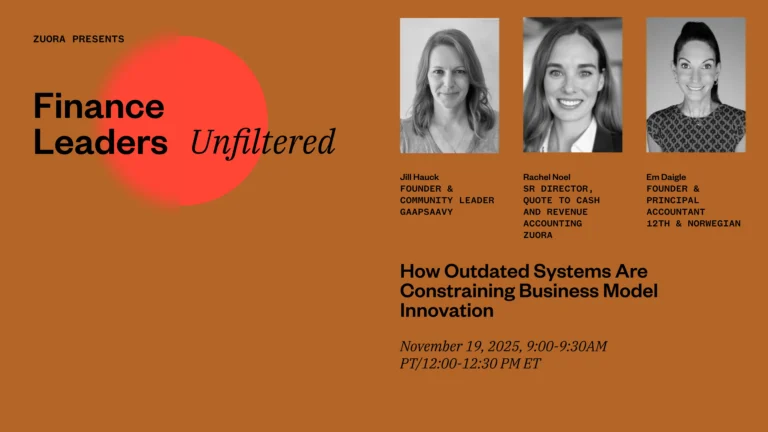
How Outdated Systems Are Constraining Business Model Innovation (Episode 4)
Hear a candid discussion between finance and accounting leaders on how outdated systems can stall business model innovation. You’ll learn why changing go-to-market offerings, pricing complexity, and fragmented data make scaling difficult, and get practical advice for overcoming these challenges to streamline your order-to-cash processes.
5 chapters · 28 min watch -

How Confusion Around Order-to-Cash is Restricting Growth (Episode 2)
Finance and IT leaders often face misalignment that restricts product launches and business agility. In this episode, Em Daigle and Todd MacLennan examine the real impact of breakdowns in the order-to-cash process. You’ll learn how cultural alignment, technology investments, and data quality shape outcomes for finance and go-to-market teams.
7 chapters · 27 min watch -

Finance Leaders Unfiltered
Hear finance experts discuss how technology, evolving roles, and automation are reshaping the finance function. You'll learn about major blockers to strategic work, how teams are overcoming manual processes, and how a modern tech stack can support business growth and efficiency.
8 chapters · 29 min watch
Read along Expand Collapse
… who don’t know me, I’m Em Daigle, founder and chief automation officer of Automates, which is a community of accounting and finance professionals that’s focused on AI and automation solutionss. Um, I’m lucky to be joined today by Angela and Laz. Thank you both for joining me. Um, Angela, do you wanna give a very brief intro, and then, Laz, you can do the same? I know we’re tight on time, so we’ll jump in right after that. Yeah. Um, hi everyone. I’m Angela Liu. I am a fellow founder of accounting community called GapSavy, where we bridge technical accounting to operational reality in tech. Um, so super excited to be here and, uh, talk about this topic. Awesome. Okay. Yeah. Hey, everybody. Laz Gouchourikos. I run the revenue advisory team at Zorra,
uh, which is just a, uh, fancy way of saying I own the, uh, pre-sales technical solutioning for our Zorra Revenue product and the post-sales customer adoption and enablement on the platform. Awesome. Well, both of you, thank you. I think those two intros don’t nearly go as deep as your expertise and everything that precedes you. Um, but given that we have a 30-minute session today, don’t wanna waste any more time, um, and wanna jump right in. So, um, AI and AI investment is the hot topic that everybody’s talking about, um, but it feels like so many teams are still stuck in this same grind, right? Like, in fact, uh, the Zorra,
uh, report that they did showed that 89% of finance leaders say they’re, they already have AI in their tech stack, but 79% of those are still reporting that their teams are buried in manual work. So, feels a bit surprising, um, but I’d love to hear your take on this stat. Um, Angela, would love if you could kick us off, and then, Laz, I’ll kick it off to you after that. Yeah. Sounds good. I, I was surprised at the stats, but I love when we do polling and see where people really are. Um, so thanks for sharing that. Um, when I think about AI and the manual workload, I kind of think of the fact that, you know, that percentage of manual was, has been so high for so many of us,
we almost don’t talk about it out loud. Um, and so, I feel like the progression of whether, you know, maybe we started at, you know, 100 and now we’re at 79, and maybe that’s considered good progress or bad progress, I feel like that is, um, in some ways subjective, because we’ve been doing so much manual work under the cover, um, where we’ve always been talking about wanting to automate, but in reality, we still had a ton of spreadsheets and we were doing a lot of stuff in email. Um, and then I think the other thing I would say here is that AI is changing so fast underneath us that if you were implementing and started the process of purchasing in 2023 when everyone got excited about ChatGPT, you probably turned to purchasing in 2024. And in 2024, I think that was the first year that AI was able to handle
data really well. Um, and the context windows were opening up quite a bit. Um, meaning that the capabilities from, like, a week-by-week basis, definitely month by month, um, and then each year, I would say the large advancements are huge. So, this year has felt like light speed. Honestly, I thought last year was fast, but this year I feel like has been the year where the technology has actually gotten to a space where the accuracy in prompting, um, the accuracy in the, you know, 80% accuracy in return that gets to, like, human in the loop, um, is finally starting to make sense. The data capabilities are insane. Um, that’s all happening in 2025. So, if that’s, if you purchased in 2024, the vendors that you purchased for are probably scrambling to put those into their feature sets today,
or you’re building something individually. In which case, I know we’re gonna talk about this later, but, like, that means that you still have to build. And so, those stats, at first they surprised me, and then as I thought about it more and I was like, “No, that’s, that’s the reality that accountants live in.” We’re not building the LMs, right? Engineering has, and you can see that, you know, none of us thought that AI would make coders obsolete first. (laughs) Um, but those- Totally…. are the folks that are building the LMs, and that’s a skill set. We, on the other hand, as accountants, we’re subject matter expertise, we’re not building the LMs, so we’re just a little bit on the lag of, how do you do our jobs really well? Um, so I don’t think the stats are terrible. I think that they should be inspiring for, like, look how much we can build.
Yeah. No, I think that makes a ton of sense. And I also think that, you know, I, I spend a ton of time talking to CFOs and CAOs, and I think that everyone recognizes the importance of being fluent and functional with AI. And I think that people are, you know, and even finance folks, you know, we’re, we’re really moving into that as well. But I think just by nature, finance and especially accounting folks are just skeptical at just who we are as humans, right? And I think that, uh, uh, because of that, there has always been, or, or there will always be a, a bit of uncomfort in moving and adopting to new technology. Um, unfortunately, because I do think that there is a lot that, uh, new technology can drive for, for folks like us, right? I think about a couple of things here. Um, you know, I, I think that, uh, even automation, right? Zorra, as an
example, has been doing automation of the order to cash process for, you know, 15, you know, 17 years. And even still, we run into customers who just think, you know, “Well, my process won’t fit with that. I’m a bit of a snowflake. I’m unique,” right? “We’re a little bit different. I’m a little bit, uh, nervous about it.” So, I think there is always a bit of that skepticism, but I would also say that, um, you know, I, I think that, and, and we’re definitely gonna get into this too, but I, I think starting off smaller and making smaller, you know, incremental, uh, adoption of AI is going to get people a lot more comfortable, uh, over time. I think that’s a great point. And I also (laughs) wanna double down on the fact that I think traditionally, those of us in finance and accounting always feel a bit more…I’ll- I’m gonna call it risk averse.
Um, but maybe that’s something about feeling a little uncertain with change or doing something a little differently. Like, we all love our spreadsheets, so automation is one jump, so AI feels even bigger than that. And I think from my perspective and the- a number of the conversations I’ve had, is that folks are still, um, at different levels of maturity. So, there are many that are kind of diving in and trying to figure out what AI can do, um, but there are still many that feel far too cautious. Um, or- or really just… (laughs). I make this joke, but I was talking to somebody the other day who literally is still treating ChatGBT as though it’s Google. I’m like, “That’s actually
not how to use it in the best way possible.” (laughs) But I think when it comes down to AI making more of those decisions for finance, um, it becomes a little more difficult. Um, so probably not surprising, but I think, um, all of the- the points are- are super valid. Okay, so, uh, now, thinking about how AI is changing the way that fi- team- finance teams work, would love to dive a little deeper with you both into what that might actually look like in practice. So, specifically, how do each of you think about security or compliance and how that should factor into AI adoption? Um, Angela, I know this is a hot topic
that you and I actually have chatted about recently. Um, so from your perspective, like, how do you think about it in practice? Yeah, I- I think security is one of those things that, um, actually has evolved from a technological standpoint quite a bit. And that being said, I am not a security expert, and I- I don’t think most of us are on the call. Um, and that being said is, I’m not gonna understand all the encryption and all the advancements in it in 2024 and in 2025, which were significant, um, but I do know that we are all trying to stay up to date. Meaning that if your InfoSec said you couldn’t have OpenAI’s ChatGPT last year, and you feel like you’re getting behind on AI
upskilling or you’re trying to use Gemini or you wanna play with Claude, um, I think that those from a constant conversation with your InfoSec and making sure they’re up to date, um, in that openness, I- is super, super important. So, like, I feel like that function will always be there. Then within the tools, I feel like there is also AI upskilling in how you use the tools and what you can put in them and not. So for example, if you bought a ChatGPT Pro subscription, that’s different than what they used to call Teams and now Business. Um, Pro actually means that you actually have to go into a setting and turn off training off of your data. Um, that’s crazy to me, but it’s true, and just one little tiny understanding of knowing that that’s what you have to do after
you sign up and pay for that thing to me is so interesting. Um, it’s also possible within your actual functions to minimize the amount of, um, PII or, like, emails or things that you know you’re not supposed to put in there. So for example, if you wanna play with a whole dataset and build a script or code in Python, you can actually take the headers and create, you know, several lines of dummy data. You can still build a script that works that you can then run locally on your computer and therefore not be sending your data to the LM, um, and instead having, you know, it build something that’s more deterministic, like a script, and then running that in a local safe space. I think those I still put into a bucket of AI upskilling, which is, like, we should all give ourselves some comfort that this is
new to all of us, InfoSec, accounting. It does not matter what job you have. Um, it is our jobs and our responsibility to upskill ourselves to know how to protect against this new technology, and realistically, sometimes we’re gonna be wrong and we’re all moving together. Um, so that’s kind of the framework that I think of in InfoSec, which is keep asking and keep making sure that you’re up to date on how to be safe within these tools. That’s a- Yeah, I think that the keep asking and then the- and the constant conversation with InfoSec is really- is really key, right? Like, we’ve seen… Here- here at Zuora, right, we’ve even seen this evolution of how InfoSec has allowed us to use, uh, you know, AI in general, uh, ChatGPT, Gemini in particular, right? Some of the- some of the tools that we’re specifically using. And, you know,
every couple of weeks, there is another email that’s coming out saying, you know, “Here is a new thing that we can use. Here’s something new that is, you know, being given out to the entire enterprise or is being, uh, you know, tested with a small group of people, and, you know, here are the limitations around that.” And then another couple of weeks later, you know, it’s, “Okay, we’re gonna lift some of those limitations, and we’re also gonna test something new,” right? So there’s- there- it is a very evolving, uh, uh, process within my organization, uh, but it is really exciting because we are seeing, you- you know, over the last 12 months or so, this real, you know, accelerated implementation across all areas of the business, uh, of- of where we’re using it and- and- and the types of data that we’re allowed to- to use with it. Follow on question for each of you on this. Um, you may not have an answer on the spot,
but curious, because I- everything you just said, spot on, right? I have the benefit and feel very, um, lucky that every day I get to spend my days trying to figure all this out and being able to stay on top of it, but then I think of everybody, probably many folks here, um, joining the call as far as everybody’s got a full-time job on top of it, and then everybody’s got something at home, whether it’s pets, kids, uh, parents, everybody’s taking care of somebody else too. So, how do you guys yourselves try and stay on top of that? Like, Gleb, you mentioned that- that, um, email from, uh, the product team, so maybe that’s how you do it. Um, Angela, curious from your perspective too, like, how do you guys try
to stay up with all of those things so that you know, for example, when you do log into ChatGBT, there is, um…… a lever you can use so that it’s not training based on your information. However, you still need to make sure that you’re protecting all of your data, um, and not simply loading data into these open platforms. Yeah. Uh- Yeah. For, for me… Oh, go ahead, Angela. You go first, yeah. Well, uh, I, I’ll kind of answer the, like, how do you, how do you stay on top of it in play? Well, I, I feel like one of them is, like, you can’t. It’s impossible. It is moving way too fast. Even if it was my full-time job, which I, I also have a lot of luxury in being able to play with this, like, it is just moving too fast. Mm-hmm. And so I think de-shaming yourself and staying
like, “Oh, I feel, like, super behind,” I’m gonna tell you that I feel behind all the time. (laughs) Um, and I think that that might help you feel like, “Oh, okay, that’s cool.” Um, what I have seen and what has been successful in me is, um, honestly joining community. So I’m part of different community groups, like, um, the AI Finance Club or Women Defining AI. I also run GapSavy, and we also share within that. And then, of course, there’s Automates, right? There’s all of these spaces. But I think that what I have heard, um, even running… I, I ran this finance transformation group last week, and one of the companies shared that they had, um, taken one of the trainings that we had built, like, a master class that I had done with, um, someone else. And they had taken each demo, and each week, they practiced that one
skill together as a team. And then, on like a Friday, they would, um, see what they had built out of it. But it’s these tiny, small chunks and actually creating the space for it, meaning, like, a 30-minute meeting. Sometimes booking a meeting is the most successful thing you can do. (laughs) Um, creating that space is actually the way to stay accountable. And then I know that we’re, um, not a very long time, but the other thing that that was really interesting that someone shared, um, in that group, was to actually incentivize your teams in, “How much usage have you done this week?” Um, so there were actually metrics within that team of rewarding team members and changing that inst- uh, incentive structure to say, “This is the coolest thing you could be doing right now.” Um, and I think that’s really important, because we all like to do things that we’re really good at,
and I think we’re all incentivized by doing things right, and making it the right thing is probably the best thing you could do with the people that surround you. I like that. Laz, did you hear that? I, I, often, yeah- Yeah. I, I respond to incentives very often, so I, I, I can appreciate that, uh, for, for sure. Uh, you know, at Zuora, you know, I, I guess, you know, b- between, you know, I’ve, I’ve got the benefit of being, you know, at a, at a, at a fairly large, you know, enterprise, where we’ve got a cross-functional team that was built out, that was, you know, that’s kind of leading like the AI initiative. Um, and there’s even a member of my team that’s on that, right? So, number one, I, I also feel that, uh, that, uh, you know, that, that bit of I constantly feel be- behind, but I’ve also got someone I can go to, uh, that works on my team, that I can always say, “Hey, what am I and am I not allowed to do with this?” Again, by the way, because
I’m not really great on details sometimes. But also, he’s also the person that m- me and my team all go to when it, when it comes time for, “How, how do I even do this? How do I begin to think about building an agent? How do I start this process?” Uh, I mean, there are probably more Slack channels than anyone wants to think about within the organization, about, you know, ways of doing it. But again, to your point, it’s building a community within a community at Zuora, and that’s how we’ve chosen to solve it. Um, I’ve personally found it to be really successful. Uh, again, it’s still really new. It’s still really green shoots of, of how we’re using AI across the organization. Uh, but I find it to be really helpful, and, and if there are other organizations that are trying to think about it that way, I would highly suggest the way that we’ve done it, right? Cross-functional team, groups of people throughout lots of different teams,
um, who have, uh, a lot of experience or who are gaining experience and can be that, you know, that, that leader within the organization. I love that, and I also think- I also think- Yeah, go ahead. I just want to add thing, one thing to what Laz said, because I think sometimes, and definitely last year, but this year, hope it’s changing, um, that everybody thought this was like an engineering and a product team, and you probably had some AI group within the company. They were supposed to, like, implement this thing and take this charge. Like, screw that. AI is for everyone. It’s a general-purpose tool. Like, you’re in finance, you’re in accounting, like, make, make the little club yourself. Um, and I think that that’s super important, because they’re not… Everyone is scrambling. You are the best suited to do it within your domain. And I think that’s super, super important. So what, Laz,
you said, it’s just like, start it within your group. No one is going to start it for the accounting department. Yeah. Spot on. I love that, and I love also the idea that you’re making time to test it out, to try it. There’s something to muscle memory, right? Like, if you’re reading about all the updates, it’s probably not going to stick nearly as much as if you’ve got, like, the, uh, Angela, the example you gave, where there’s a team who’s literally making the time during the week to practice. It, it is. It becomes muscle memory, and then it becomes easier, so that as it does change, as it does get better, you’re able to shift with it and be able to be a little more flexible
about the improvements that are being made. I think of it as, it’s a behavior change. And so, in order to do that, it’s not going to be just reading documents or reading updates or, you know, getting a weekly readout on something. I think it, there is something to taking, taking ownership and taking that next step, um, for sure. That’s going to really make it, um, far more beneficial to everybody and help everyone really, um, adopt it more widely within their finance teams. Um- I, I think most people are the type of people who learn by doing, as opposed to learning by just listening to o- other people. So, uh, I mean, I know I am. I know the vast majority of my team is that way as well, right? If I don’t have it up and open and in front of me constantly, I’m gonna forget
about it. So having, having a tab open of ChatGPT throughout the day, right? And using that constantly, just again, to the point of muscle memory, constantly going back there, showing or forcing myself to get into that mindset, you know, getting better with my prompts, getting better with how I’m generating all of that, to, to pull back the information that I want, I think is really key.Spot on. Love it. Um, okay, so I could talk AI all day, however, I wanna put that aside for a moment because the report that ZORA did also showed that of the leaders that were polled, 68% said there were still tech gaps limiting order-to-cash effectiveness. So, you know, I think we’re still looking at… there’s still an automation problem. Um, and so wanted to get
both of your takes from, uh, your perspective on how leaders should really think about and decide where to make their investments, especially as AI is now an investment, um, uh, consideration, right? We also still need to make sure that we’re using automation because that is highly critical and especially within our, our finance organizations and making sure that we have these tools, um, and solutions that are fully auditable and can help you automate, um, everything, and it’s not just up to AI. So Angela, let’s start with you, um, but k- kind of again, why do you think it’s still such a problem that we have tech gaps in this
OTC process, um, and, and that impacts the effectiveness? Yeah. Um, qu- quote-to-cash is complicated, and anyone that is in quote-to-cash is, like, a little bit of a weirdo where you like things that are insanely challenging, where you get to, like, solve the world in tiny little ways. And so that’s just the people that it attracts. It’s weird. Um, that being said, um, sometimes I like to compare, uh, the two sides. So expense, if you think about the accounting literature on expense, there is literally not a book in the accounting firms on expense. But then you look at the revenue guides, for example- (laughs)… and they’re for 500 to 1,000 pages. If you translate that, just the amount of information
and interpretations, and I’m gonna say the word requirements- (laughs)… (laughs) that means that the type of application or the tech that you would build for that type of application is significantly different in, one, the subject matter expertise, two, the amount of decisions that you have to make in configuration code. Then multiply that with all of the weird stuff like rounding, where to, like, store the dataset, how to store the dataset. Like, translating all of that into tech is incredibly difficult. So you ask, like, why are there all these tech gaps in quote-to-cash? And it’s, it’s because it’s significantly, um, it takes significantly more features and functionality. So I do not, um, I, I think many, many have tried to solve this space. Obviously, ZORA has come a very, very
long way in it, but I also think that what we have been doing in quote-to-cash is we have been coding ourselves in Excel. We have been building ourselves as people. We have been creating processes, and so for me, I think about, uh, you mentioned the word ROI, and ROI is such an interesting thing in a space where we have this completely novel new technology that is new for everyone in upskilling. Like, I don’t care if you’re an accountant, if you, like, do house plants, if you’re a hairdresser, right? Like, if you’re in HR, it really does not matter. We are all challenged to learn this new skillset. And so I think about what that means with our subject matter expertise and how difficult
it has been to translate some of that into developer world, coding world, all of those features, functionalities, and requirements. I totally get why it’s hard, and I think we have this space where ROI comes in, you can make two choices, but I really think you have to make both. Um, I don’t think it’s a binary one, is you can try to boil the ocean and automate quote-to-cash all in one thing and hope that AI’s gonna solve, and that might be the case and someone else might build it, or you might take all of those manual processes that you obviously know what, how to do it because you’ve already built it, um, and start there and then invest in actually upskilling your team. The funny thing with ROI is that the landscape of investment of learning and development is significantly different than having an automation tool and saying like, “Oh,
we’ve automated X amount of hours,” um, versus, “We’ve done X amount of training and someone has used ChatGPT or Claude or, you know, X amount of time,” because there’s a lag in the ROI. But I do think that if companies do not invest in upskilling their teams, they will miss out on the best automations or they will invest in all sorts of weird stuff (laughs) that will get very, very expensive in tokens, right (laughs) A token is how much you input, and you have to know something about how you build so that you are efficient in that usage. Um, so I would say invest in both. The upskilling is not gonna feel great, but it will have a much bigger return, and I think that we’re just starting to see that measured. But don’t expect it to be the turnaround that you have in, you know, “We implemented this ERP,”
or, “We implemented this automation.” It’s a different type of animal. It’s still absolutely worth doing. Yeah, I, I think you, you, you brought up something really interesting, right, in, in, in the investment in the team, and I think one of the, one of the hidden costs that’s often overlooked, or the hidden risks maybe, it’s often overlooked in the business, is, like, the mental health and the frustration of the resources that are… of, of people who just are not happy in their job, are not getting the fulfillment out of their job. And oftentimes that is a result of having a job that is really difficult. Like you said, it’s a weird job, it’s Excel based, it’s really, you know, data’s in disparate places, it’s all not formatted correctly, right? It’s, uh, just a pain to, to run through the process, and I think that the people who are stuck owning that job and owning that process can get really frustrated really quick. And I
think that the cost of losing good resources and the cost of hiring and ramping someone new is often really, really hidden, and I think that’s a real risk to the business. So when you talk about where should, uh, organizations invest, you know, Angela, I think you’re spot on, right? I think they should be investing in upskilling that team and giving the resources on those very important-… processes within an organization, the skills and tools that they need in order to feel successful and feel like they’re making a difference at work. Because without that, it’s gonna be a real challenge to retain people. Love it. And upskilling, there’s really no downside, so there’s only- Only… … return on investment, that, like it truly is a positive return on that every time,
so there is no downside and I think it, yeah, I, I agree, it can have the biggest impact all around. Um, okay, I know we’re running out of time. I could sit here with you guys all day long, um, especially even longer if I had a glass of wine in hand, but I don’t. So, um, we’ve talked AI, we’ve talked automation, um, both from investment perspective, but if a team has already made some AI investments, um, but their team is still overwhelmed, what’s the one thing that they can or should do? Um, Laz, we’ll start with you and then Angela we’ll close out with yours. Yeah. Uh, I referenced this before but I say this constantly to people that I talk about,
it’s start small. Like there is no project that is too small to really work out. Even if it’s not gonna get you that much in the way of efficiency, it at the very least gives you e- somewhere that you can feel accomplished about something and you can feel like, “I did it. I built it. I can now go onto the next one, and the next one, and the next one.” Right? I was talking to a, uh, a CAO, uh, just last week whose team built an agent that they can just drop an email in and the agent will suggest a journal entry that will solve the business problem that they’re talking about. Uh, they tried it, it failed. They tried it again, it failed, and they kept trying it and it got better and better, and I thought that was really cool and it was really interesting. And again, it’s not something that I would’ve thought about and, I mean, a journal entry’s
a journal entry, right? We’ve made billions of them in our time, right? But, at the end of the day, if you can train an agent to receive an email, read through it, understand what’s going on and create a journal entry, it’s really cool. And the person who did that has now created an agent and they understand what that’s doing and they can then go onto the next one. So again, eh, eh, y- I’ve said it a million times, I’m sure everyone on this call has said it, there’s no job that’s, there’s no process that’s too small to just, just start it and try it. Love it. Um- Angela. Mm-hmm. I, I love that 100%. Um, to add to that, I feel like in your small, small wins and goals, um, you know, build that, build that encouragement with your team to try some different tools. And I know this is a little
bit capped by Infosec, um, but I actually really love maybe do a month on ChatGPT, then do Claude Anthropic, play on NotebookLM, um, and keep trying them because that use case that Laz just said, which is like turn an email into a journal entry, in 2023 and even in 2024, it sucked at it. (laughs). It was not great. And sometimes it would do, you know, things that, you know, you, you were like, “Oh.” And then, and for a moment you were like, “Cool, I’m still smarter than it.” Yeah (laughs). But (laughs) that felt good, but like in 2025 it’s like, “Oh my gosh, this is actually better than me.” Mm-hmm. Um, choose something that you’re really good at so you can immediately verify it, um, and then once you’re there, like start expanding to learning new things. But I love the
idea of different tools, a continuous try, um, and, and yes, that totally small thing, time is time. Five minutes is five minutes. Two minutes is two minutes. If it immediately gets commoditized because OpenAI comes out with a source reference that you worked on for three weeks, which is what I did, so what? Like you still learned something and, and that is actually the bigger goal of how you think through this and how you upskill your own mind, because you’ve got lots of stuff in your head and there are lots of things to fix, and you probably have the best chance at fixing it because you’ve been in that seat. Yeah. I like-… the concept of starting off with something that you’re an expert at, right? If, if you’ve got a challenge of, I, I, I’ve got a ton of messy data, right? And who on this call doesn’t have messy data, right? But you’ve got a ton of messy data and every month you
need to do something with it in order to get to, you know, closing out for the month, as an example. Start off with a month that you’ve already cleaned up that data, right? Start with that raw file and, and with the file that you ended up with, and start building some prompts to see if you can get AI to recreate what you did and you know it’d be correct, and see how close you can get it. Again, it’s, Angela, to your point, it’s, yeah, I’m still smarter than AI and that’s great until AI can make your life a whole lot better by doing that for you and maybe it helps you go on to do something else that you wanna do at work, or maybe it helps you just close your laptop and go play with your kids. You know what I mean? Like there’s so many other things that you can do, uh, as opposed to cleaning up bad, messy data I’m gonna take that and start a hashtag StaySmart, um, on your behalf, Laz, so thank you for
that. Um, okay. That’s all the time we have. Angela, Laz, thank you so much for joining me and thank you to everybody who’s tuned in. I do have a couple of asks for you all. Um, first, please take a moment to fill out just a brief survey. We just wanna make sure we’re always improving and making these as valuable as possible for you all. Um, I also want you to, to, or want to enj- invite you to join the next Finance Leaders Unfiltered session on November 19th. And then finally, I’d love to invite anyone who is not already part of the communities, GapSavvy, um, Automate, any of the others that have been mentioned here today, always, um, a great opportunity to connect with others and, um, learn and collaborate. So, we have some
great conversations that are in parallel to one another, so please join everyone for all of the latest resources and content. All right, phew, that was a lot. Thank you so much everyone, and we will see you next time