How outdated systems limit business model innovation
Hear a candid discussion between finance and accounting leaders on how outdated systems can stall business model innovation. You’ll learn why changing go-to-market offerings, pricing complexity, and fragmented data make scaling difficult, and get practical advice for overcoming these challenges to streamline your order-to-cash processes.

Know these key finance terms
5 termsA process covering everything from generating a quote for a customer to collecting payment and revenue recognition, often impacted by system fragmentation.
Read MoreThe end-to-end lifecycle of customer orders through cash collection, discussed as an area exposed by system gaps and business change.
Read MoreA pricing model where customers are billed based on how much of a service or product they use, adding complexity to finance operations.
Standalone selling price, a revenue accounting term relevant for handling pricing models and compliance.
Generally Accepted Accounting Principles in the United States, referenced in relation to revenue recognition and compliance.
Speakers
Pressed for time? Here's what happened
-
01
Fast-growing businesses struggle to scale finance operations as new business models and go-to-market changes introduce more complexity and fragmentation.
-
02
Lack of alignment and siloed processes between sales, finance, and product teams make data handoff and decision-making slower and less effective.
-
03
Increasing pricing complexity poses major challenges for finance operations, requiring synchronization and greater system flexibility to handle evolving models.
-
04
Expanding into new markets or shifting to models like usage-based pricing exposes critical gaps in order-to-cash processes, making end-to-end integration crucial.
By the numbers
- 97%
- 82%
What to do next
It's bringing back a little bit of our childlike abilities and just playing with these different tools.
-
Educate your finance team
Encourage finance leaders to experiment with new tools and processes before committing to full procurement. Trying out available demos can spark valuable ideas for improvement.
-
Get finance involved early
Make sure finance has a seat at the table when considering new business models or pricing. Early involvement gives teams time to prepare, select tools, and respond to change effectively.
-
Focus on integration
Work towards integrating core systems to streamline the flow of data, reduce manual effort, and align teams from sales through revenue accounting.
-
Standardize where possible
Identify recurring complexities or nonstandard transactions, and look for ways to create repeatable, automatable processes—while accepting that some exceptions will always require manual handling.
-
Question legacy processes
Instead of automating every manual step, examine why processes exist and whether steps can be eliminated. Upstream education and small process changes can sometimes solve issues better than new systems.
Want to fix gaps in your order-to-cash process and support new business models? Talk to Zuora's team to get started.
Start the conversationWhat to explore next
-

How Confusion Around Order-to-Cash is Restricting Growth (Episode 2)
Finance and IT leaders often face misalignment that restricts product launches and business agility. In this episode, Em Daigle and Todd MacLennan examine the real impact of breakdowns in the order-to-cash process. You’ll learn how cultural alignment, technology investments, and data quality shape outcomes for finance and go-to-market teams.
7 chapters · 27 min watch -
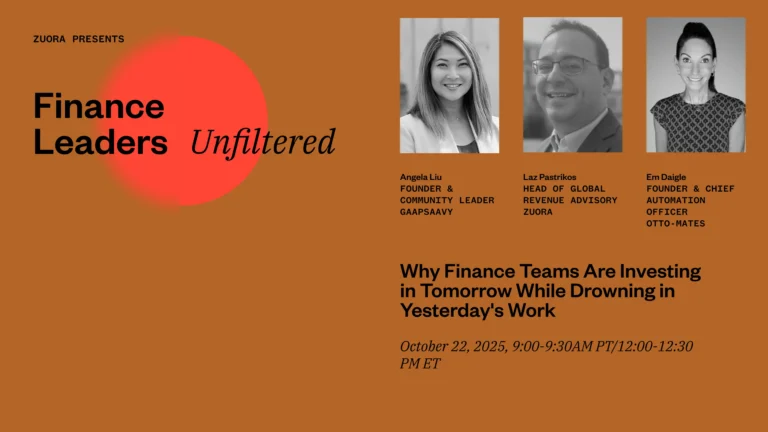
Why Finance Teams Are Investing in Tomorrow While Drowning in Yesterday’s Work (Episode 3)
Leaders in finance, automation, and revenue advisory discuss why so many finance teams are still struggling with manual work—even as AI investments grow. Hear their perspectives on technology adoption, upskilling, automation gaps, and practical steps to move forward.
8 chapters · 31 min watch -

Finance Leaders Unfiltered
Hear finance experts discuss how technology, evolving roles, and automation are reshaping the finance function. You'll learn about major blockers to strategic work, how teams are overcoming manual processes, and how a modern tech stack can support business growth and efficiency.
8 chapters · 29 min watch
Read along Expand Collapse
All right. We’ll go ahead and get started. I’m excited to kind of see where these polls land us. Um, but as Sabrina had mentioned, we’re here to talk through our final installment with our Finance Leaders Unfiltered series. Um, and today is all about how outdated systems are constraining business model innovation. But, um, to start off with a few introductions. Um, for those who don’t know me, my name is Em Daigle. I’m the founder and chief automation Officer at Automates. We are a community of accounting and finance professionals, and we focus strictly on collaboration and learnings from one another, uh, about AI and automation. So,
um, would love to have you join us if you haven’t already. Um, two such members who I’m super excited to have here with me today are, uh, Jill and Rachel. And so I’ll let them introduce themselves as well. Uh, Rachel, do you want to go first? Sure. Hi everyone. I’m Rachel and I lead the quote to cash and revenue accounting functions at Zuora. Um, I’ve been there about nine and a half years. Been through a few different implementations, um, and definitely excited to speak more about quote to cash and how, um, systems are holding us back from realizing our efficiencies. Awesome. And Jill?
Hello everybody. My name’s Jill Houck and I am the founder and owner of 12th& the Region. It’s a consulting company focused on finance and accounting professionals, helping them grow their people, their processes and their systems. And I’m very excited to be here today to talk about my favorite topics. Yay. Awesome. Um, and selfishly I’m very excited too because I’ve had the opportunity to work with both of these ladies as well, um, in the past. So, um, in preparation for this, super excited because I think between the three of us, we have lots of insights either firsthand or, um, with our own teams or who we’ve kind of helped along the way w-, be it clients, customers, th- that sort of thing. So super excited. But, um,
maybe before we jump in and really look at more of the survey results, probably good to start with some context. Um, so like when we think about business models, go-to-market offerings and the way it’s shifting so much in the world we’re in today, especially now with AI, you know, innovation is really coming to a forefront. Um, curious to hear from each of you why you think so many fast-growing companies today are really struggling to scale their finance operations as their business models evolve. Um, Rachel, I’ll kick this one over to you first and then Jill would love to hear, um, anything on top of that.
Sure. I think to start, um, sometimes what can happen is you can have different teams kind of working siloed in their different processes and so it makes the passing of data between the teams or between tools that aren’t integrated, um, a little bit more time-consuming. And so I think that that can make, um, make it so that if you have new models added to the mix, um, just makes those processes even more fragmented and m-, um, that data passing even more slow across the teams. Um, and so I think that that brings the need for really having systems integrated and teams really working together in lockstep and thinking about the end-to-end.
Couldn’t agree more. Jill, what about you? Anything to add to that? Yeah, I, I absolutely agree with what Rachel said. I think on top of that, um, there’s a lot of misunderstanding about let’s just say how the sausage is made on, you know, revenue teams. And so a lot of systems are built with customizations or, um, certain requirements that may not actually support a new business model. Um, and so there’s some time required to set up that system or investigate how they can handle it. Um, but a lot of times we have some of these go-to-market motions, you know, new pricing packaging gets rolled out before accounting is sometimes able to get their hands around what they need to do in
the systems to, like Rachel said, um, capture that data in, you know, a streamlined workflow. Yeah, I think when I talk with different folks too, it’s sort of like, especially with AI and all of the different things that are now coming to fruition, I think product teams are innovating so quickly that then the sales teams are trying to sell things very quickly and keep up. And I know that the marketing teams are excited to share what, what they have. Um, but curious from your standpoints too, if you ever see like this breakdown in like, Rachel probably especially from you, I know like there’s so many things happening so quickly. How do you reconcile like what’s actually
going to market and being sold and then being able to make sure that your finance team knows about it versus like also what your sales teams know they can do or can’t do? That sort of thing, which I know is obviously a huge pain point for not just you or, you know, um, you Jill, but like all of us here. But curious like is that something that like even with the best system, I think there’s something also there to like that cultural like shift in making sure that we’ve got some alignment there. Yeah, I’ll jump in there Rachel, just real quick. I think you’re absolutely spot on. Um, I think it’s cultural and I think a lot of it’s just…Um, leadership a lot of times can enforce communication styles
or certain processes, and I think it’s really important to have that from the top down to show that the executive team is all aligned. And so that allows the underlying teams to also be very aligned with each other and work together more consistently, um, so that you can suss out what’s, what’s real and what’s not, right? (laughs) Yeah, exactly, exactly. All right, so, um, I know pricing complexity comes into the mix here. So yes, there’s a lot of different go-to-market changes going on, whether it’s bundling or new ways to offer, whether it’s maybe going from subscription to some sort of usage, like lots of different things. But I think the pricing complexity is an interesting one. Um, and according to the survey,
97% of SaaS finance leaders said that their systems couldn’t support the pricing complexity. So, while I think the challenge may seem similar to the former one I was just asking about, about, like, evolving business models, but I’d be curious to see, um, how, if you think that the pricing complexity is different, if it’s the same. But Jill, why do you think that number is so high from the survey? And, like, uh, maybe it’s same reasons, similar reasons, totally different reasons. How do you see that? Yeah, I would say two things come to mind. One is, I think, you know, pricing and going to market with that pricing is one thing, but then accounting
for it and forecasting on that is completely different. And so again, it’s, you know, how do you get that pricing model to a finance team that they can actually forecast it in a way that’s still aligned with how your business is operating, right? You’re not gonna just completely flip the script and say, “Well, now we’re no longer gonna have business that’s subscription, and now it’s all usage.” (laughs) So there’s gotta be, there’s gotta be a transition period. And so the finance team needs to be able to model that, um, and integrate that into their models. And then on the revenue side, and Rachel can probably speak much more in depth to this, but there’s a, a number of things that pricing impacts, whether it’s SSP or your variable consideration. There’s a lot
of other considerations that have to go into the revenue accounting for that pricing model that not only makes the system complex, but makes leaders, you know, a little bit weary, because they need to make all of those things happen in finance and revenue in order to support the pricing model. I think that’s spot on. And another thing I’ll just say is that I think that leads to the importance of really bringing your finance teams in early so that they can, um, understand what these models are and un- be able to communicate what these different impacts could be. Um, now, we might still go to market with these different pricing models, but at least you’re going in eyes wide
open with what’s going to happen and you know the impacts that’ll be happening on all the systems so that you, so that leadership can really make informed decisions and really understand what’s gonna happen to, you know, the speed of the close, um, whether we’re gonna be able to take the revenue in these different pricing models, um, and how the bigger picture is all gonna unfold, um, if we do, um, different pricing models. Yeah, and I think it’s interesting. One thing that’s come up in a few conversations I’ve had recently is about either who owns the order-to-cash process or are the owners, if it’s more than one, in lockstep to understand the true end-to-end needs. Because to your
point, Rachel, like, if you don’t understand from a upstream process what the back office needs or from the back office not understanding maybe some of the challenges or, um, goals and, and everything that the upstream team is doing on the front end, um, it’s really hard to make sure you’re capturing all of the data in the right way, in the right system, that’s going to talk to each other, um, so that everybody’s informed along the way. Um, and Jill, one thing, I know you and I have talked about this before, but, um, I’m going to ask you maybe a little bit about what you mean, because I like the idea of it, but around, like, what, you br- always bring up, like, is everybody
talking about the same thing? Meaning, like, it often comes down to definitions. Um, and I think it would be great if everybody on the call here could hear a little bit about your take on that, because I, I think it’s a really important, um, point to make, that we may be talking about the same data, but the same data may not mean the same thing to everybody. So, like, from that perspective, what have you meant when you’ve talked about that and, like, making sure everybody’s working off the same definition? Absolutely. Um, the top three are bookings, billing, and revenue. (laughs) Everybody uses those terms, maybe not in the same way. (laughs) And they, they all can represent a similar number,
right? Like, if, if we just take one contract, the booking may be $100 and the revenue may ultimately be $100 and the billing may ultimately be $100, but those might occur at different times. And so, you know, I think a lot of go-to-market teams that I work with, whether it’s deal desk sales, um, customer success, they talk a lot about, “Well, we’ve been paid,” or, “We billed them,” or, “We invoiced them.” And that a lot of times, in, in their minds, means we recognize the revenue, and that’s not necessarily how it works, (laughs) um, as we can all attest to. Um, and so I think being able to define what those mean at different…… stages in that data flow, right? A- again, it’s all
the same data from the same contract, but there’s different points at which people are talking about that data. And so, if you talk about that contract as revenue overall, versus bookings, billing and revenue, you may be skewed in decisions you’re making, either as a leader or maybe just an operator. If somebody tells you, “Oh, yeah, that customer pays $100,” well, maybe that’s material and we care about them, but maybe that’s actually not their revenue, maybe that’s just their bookings amount, that’s what they’ve contracted for and we haven’t actually delivered on it or we haven’t billed them for it yet. (laughs) So that’s kind of my talk track around those definitions. (laughs) Yeah, I agree. Rachel, I think… So, eh, also for those listening, I actually was at Zuora for a little over six
years, so I’ve been in the thick of it there, um, and I think there’s actually something that is really interesting about Zuora in the sense that I do believe that those teams, the sales team all the way through revenue operations, all the way through, I’ll call it rev rec, right? Like, accounting backend, does a really nice job of kind of all coming together and understanding that full end-to-end, um, I’ll say value, when you have it. Um, I’ve worked some places where that’s definitely not the case, and it is like banging your head against the wall sometimes. Um, whereas it was really refreshing for me to see, at Zuora, the sales team so tightly, um, engaged with,
uh, the, the end, w- back end team, I’ll say, or the accounting team. Um, curious from your perspective, Rachel, h- maybe taking it from, like, where you may have worked before, what you see now at Zuora, and also having been through a few of the implementations. I know, like, Zuora on Zuora has taken on its own journey, but curious what you’ve seen and the benefits of having now, like, that end-to-end system where you do have the data all in one spot and you do see the teams working together kind of, like, all in the same vein, and, you know, w- maybe the benefits that you’ve seen there at Zuora from it? Yeah. So I think that there’s a few angles on that question. Um,
the first one I will say, um, I think it comes from the top. Um, when Todd started, I remember he told me, like, “Hey, Rachel, um, if sales isn’t selling anything, you don’t have anything to count on the finance side.” And so, you know, you need to be working with sales and, you know, obviously we need to make sure that we’re protecting the revenue, we’re doing everything in cl- compliance with US GAAP, um, but we really view it more as a partnership to get to the same goal of getting the deals signed for the company and really helping the business. Um, as far as how things have changed, um, since I’ve been at Zuora, I do feel like, um, you know, four or five years ago, we were in a spot where we did have some fragmented systems,
where, um, they weren’t talking to each other. Our billing tool and our revenue tool weren’t, um, w- like, weren’t in a place where they were fully integrated. And so, that did lead to some friction because, um, every n- new deal structure that sales would come up with, we had to deal with in the systems, and then the close kept getting longer, um, and then FP&A needed the numbers. And so, it just became this, um, vicious cycle of, um, finance kind of getting in, potentially getting in the way of business. Um, now that we’re on systems where everything’s fully integrated from CPQ all the way down to revenue, um, and we have managed to support
most of the deal structures that sales needs to do in the course of business, um, I feel like that partnership has become stronger, um, and our teams are, you know, more able to collaborate with them on a regular basis. So it’s been night and day, um, as we’ve transformed our quote to cash process. Yeah. I love that. I think it’s such a, like, I say success story, ’cause you always wanna make sure that if somebody is offering some sort of finance tool, that they’re actually using it themselves, but I’ve seen that transformation. I think it’s pretty darn special over there. Um, so, uh, let’s kinda move on a little bit to thinking about, um, making some moves, like whether it’s switching to a new usage model or maybe it’s
moving upstream or, um, upmarket, sorry, excuse me, or some sort of, like, M&A activity, um, when we looked at the report, it showed that 82% of finance leaders say that expanding into new markets or new models has exposed, uh, some pretty major gaps in their order to cash process. Um, so Rachel, I know you just kinda talked on, like, w- what some things were that m- maybe used to be a pain point for Zuora that- that’s been improved, but how do you see things like… and maybe you’re feeling it or maybe you’re hearing even the sales team talk about it, but how do you see things like usage-based pricing or M&A and moving upmarket really start to complicate the finance operations?
So I think, first of all, um, I’ll take going upmarket as an example. Um, as you get e- more and more enterprise deals, you’re, you’re never gonna have everything be standard at the end of the day. So what we’ve really done is focused on the non-standards that continually come up and try to make sure that we prioritize figuring out how those are gonna work in the system from CPQ all the way through revenue. And then, um, just knowing in the back of our minds that we are gonna have certain edge cases and then, um, thinking through how we’re gonna, um, handle those in the best way we can. So…Yeah. Jill, anything to add there?
I mean, I think Rachel hit it, (laughs) right nail on the head. Um, but, you know, the, the thing that I see a lot of times is, um, not, like Rachel was saying, like not expecting that you’re gonna be able to automate 100% of this new maybe, like, the M&A activity or going upmarket, like you said. Um, you might not be able to automate that 100% out of the box. And so it’s like, how can you bucket those to find some standardization to enable the sales team to sell something that can maybe be automated? And then if it isn’t, um, just knowing that you’re gonna have additional processes for that to capture it as part of your month-end close and not
getting caught up in, “I have to fix it right now and, and have everything perfect,” because that’s just not realistic. Yeah. And so to that point actually, um, curious how each of you may approach the idea of being or accepting a certain level of nonstandard transactions, right? Like, I think we’re all in a world now where we know if you wait for something to be 100% automated, it’s, well, one, probably far too rigid, and you’re gonna run th- you’re always gonna run into the exceptions. Um, but when you think about either Jill helping your clients or Rachel dealing with some of those nonstandard, um, transactions coming through and trying to solve for them, like, how do you think about
where that either breaking point is where you’re like, “Okay, this is happening maybe far too often, and so now there, we do wanna put something in place,” or, and Jill, this might be more to your point, um, where you’re helping your clients either establish a set of, like, what is standard. Like, how do you look for those pockets to say, like, “This is a good either use case or, um, a, a place where automation would really help,” versus, like, the onesie-twosies? Like, how do you approach that? Rachel, maybe we’ll start with you from your team. Like, how do you think of, like, when is that breaking point where, like, “We’re handling a few too many of these, and we see them popping up”? Like, how do you guys approach that and start to, like, think about when automation
is sort of, like, the next best thing that you need to think about? I think it, it’s kind of twofold. It’s, one, the number of times it’s happening, but then two, how much effort is the team putting into it every time, um, the item happens? If it’s something that’s fairly simple and, um, the lift to automate it would be a ton, we might leave it that way a little bit longer. Um, but if it’s something where maybe it’s happening a few times a quarter, but the team’s having to recalculate revenue on the backend or something like that, then we would prioritize it further and explore with IT what the lift would be and, uh, try to get that fully automated all the way across.
Um, I would also say that we do expect, um, at least once a quarter for some of the very, very large deals, that there will be something that, um, we’ll have to account for differently or write a large memo for. Um, and those would be items that are just so special that we wouldn’t even, um, consider it a change in process. And those would be the ones that we will try to figure out if there’s ways that we can, uh, create a waterfall in the system or something like that to help us, um, monitor it. Um, but we wouldn’t try to necessarily make that part of our process, so. And hopefully those big deals are so big that you want them
and you don’t necessarily mind (laughs) handling them in, in a manual way. Exactly. (laughs) Yeah. Um, Jill, from your perspective, I know you’re a little bit different in, like, the way that you help your clients, but how do you help guide them in thinking about it? ‘Cause I know this is something that I get a question a lot about, and I think it’s important to, like, help everyone else kind of set a frame of mind or some sort of reference around, like, where the levels of like, “Okay, we’re gonna handle this manually,” versus maybe not is, um, when you step into a business to help them try and figure out what’s standard and what’s not. Yeah, I try, try to take, um, a little bit more of, like, a sales ops approach, I would say. Um, just because it’s
a lot of times trying to help, like you said, people figure out what is standard and what is nonstandard. So, a lot of times I’ll start more from a data perspective, like sales ops data saying, like, “Is this, um, something we’re seeing across certain industries? Is this something that we’re seeing across certain sales reps,” right? Is there, like, an education that needs to happen to get out of that nonstandard world, right? It, like, a lot of times it is as simple as that, right? It’s helping m- you know, build that bridge between revenue accounting and the go-to-market team of, “Oh, okay, like, this is the struggle you’re having. What if we frame the deal a little bit more this way, and then it can fit into our automated system,” right? So again, it’s just approaching it more from a data perspective and figuring out, is there something
upstream that’s actually causing this recurrence to happen, and can we modify it? And if not, then, then looking into and talking to my clients about, “Okay, you can either hire somebody, or we can look into a system that might be able to automate some of this.” And historically, it’s been more, “Let’s just hire somebody,” but now nowadays- (laughs)… people are very interested in tools. (laughs) Yeah, exactly, which is a good place to be. And I think you just brought up something too that’s really important is, especially as folks are thinking about…… automating, whether it’s, um, putting in a system, looking at their processes. There is something to that educational aspect too, to like understanding why the process is the way it is, and it doesn’t necessarily
need to be that way. So the answer isn’t always, to your point, Jill, it isn’t always implement a new system, maybe there’s just like little tweaks. Or, if you are implementing a new system, um, a lot of times what I’ve seen too is if you’re just going to automate what you did manually before, there’s n- th- yes, there’s the benefit of having some time savings, but typically, that manual process looks a certain way be- (audio cuts out) I’m so sorry. Everything’s dying. Can you guys hear me okay? (laughs) Okay, perfect. My AirPods just died. So sorry for everyone listening. I just wanted to make sure you could still hear me. Um, but I think there’s something to be said for really looking and understanding what that process is and why those steps were there, because a lot of times you don’t just have to go through all
one through 10 steps and automate all 10 steps. Maybe you only need to automate four of them, and then the other six no longer apply. So, I think there’s something to making sure you’re educated on your process, why it is that way, what’s causing it. Are there things you can do upstream to help prevent some of those things that are needed downstream, um, even if it is educating also the, the sales team on why something can or cannot be contracted. Um, okay, great. So I know we’re down to just the last few minutes here. Some quick final thoughts, um, from each of you. Um, so if we accept that, like, outdated systems are really impeding the ability for supporting business growth,
what do you think some of the most impactful ways are that finance leaders can really help to modernize the order-to-cash process? Um, Jill, do you want to start? And then Rachel, we can finish up with you. Sure. I believe that this comes down to finance leaders educating themselves and playing around with tools that are out there. I think it’s so easy in finance and accounting to get caught up in the standards and the guidance and, and doing the actual accounting that w- we don’t spend a lot of time playing around in systems. And I think it’s bringing back a little bit of our childlike abilities and just playing with these different tools that there’s a free, you know, demo or free way you can play with a tool that you think might
work, play with it before you start the whole deep dive of buying and procurement and all of that. Yeah. I like that. Rachel, how about you? Totally agree with that, and I think, um, where I’m gonna go back to is, I think stressing the importance of really h- giving finance that seat at the table, and stressing, uh, the value of having finance, um, involved upfront. Because then you do have time to react. You have time to figure out what systems you potentially need, what, um, you need the tools to be able to do, and all of that kind of thing, so that you’re, um, ready as new models come, and, uh, you have to make sure that you’re able to handle them in your systems.
Spot on. Um, awesome. Well, listen, um, ladies, thank you so much for joining me. Um, for everyone joining us today, thank you. Um, would love to ask you to take a minute to fill out a very short survey so that we can make sure that all of these are really valuable to you. Um, we’ll be getting some information out to you, and there are other opportunities to learn more with, uh, the finance repor- uh, modern finance report. Um, and then Rachel’s got a great on-demand, um, series as well, Back to Real Accounting, um, and then, uh, shameless plug, please join Automate if you haven’t, and we can keep the discussion going. So, um, Rachel and Jill, thank you so much for joining me, and, uh, thanks
for everyone listening in, and, um, look forward to the next one. Thanks.