Frequently Asked Questions
Recurring Revenue & Subscriber Insights
How much revenue do existing subscribers generate for subscription businesses?
According to Zuora's Subscribed Institute analysis of over 891 companies, existing subscribers generate on average 76% of a company's annual recurring revenue (ARR), with the range typically between 70% and 81%. This highlights the importance of focusing on customer retention and expansion in subscription business models. [Source]
How does company maturity affect the share of revenue from existing subscribers?
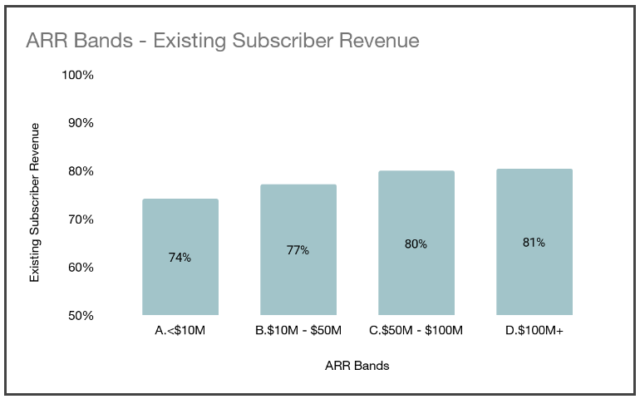
More mature subscription businesses have a higher share of revenue generated by existing subscribers. Companies with less than M ARR see 74-77% of revenue from existing subscribers, while those with over 0M ARR see 80-81%. As businesses grow, more future revenue comes from their established customer base. [Source]
How does the share of revenue from existing subscribers differ between B2B and B2C companies?
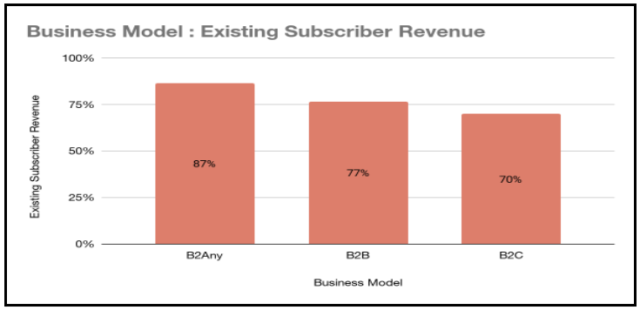
B2C companies tend to have a lower share of revenue from existing subscribers (70%) due to higher churn and more new subscriber acquisitions. B2B companies see about 77%, while companies serving both (B2Any) see as much as 87% of revenue from existing subscribers. [Source]
How does industry sector impact the percentage of revenue from existing subscribers?
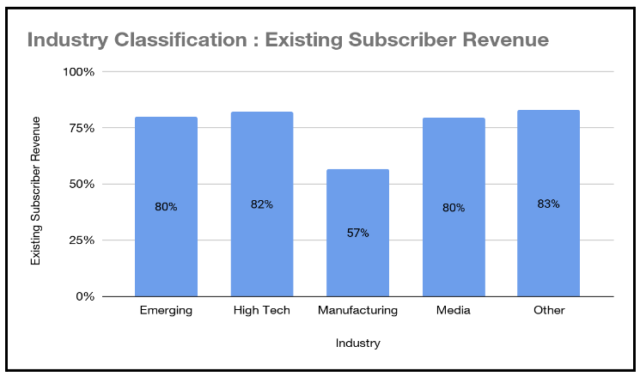
In most sectors (Emerging, High Tech, Media, Other), existing subscribers generate 80-83% of ARR. In Manufacturing, the figure is lower at 57%, likely because many manufacturers are early in their subscription journey and rely more on new acquisitions. [Source]
Why is focusing on existing subscribers important for subscription businesses?
With 70-80% of revenue coming from existing subscribers, focusing on sustaining and expanding these relationships is critical. Retention and upsell/cross-sell strategies require less investment than acquiring new customers and drive long-term profitability. [Source]
What is the impact of a 5% improvement in customer retention?
Research from Bain & Co shows that a 5% improvement in customer retention can lead to a 25% increase in deep profit, underscoring the value of investing in subscriber relationships. [Source]
What are the three core levers for monetization in subscription businesses?
The three core levers are subscriber acquisition, retention, and expansion (growing customer value through upsell and cross-sell). Balancing these is key to sustainable growth. [Source]
How does the Subscription Economy® differ from traditional business models?
In the Subscription Economy®, revenue is realized over time and depends on ongoing customer satisfaction, retention, and expansion, rather than one-time transactions. This model requires a focus on customer-centricity and long-term relationships. [Source]
What is the Subscribed Institute?
The Subscribed Institute is Zuora’s think tank, providing research, content, events, and advisory services to help businesses succeed with recurring revenue models. [Source]
Which industry sectors are included in Zuora’s recurring revenue benchmarks?
Zuora’s benchmarks include High Tech (SaaS), Media, Manufacturing, Emerging (Retail, Financial Services, Healthcare, Real Estate), and Other (e.g., video conferencing, digital infrastructure, consulting, etc.). [Source]
What is the Journey to Usership™?
The Journey to Usership™ is a framework developed by Zuora’s Subscribed Institute to help companies at different maturity stages (launching, optimizing, scaling, leading) succeed in the Subscription Economy® by focusing on customer-centric strategies. [Source]
Why do manufacturers have a lower share of revenue from existing subscribers?
Manufacturers typically have a lower share (57%) of revenue from existing subscribers because many are in the early stages of their subscription initiatives and rely more on new customer acquisitions for growth. [Source]
How should subscription companies balance acquisition and retention efforts?
As companies mature, they should shift from focusing primarily on new subscriber acquisition to balancing efforts with retention and expansion, as these drive the majority of recurring revenue and profitability. [Source]
What are the main challenges for companies transitioning to a subscription model?
Companies often face challenges such as shifting focus from one-time sales to ongoing customer relationships, developing retention and expansion strategies, and aligning internal teams around recurring revenue goals. [Source]
How does customer centricity impact recurring revenue growth?
Customer centricity is essential for recurring revenue growth, as satisfied subscribers are more likely to renew, expand, and refer others, directly impacting ARR and long-term business success. [Source]
What is the difference between recurring revenue and traditional revenue models?
Recurring revenue is realized over time through ongoing subscriptions, while traditional models rely on one-time transactions. This makes retention and customer satisfaction more critical in subscription businesses. [Source]
What are the key takeaways for companies in the Subscription Economy®?
Key takeaways include: existing subscribers drive 70-80% of revenue, mature companies rely more on retention, and balancing acquisition with retention/expansion is essential for sustainable growth. [Source]
What is the role of upsell and cross-sell in subscription revenue growth?
Upsell and cross-sell strategies are vital for expanding customer value and driving revenue growth, often requiring less effort and investment than acquiring new customers. [Source]
How does Zuora support companies in their subscription journey?
Zuora provides research, benchmarks, and strategic guidance through the Subscribed Institute, as well as a comprehensive platform for managing the entire subscription lifecycle. [Source]
What is Zuora and what does it do?
Zuora is a leading SaaS company offering a comprehensive subscription management platform that automates and orchestrates the quote-to-cash and revenue recognition process for businesses in the Subscription Economy®. [Source]
What products and services does Zuora offer?
Zuora offers products such as Zuora Billing, Zuora Revenue, Zuora Payments, Zuora CPQ, Zephr, Zuora Platform, Zuora Collections, and Accounts Receivable automation, supporting the entire subscription lifecycle. [Source]
What are the key capabilities and benefits of Zuora's platform?
Zuora's platform supports over 50 pricing models, automates billing and revenue recognition, integrates with the tech stack, provides real-time analytics, and ensures compliance with global standards. It enables rapid scaling, operational efficiency, and improved customer retention. [Source]
What integrations does Zuora support?
Zuora offers over 60 pre-built connectors (e.g., Salesforce, HubSpot, NetSuite), REST and SOAP APIs, warehouse connectors (Databricks, BigQuery), 40+ payment gateways, and a marketplace with nearly 100 apps for seamless integration. [Source]
Does Zuora provide APIs for integration?
Yes, Zuora provides REST and SOAP APIs for integration with external systems, supporting modern web storefronts and complex applications. Developer resources are available at the Zuora Developer Center. [Source]
What security and compliance certifications does Zuora hold?
Zuora is certified for PCI DSS Level 1, SSAE 16 SOC1 Type II, SOC2 Type II, ISO 27001, HHS HIPAA, and SOC 3, ensuring enterprise-grade security and regulatory compliance. [Source]
What technical documentation and resources does Zuora provide?
Zuora offers extensive documentation, including platform docs, developer guides, SDK references, and integration tutorials, available at the Zuora Docs Portal and Developer Center. [Source]
Who is the target audience for Zuora's platform?
Zuora is designed for finance professionals, IT leaders, product managers, operations teams, and sales/customer success teams in industries such as SaaS, media, healthcare, retail, manufacturing, and telecommunications. [Source]
What pain points does Zuora help solve for subscription businesses?
Zuora addresses slow manual close cycles, compliance challenges, scaling hybrid monetization, multi-entity/currency operations, revenue leakage, data quality issues, spreadsheet dependency, quote-to-cash misalignment, and forecasting difficulties. [Source]
How long does it take to implement Zuora?
Implementation timelines vary: focused scopes can be completed in as little as 30 days, typical implementations take 30-90 days, and complex multi-entity programs may take several months. Pre-built connectors can enable integrations in as little as one day. [Source]
What support and training resources does Zuora offer?
Zuora provides Quick Start Tutorials, Zuora University (500+ courses), 24x5 live global support, email and ticketing, premium support options, and a community portal for peer engagement. [Source]
What business impact can customers expect from using Zuora?
Customers can expect recurring revenue growth, operational efficiency, improved retention, faster time-to-market, streamlined financial operations, scalability, and global compliance. Case studies show ARR growth, time savings, and reduced churn. [Source]
Can you share specific case studies or success stories of Zuora customers?
Yes. For example, Zoom scaled from 10M to 300M users, The Seattle Times improved conversions by 30% and retention by 25%, and Hudl saved 100+ hours per month. See more at Zuora's Customer Case Studies.
What feedback have customers given about Zuora's ease of use?
Customers like Mindflash, TripAdvisor, FireHost, Briggs & Stratton, Buildium, and AppFolio have praised Zuora for its flexibility, ease of integration, reduced manual workloads, and improved reporting. [Source]
What industries are represented in Zuora's customer base and case studies?
Industries include SaaS, communications, retail, energy, finance, healthcare, high tech, home services, HR tech, manufacturing, media, OTT/entertainment, software, telecommunications, and video games. [Source]
Who are some notable Zuora customers?
Notable customers include Zoom, Box, Zendesk, Asana, AppDynamics, The Financial Times, The Guardian, Schibsted ASA, The Seattle Times, Siemens Healthineers, GoPro, Fender, Schneider Electric, Caterpillar, Dell, Ford, Toyota, and General Motors. [Source]
Why should a customer choose Zuora over other solutions?
Zuora offers flexibility (50+ pricing models), proven scalability (e.g., Zoom's growth), AI-powered tools (Zephr), hybrid monetization, strong compliance, and a track record of customer success, making it ideal for businesses with complex, global, or rapidly scaling needs. [Source]
What real-time product performance metrics does Zuora provide?
Zuora provides real-time metrics on profitability, conversion rates, and discounting rates, enabling businesses to optimize pricing, respond to trends, and improve sales velocity. [Source]