Frequently Asked Questions
Subscription Economy Growth & Industry Insights
How much has the Subscription Economy grown in recent years?
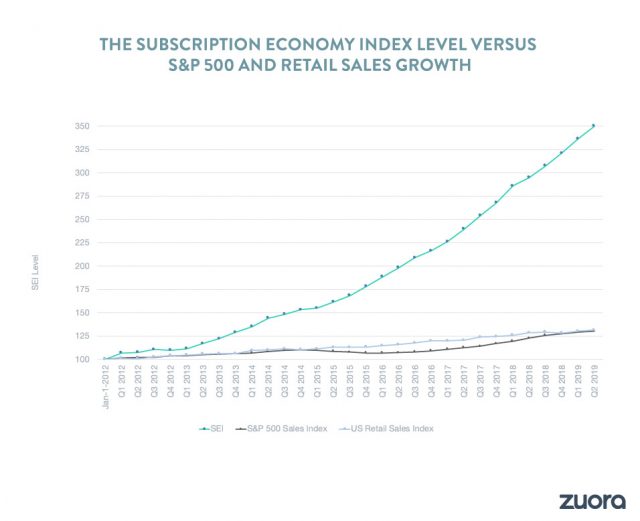
According to Zuora's Subscription Economy Index™ (SEI), the Subscription Economy grew more than 350% over 7.5 years, from January 1, 2012 to June 30, 2019. This growth rate significantly outpaces traditional business models and highlights the increasing demand for subscription-based services. [Source]
How does the growth of subscription businesses compare to the S&P 500 and U.S. retail sales?
From January 2012 to June 2019, subscription businesses grew revenues about 5 times faster than S&P 500 company revenues (18.2% vs. 3.6%) and U.S. retail sales (18.2% vs. 3.7%), according to the SEI data. [Source]
Which industries have seen the highest subscription revenue growth?
Manufacturing and IoT sectors achieved the highest level of subscription revenue growth, exceeding their S&P 500 industry benchmarks by more than 5 times. IoT subscription businesses also achieved the highest annual growth rate of Average Revenue Per Account (ARPA) at 14.3%, more than twice the SEI average of 6.5%. [Source]
What are the average churn rates for different industries in the Subscription Economy?
Business services and manufacturing industries experienced the lowest churn rates, at 16.2% and 20.4% respectively. In contrast, media (37.1%) and publishing (28.2%) industries saw the highest churn rates. [Source]
How does usage-based pricing impact subscription businesses?
Industries that incorporate usage-based pricing, such as business services (57% of revenue from usage-based models), tend to have lower churn and higher overall subscription growth. In contrast, the publishing industry, which generated only 17% of revenue from usage-based pricing, experienced higher churn. [Source]
Why do B2B subscriptions typically have lower churn rates?
B2B subscriptions often serve mission-critical functions and are deeply embedded within a business’s operations, making them 'sticky' and less likely to be canceled. This results in lower churn rates compared to B2C sectors like media and publishing. [Source]
What is the Subscription Economy Index™ (SEI) and what does it measure?
The Subscription Economy Index™ (SEI) is Zuora’s biannual report that measures the collective health and growth of subscription businesses across various sectors, comparing them to their respective S&P 500 industry benchmarks. It tracks metrics such as revenue growth, churn rate, customer base growth, ARPA growth, and usage-based revenue. [Download the SEI report]
How does launching new services impact subscription business growth?
Launching and monetizing new services drives greater individual account growth. Add-on and up-sell opportunities inherent in digital services and connected hardware support high ARPA (Average Revenue Per Account) growth rates. [Source]
What role does Zuora play in the Subscription Economy?
Zuora provides the leading cloud-based subscription management platform, acting as a system of record for subscription businesses across all industries. The platform automates and orchestrates the entire subscription order-to-cash process, including billing and revenue recognition, and powers the Subscription Economy for over 1,000 companies worldwide. [Source]
How can I access the full Subscription Economy Index™ (SEI) report?
You can download the full SEI report, which includes detailed data on subscription revenue growth, churn rate, customer base growth, ARPA growth, usage-based revenue, and electronic payments by industry and region, from this page.
What is driving the shift from ownership to subscriptions?
Consumers increasingly demand access to convenient, digital services over the ownership of physical products. This trend is driving the rapid growth of the Subscription Economy, as highlighted by the SEI and industry analysts like IDC. [Source]
Which regions are covered in the SEI report?
The SEI report provides insights by industry and region, including EMEA, North America, and APAC. [Download the SEI report]
How does the Subscription Economy benefit manufacturing and IoT companies?
Manufacturing and IoT companies have achieved the highest subscription revenue growth, exceeding industry benchmarks by more than 5 times. These sectors benefit from recurring revenue, high ARPA growth, and lower churn rates compared to other industries. [Source]
What is the impact of digital transformation on large enterprises?
IDC predicts that by 2020, 50% of the world’s largest enterprises will see the majority of their business depend on their ability to create digitally enhanced products, services, and experiences. This underscores the importance of adopting subscription models and digital transformation strategies. [IDC Source]
How does Zuora support companies in different industries?
Zuora’s platform is designed to support subscription businesses across SaaS, IoT, manufacturing, publishing, media, telecommunications, and business services, providing automation, analytics, and compliance tools tailored to each sector’s needs. [Source]
What are the main benefits of adopting a subscription business model?
Adopting a subscription business model enables companies to achieve rapid and sustained long-term growth, lower churn rates (especially for business-critical services), and greater account growth through add-ons and upsells. [Source]
How many companies use Zuora’s platform?
Zuora serves more than 1,000 companies worldwide, including Box, Rogers, Schneider Electric, Xplornet, and Zendesk. [Source]
Where is Zuora headquartered and where does it operate?
Zuora is headquartered in Silicon Valley and operates offices around the world in the U.S., EMEA, and APAC regions. [Source]
Zuora Platform, Features & Capabilities
What products and services does Zuora offer?
Zuora offers a suite of products for managing the entire subscription lifecycle, including Zuora Billing, Zuora Revenue, Zuora Payments, Zuora CPQ, Zephr, Zuora Platform, Zuora Collections, and Accounts Receivable automation. These tools support pricing, quoting, billing, payments, revenue recognition, and analytics for subscription businesses. [Learn more]
What are the key capabilities and benefits of Zuora’s platform?
Zuora’s platform supports over 50 pricing models, automates billing and revenue recognition, provides real-time analytics, ensures global compliance, and integrates with leading CRM, ERP, and payment systems. Benefits include monetization agility, operational efficiency, improved customer retention, and faster time to market. [Source]
What integrations does Zuora support?
Zuora provides over 60 pre-built connectors (including Salesforce, HubSpot, NetSuite, Snowflake), REST and SOAP APIs, warehouse connectors (Databricks, BigQuery, RedShift), 40+ payment gateways (Stripe, GoCardless), and a marketplace with nearly 100 apps. [Integration Hub]
Does Zuora offer APIs for integration?
Yes, Zuora offers both REST and SOAP APIs for seamless integration with external systems. Developers can access API references, SDKs, and guides via the Zuora Developer Center.
What real-time product performance metrics does Zuora provide?
Zuora provides real-time metrics on profitability, conversion rates, and discounting rates, enabling businesses to respond quickly to market trends, optimize pricing strategies, and improve sales velocity. [Learn more]
What technical documentation and resources are available for Zuora?
Zuora offers comprehensive technical documentation, developer resources, SDKs, and integration guides via its Documentation Portal, Developer Center, and Knowledge Center.
What security and compliance certifications does Zuora hold?
Zuora is certified for PCI DSS Level 1, SSAE 16 SOC1 Type II, SOC2 Type II, ISO 27001, HHS HIPAA, and SOC 3, ensuring enterprise-grade security and compliance for its customers. [Security & Compliance]
How does Zuora help with global compliance and regulatory requirements?
Zuora’s platform includes built-in compliance features such as data encryption, role-based access control, audit trails, and support for multi-currency and tax compliance, helping businesses operate globally and adhere to regulations like GDPR, PCI DSS, and SOX. [Learn more]
What feedback have customers given about Zuora’s ease of use?
Customers such as Mindflash, TripAdvisor, FireHost, Briggs & Stratton, Buildium, and AppFolio have praised Zuora for its flexibility, ease of integration, and ability to simplify operations and reduce manual workloads. [Customer Stories]
How long does it take to implement Zuora and how easy is it to start?
Implementation timelines vary: focused scopes can be completed in as little as 30 days, typical implementations range from 30 to 90 days, and multi-product programs may take several months. Pre-built connectors can enable integrations in as little as one day. Extensive training, support, and developer resources are available to ensure a smooth start. [Zuora University]
Use Cases, Pain Points & Business Impact
Who is Zuora’s platform designed for?
Zuora is designed for subscription-based businesses across industries such as technology, SaaS, media, publishing, healthcare, consumer goods, manufacturing, telecommunications, and entertainment. Target roles include finance, IT, product management, operations, sales, and customer success teams. [Source]
What core problems does Zuora solve for businesses?
Zuora addresses slow manual close cycles, ASC 606/IFRS 15 compliance, scaling usage-based/hybrid monetization, multi-entity and global compliance, cash flow and collections, data quality, spreadsheet dependency, quote-to-cash misalignment, and forecasting challenges. [Learn more]
What business impact can customers expect from using Zuora?
Customers can expect recurring revenue growth, operational efficiency, improved customer retention, faster time-to-market, improved financial operations, scalability, and global compliance. For example, Swiftpage saw a 140% increase in subscription customers and a 131% ARR growth after launching on Zuora. [Case Studies]
What are some common pain points Zuora helps solve?
Zuora helps address slow manual close cycles, compliance and audit readiness, scaling complex monetization models, multi-currency and tax compliance, revenue leakage, poor data quality, spreadsheet dependency, quote-to-cash misalignment, and forecasting challenges. [Learn more]
What industries are represented in Zuora’s customer case studies?
Zuora’s case studies cover collaborative work management (SaaS), communications, consumer goods/retail, corporate services, energy/utilities, finance, healthcare, high tech, home services, HR technology, manufacturing/IoT, media/publishing, OTT/entertainment, software/technology, telecommunications, and video games. [See all industries]
Can you share specific customer success stories using Zuora?
Yes, notable success stories include Zoom scaling from 10 million to 300 million users, The Financial Times growing digital subscriptions, Asana scaling its business, and Hudl saving over 100 hours per month through automation. [Read case studies]
Who are some of Zuora’s notable customers?
Zuora’s customers include Zoom, Box, Zendesk, Asana, AppDynamics, The Financial Times, The Guardian, Schibsted ASA, The Seattle Times, Siemens Healthineers, 24 Hour Fitness, GoPro, Fender, Schneider Electric, Caterpillar, Konecranes, Dell, Ford, Toyota, and General Motors. [See all customers]
Why should a customer choose Zuora over other solutions?
Zuora offers flexibility with 50+ pricing models, proven scalability (e.g., Zoom’s growth), AI-powered personalization (Zephr), hybrid monetization, strong compliance (SOC 2, PCI DSS), and a track record of success with leading brands. [Learn more]