The Subscription Economy is built on a relationship between your business and your subscriber. This relationship is legal, financial and emotional. The quality of this relationship is determined by the experience your customers have with your brand.
The subscriber experience can be defined as the sum of all the interactions a subscriber has with your brand. Each interaction builds on itself and creates a great experience or erodes the relationship and leads to churn. These interactions take place across the entire subscriber journey.
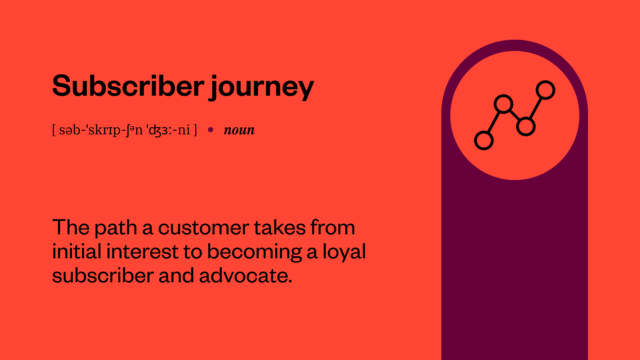
It’s important that you understand the subscriber journey and target your efforts accordingly. There are 5 critical stages in the subscriber journey:
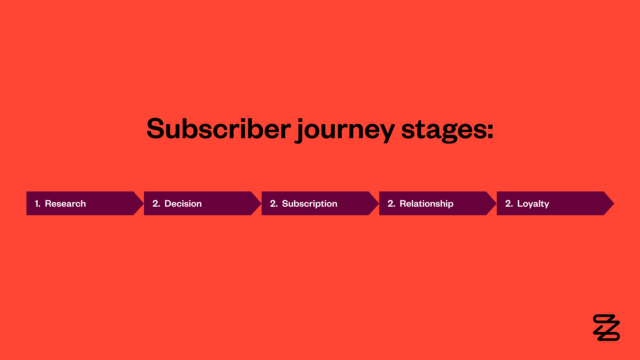
#1 - RESEARCH
Like most decisions, the subscriber journey begins with an identified need or pain. These cover a wide spectrum but the commonality to all is a catalyst to change. A subscriber has a physical, emotional or financial trigger to find a solution. In the first phase, the subscriber is searching for possible solutions to this identified need. It’s important for your business to truly understand these catalysts so you can market your solutions more effectively.
For instance, let’s say that your generic email blast is not delivering the results you want and you’re unable to accomplish your “marketing automation” concept. What would you do? You’ll probably post on social media asking for advice. You’ll probably search for “How to improve SaaS Marketing results” on Google. You might look for an online guide to implement marketing automation for your industry. Your goal here is to see if there is a better way, to see if there are any real alternatives. We all do this – at home and at work. And so do your subscribers.
As a next step, you’ll probably engage and evaluate the options. Your research might throw up many marketing automation players. How will you narrow it down? Statistically, it is the businesses with the best content that help you think through this process. Examples of companies who do this well with content and form on their websites are Hubspot and Bench.
You have several assets that can help your customers navigate this stage such as your website, content, webinars, email marketing, your social presence, events, advertising, blogging and thought leadership.
#2 - DECISION
In the decision phase, the subscriber is evaluating a shortlist of options and comparing solutions to find the best fit in capability, price and other key factors.
Think about your own personal habits – once you have a shortlist, you probably take the time to validate your decision with some third party insight. You may ask your network of peers for their feedback and try to confirm the impact your decision will have on your business.
This validation for final decision making is usually sought from third party sources as they are viewed to be more authentic and accurate. For example, in the software space, Capterra and Software Advice are two leaders who help in this space.
Other industries have similar services or research reports. Find out the ones relevant to your industry and ensure you have complete profiles, contact information, etc. When possible, engage with them and keep them updated on new developments to your products.
During this stage, assets such as case studies, whitepapers, FAQs and references help customers understand how your solution works.
#3 - SUBSCRIBE
The close stage is pretty straightforward – make the decision, finalize the agreement and implement. It’s all about organization, clarity and communication to make it simple and easy for customers and to guide them step by step.
Slack arguably has the best onboarding process. When you sign up for Slack and download the app, you get an automated tool called the Slackbot. The Slackbot guides you through the setup, asks you questions and sets up your profile and preferences as you’re responding. It’s fast, frictionless and fun.
Remember to also thank your customers – a nice gesture such as a note and small gift will make them feel good about their decision to go with you.
#4 - RELATIONSHIP
Your company has just gained a new subscriber who is now using your product or service. This is the “use” stage for the subscriber and this is where you help customers realize the value of your solution as you continue to build your relationship.
Success here is dependant on how you engage with the subscriber based on who they are, what they’re doing and your most recent interaction with them. Just like a personal relationship, it’s all about context and value.
Ask yourself – Are we talking to them personally? Are we leveraging behavior to provide context and share insights? Are we offering insight relevant to their situation? Are we using the information we have to connect and gain more insight which can then improve future interactions?
#5 - LOYALTY
The Loyalty phase focuses on retention and is about nurturing your relationship with your subscribers. You should continue to leverage your knowledge of them to expand the relationship. The key to successful loyalty is continuous value delivery and relevant communication.
A subscriber’s engagement with your brand should dictate the frequency of your communication. Customers don’t want to hear from companies every other day. When you see a subscriber not engaging with your communication but using your service, be strategic with your communication and cut it down a little. If a customer engages-stops-engages, reach out and see how you can help. The sooner you engage, the higher are the chances of saving the customer.
It’s important to note that the above stages are not necessarily in order for all subscribers. The exact journey path may vary by company, type of solution, pricing model and subscriber. So, understand your subscribers, their journeys and continually build your relationship with them.
How to map your Subscriber Journey
Mapping your subscriber journey involves understanding the unique experiences of your subscribers at every touchpoint.
- Start by gathering data through surveys, interviews, and analytics to identify key interactions and pain points. A subscription management tool can greatly enhance this process by consolidating subscriber data and tracking engagement metrics, making it easier to visualize the journey.
- Once you have your data, create a visual map that outlines each stage of the journey, including the emotions and challenges subscribers may face. This mapping process helps pinpoint areas for improvement, allowing you to design a more tailored and effective subscriber experience. Additionally, many subscription management tools offer features for monitoring subscriber behavior over time, enabling you to identify trends and make data-driven adjustments.
- Regularly revisit and update your map to adapt to changing subscriber needs and behaviors. By leveraging the insights from your subscription management tool, you can ensure your mapping remains relevant and continues to support subscriber satisfaction and retention.
Keep in mind that no matter which stage your subscriber is in, driving growth and success in the subscription economy is predicated on creating an exceptional experience through the entire subscriber lifecycle and nurturing that relationship.
Subscriber Journey FAQs
1.
How detailed should a subscriber journey map be for it to be useful?
Aim for enough detail to capture key motivations, touchpoints, and pain points at each stage, but not so much that it becomes unmaintainable. A good starting point is one map per major segment (e.g., self‑serve vs. enterprise) with: goals, channels, main actions, decision points, and 3–5 common obstacles. You can add more nuance—like persona‑specific variations—once the core map is actively used by teams.
2.
How often should we revisit and update our subscriber journey map?
Review it at least twice a year, or whenever you roll out meaningful changes (new pricing, onboarding flows, packaging, or channels). Use data triggers—like a spike in churn at a specific tenure or a drop in trial conversions—to prompt earlier reviews. The journey map should be treated as a living artifact, informed by both quantitative data and feedback from sales, support, and customer success.
3.
How can different teams use the subscriber journey without duplicating effort?
Marketing can use it to plan campaigns and content that match each stage; Product uses it to prioritize features that remove friction; Customer Success uses it to design playbooks for onboarding, expansion, and risk mitigation; Finance and RevOps use it to align KPIs and revenue forecasts to stage transitions. A shared, documented map helps each team work from the same mental model while owning different moments in the journey.
4.
What metrics best indicate that subscribers are successfully progressing through stages?
Look for leading indicators tied to behavior, such as activation events completed (first value moment), feature adoption depth, product usage frequency, engagement with key communications, and upgrade or expansion actions. Pair these with lagging indicators like churn rate by tenure band, NPS/CSAT after key milestones, and cohort revenue over time to validate whether movement through stages is translating into durable value.
5.
How do we handle subscribers whose journeys don’t follow the “typical” path?
Design for common patterns, but allow flexibility for non‑linear journeys. That means: trigger‑based workflows rather than strictly time‑based ones (e.g., actions fire when someone hits a usage threshold or stalls), multiple re‑entry points (e.g., win‑back campaigns), and the ability to skip or compress steps for high‑intent users. Your map should acknowledge that not all subscribers will move sequentially from one stage to the next.
6.
How can we practically connect subscriber journey insights to pricing and packaging decisions?
Use journey analytics to see where value is realized (which features and usage patterns correlate with retention and expansion), then align tiers and add‑ons with those milestones. For example, if a key “aha” moment consistently precedes upgrades, consider making that capability more discoverable in earlier stages and structuring packages so that moving to higher tiers feels like a natural extension of proven value, not a jarring paywall.