Glossary Hub / Material Weakness: What it is, how it affects finance, and examples
Material Weakness: What it is, how it affects finance, and examples

Material weakness in internal controls over financial reporting can significantly impact the accuracy and reliability of the company’s financial statements. These deficiencies indicate a company’s internal control systems have failed to prevent or detect potential misstatements. As a result, investors lose trust in and organization’s financial health and governance.
According to research, companies that report material weakness are 12-48% more likely to experience future stock price crashes than companies with effective internal control.On March 14, 2023, a bank found a material weakness in its financial state, which plummeted its stock price by 3%. This demonstrates the high risks investors associate with deficient internal controls
Also, remediating these control issues requires time and money, straining short-term profitability. On average, companies spend $7.8 million to eliminate each material weakness. Companies must take decisive steps when material weaknesses arise to restore investor confidence and avoid regulatory actions.
TL;DR
This article explains what a material weakness is, then explores how it affects finance and the wider business—from undermining the accuracy and reliability of financial reports to increasing the risk of stock price crashes and eroding investor confidence, illustrated by real-world examples like a bank whose share price dropped after disclosing a material weakness.
It walks through typical causes and audit examples of material weaknesses, and concludes with ways to remediate them and strengthen internal controls, including how automated solutions like Zuora Revenue help recurring revenue businesses tighten revenue recognition processes and reduce the risk of control failures.
What is material weakness?
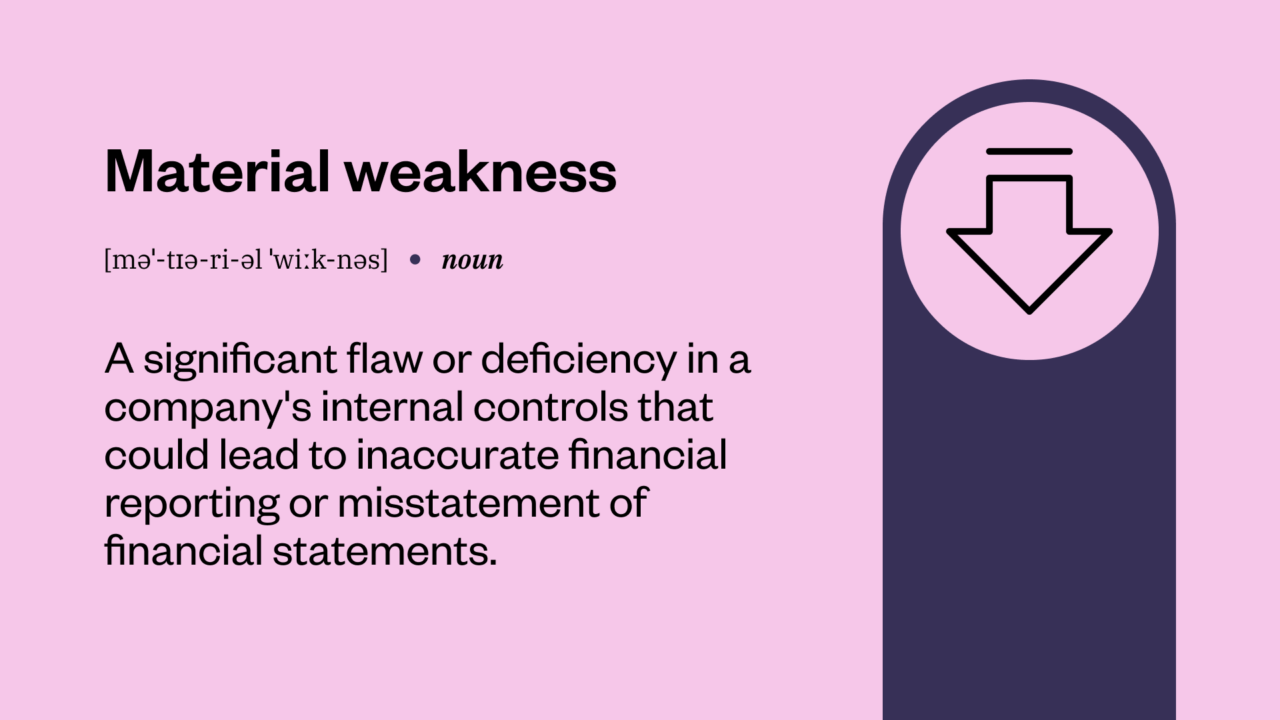
A material weakness happens when a flaw, deficiency, or a group of deficiencies leads to a potential material misstatement of a company’s financial statement due to an oversight from the internal control’s financial reporting.
Several factors can trigger material weakness. It is sometimes caused by deficiencies from internal control errors leading to significant erroneous financial statements. This means that the internal control infrastructures or measures put in place by a company to prevent irregularities and enhance operational efficiency failed or are not completely effective.
As a result, the company’s financial data become unreliable and cannot easily be used to assess financial health and determine suitable stock prices.
The costs of material weakness are high. Companies must establish an effective control system that enables internal controls to determine a deficiency and report it to the audit committee for appropriate intervention.
Types of material weakness
Material weaknesses come in various forms, each presenting unique risks to financial reporting integrity and organizational effectiveness. While every weakness signals potential control failures, understanding specific types helps in developing tailored strategies for detection and remediation. Here are some of the most common types of material weaknesses:
Financial reporting and reconciliation weaknesses
These weaknesses arise from deficiencies in the processes and controls over financial reporting, such as inaccurate reconciliations, delayed closing processes, and uncorrected accounting errors. For example, if a company fails to reconcile its accounts monthly, discrepancies may go undetected, leading to potential misstatements.
Revenue recognition deficiencies
Recognizing revenue according to Generally Accepted Accounting Principles (GAAP) or International Financial Reporting Standards (IFRS) can be complex, especially in industries with recurring or variable revenue streams. Weaknesses in this area may lead to premature, delayed, or inaccurate revenue recognition, which could materially misstate financial results.
IT control weaknesses
Inadequate IT controls can result in unauthorized access to financial data, inaccurate financial reporting, and data manipulation. IT control weaknesses often occur when there is a lack of access restrictions, inadequate data security protocols, or poor system integration, all of which compromise data integrity and the reliability of financial information.
Control environment issues
The control environment forms the foundation of internal controls, including management’s attitude, ethical standards, and commitment to competence. If a company’s leadership does not prioritize internal controls, it creates an environment where material weaknesses are more likely to develop. This type of weakness may also include insufficient oversight, weak segregation of duties, or lack of a robust compliance culture.
Inventory control weaknesses
Companies with significant inventory often rely on controls to monitor stock levels, valuation, and movement across locations. Inadequate controls in this area—such as poor inventory counts, lack of reconciliation, or failure to integrate inventory systems—can lead to overstated or understated inventory values and potentially material financial misstatements.
Example of a material weakness
Here is an example of a material weakness related to internal controls over financial reporting:
Inventory count controls
Suppose a company has distribution centers that maintain significant inventory levels across several locations. However, the company has inadequate controls related to inventory cycle counts and validating the existence of inventory. Specifically:
Cycle count procedures are informal and undocumented, varying widely across locations. Employees do not perform counts routinely.
When cycle counts are done, there is no management review and reconciliation of count results.
The company maintains physical inventory records in spreadsheets instead of integrating them with the inventory system, which leads to inaccurate reporting.
Management performs no routine spot checks at any location to verify inventory existence overall.
As a result of these ineffective controls, several locations significantly overstated inventory quantities towards year-end, leading to days’ sales outstanding appearing better than reality. Based on certain inventory accounts representing over 20% of total assets, they deemed the monetary misstatement material.
Given the reasonable possibility that a material misstatement occurred across multiple inventory accounts and was not prevented or promptly detected by internal controls, this combination of deficiencies represents a material weakness.
What are the impacts of material weakness on finance and accounting?
A material weakness in internal controls over financial reporting can significantly impact a company’s finance and accounting functions. Some of the major issues include:
1. Financial statement inaccuracies:
With ineffective controls, there is a greater risk of material inaccuracies and misstatements going undetected in the published financial statements. This reduces overall integrity and reliability for stakeholders.
2. External audit problems:
Auditors will expend more effort evaluating misstatements and mitigating control risks. This leads to higher audit fees and potential failures if they can’t address the issues.
3. Higher costs and inefficiencies:
Significant manual reconciliations, control remediation efforts, and process workarounds lead to higher costs and less efficient accounting operations.
4. Regulatory scrutiny:
Material weaknesses must be publicly disclosed and disclosed to the audit committee—this increases scrutiny from regulators like the SEC on reporting and corrections.
5. Investor and market uncertainty:
Discovery of the weakness may lead to loss of investor confidence, negative impacts on valuation and share price, and increased uncertainty.
6. Credit and lending issues:
Questions around the accuracy of financials may make lenders leery and could impact the availability, terms, or costs of credit lines or loans.
Causes of material weakness
Identifying and addressing the specific drivers behind material weaknesses is necessary to implement the right solutions and prevent future recurrence. The following are the common causes of material weakness as identified by auditors.
Inadequate GAAP accounting expertise
Companies, especially small or mid-sized ones, may lack Generally Accepted Accounting Principles (GAAP) experts employed to identify improper accounting and ensure statements adhere to complex GAAP standards.
Related: IFRS 15: Contract Combinations Vs Contract Modifications
Dependence on manual processes
Over-reliance on manual data entry, calculations, or adjustments often results in errors, increasing the risk of material weakness. Automated systems can reduce this risk, but companies lacking technology solutions may find it challenging to ensure accurate financial reporting.
Poor technology implementation or integration
Technological innovation ensures that a company’s operations and processes are more optimized and detailed while working with heavy data. However, new technology comes with its implementation/integration risks.
Suppose it is not appropriately done, and management controls are not effectively in place to migrate to a new technology. In that case, loopholes might compound existing problems, and control issues become more complex instead of getting simpler. This can lead to compromised data integrity, thereby risking material weakness.
Adopting new accounting standards
Disruption usually occurs when companies adopt new accounting standards. This is because companies need to implement the right processes and controls after the adoption.
Adequate controls must be in place to prevent multiple control risks after the adoption. But often, companies ignore these controls due to their workload, dealing with vast volumes of data while having a short adoption period.
Related: What ASC 606 means for revenue recognition
Long-lived assets or liabilities valuation deficiencies
Valuation specialists usually help organizations determine the value of assets and liabilities that have existed for a while. Management needs to own the whole valuation. However, they may not effectively execute critical valuation in some considerable cases. This might lead to deficiencies in financial reporting.
Delayed financial reporting
Consistent delays in the financial close process or late filing of required reports (such as quarterly or annual filings) may indicate inadequate controls in place. These delays often result from ineffective internal processes or lack of control over data accuracy, which increases the risk of material misstatement.
Inadequate tool usage
Sometimes, the accounting unit experiences manual errors because companies are not using effective analytics and reporting tools. This makes it difficult for the team to conduct significant control activities and effectively mitigate risk. As a result, the team needs to do it manually, and controls may break down while impacting accounting processes.
Related: The benefits of end-to-end revenue automation
High turnover positions
Frequent turnover in crucial finance and accounting positions can result in losing the institutional expertise needed to execute essential controls to prevent misstatements. Loss of historical knowledge also hampers investigations when errors arise.
Risks of ignoring material weakness
When a company encounters material weakness and chooses to ignore it, it has adverse effects. Companies should be transparent and prioritize timely remediation.
Company reputation suffers
The first significant effect is how the company’s reputation can suffer. A poor reputation can break the trust between the company, investors, and the general public. As a result, investors might withdraw their financial support, and the public might boycott the company’s products or services, leading to revenue loss.
Regulatory noncompliance
Under Sarbanes-Oxley regulations, companies must report all material weaknesses and have their auditor validate the correction of deficiencies within a year. Ignoring issues can spur SEC inquiries and penalties.
Legal consequences
Shareholders or stakeholders can sue companies if they fail to disclose control weaknesses, alleging negligence and failure to provide accurate financial reporting. Ongoing class action lawsuits are expensive and damaging. This can substantially impact the company’s finances while incurring other external auditing fees.
How to report a material weakness
Companies have a few options when it comes to reporting material weaknesses in internal controls:
SEC filings and disclosures
Regulations require public companies to disclose the existence of any identified material weaknesses in their regular SEC filings, such as the annual 10-K and quarterly 10-Q reports. These documents have sections dedicated to management reports on the effectiveness of the company’s internal controls.
Remediation plans and progress updates
In addition to disclosing weaknesses, companies also use periodic SEC reports to provide specifics on remediation efforts, implementation timelines, and subsequent progress toward eliminating deficiencies. Providing transparency helps restore investor trust.
Amended financial statement filings
If a material weakness directly results in a material misstatement on previously issued financial statements, amended statements may need to be filed along with an explanatory disclosure detailing the control deficiencies detected.
Press releases and shareholder letters
To promptly communicate material weaknesses even before the next scheduled regulatory filing, companies may choose to voluntarily issue press releases, business wire notices, or letters directly to shareholders on the details and ongoing remediation plans.
Investor conference calls
Managers may communicate weaknesses and take investor inquiries through quarterly earnings result conference calls. These provide an opportunity to reaffirm remediation commitments aloud.
Strategies to prevent and detect material weakness
As much as detecting material weaknesses is crucial, companies should prioritize stopping them before they occur.
Detection strategies
Whistle-blower programs
Create a system that alerts senior management and encourages an employee to report concerns related to internal control. Provide hotlines for anonymous individuals to ensure a confidential channel to disclose potential issues.
Data analytics
Analytics is an excellent tool for determining patterns within large datasets, understanding data performance, and determining anomalies or outliers. This can provide insight into the detection of material weakness.
Walkthroughs
When employees are unaware of the components and processes of internal controls, material weakness can easily slip through, and misstatements can occur. Thus, it is crucial to educate and train employees regarding the changes that happen as internal controls are involved. Walking your employees through the internal control processes makes it easy to identify any possible weaknesses.
External audits
Another crucial activity that you should allow is the external audit. Allow an external auditor (independent third party) to assess whether your controls are effectively designed and implemented. This helps you prevent any anomalies that might become a material weakness.
Prevention strategies
Control the environment
As an organization, it is vital to establish a company culture that encourages accountability and promotes competence among employees and senior management. This enables you to create and execute policies and procedures to specify proper controls to prevent material weakness.
Risk assessment process
Control procedures must be subjected to risk assessments. This enables the company to recognize possible causes of the failures, the reason for the ineffective controls, the party responsible for the control, the possible solution, and when the responsible party acts towards remediating it. With this, the internal control team can identify areas of the financial statements with a high risk of material weakness.
Information and communication
As an organization that optimizes its operations with technology, it is essential to communicate policies and procedures across the entire organization. This will keep the teams on the same page and provide a framework for members to work effectively and efficiently. Likewise, senior management should encourage the review of financial statements and encourage internal reporting.
Monitoring activities
Monitoring activities based on frequency and quality enables you to effectively assess and evaluate internal controls. When done consistently, your company becomes more successful at risk management. This is because you take corrective measures once you detect a deficiency and prevent material weakness from happening.
Control activities
Lastly, you can automate controls where appropriate and cause teams to encounter reviews and authorization steps before completing an operation. You can quickly avert material weakness with activities such as authorizations and reviews.
Material weakness vs. significant deficiency
Material weakness and significant deficiency are types of control deficiency. They have different meanings and implications for a company’s financial reporting.
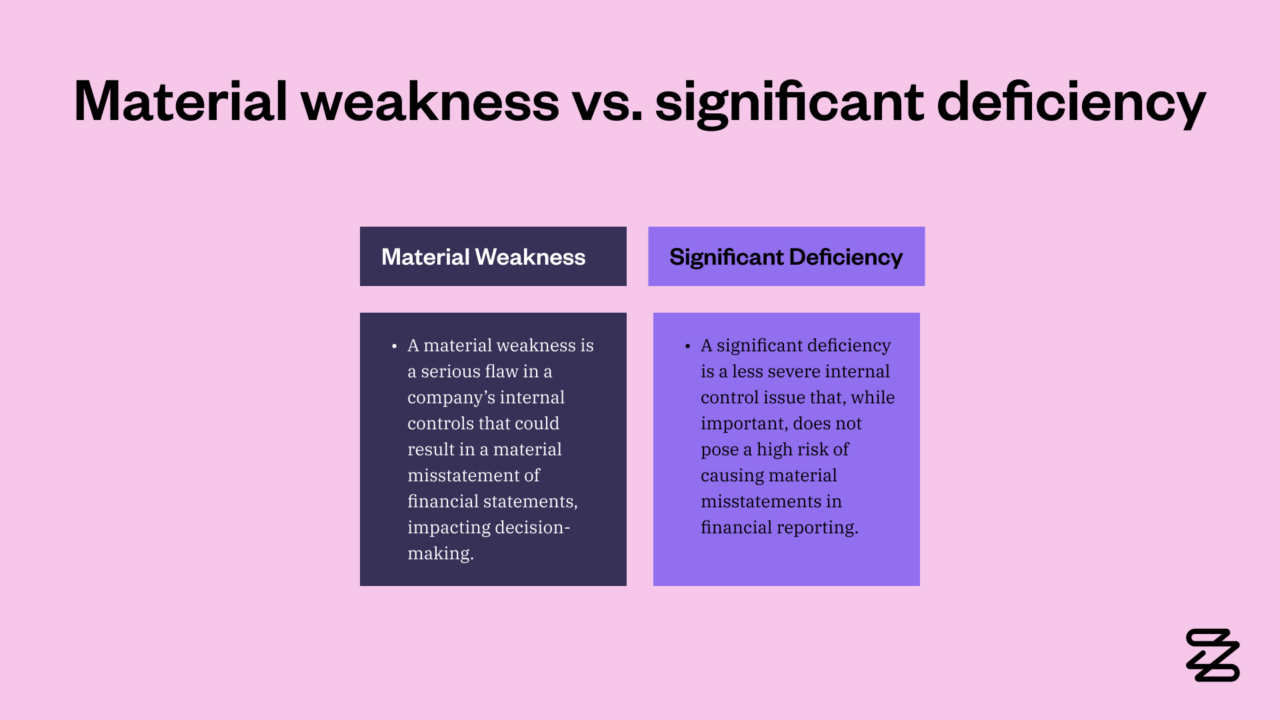
Material weakness and significant deficiency require decision-makers attention in a company, but the weight and severity of material weakness are higher than significant deficiency. Material weakness intersects with the company’s integrity, value, and public perception, all of which can hurt the company’s performance and ability to attract more investors.
The likelihood of misstatement after assessing the magnitude of the control deficiency determines whether a control deficiency is material weakness or significant. This means that a significant deficiency will attract the attention of the responsible party for the oversight but doesn’t have material impacts on financial reporting. Simply put, it has significant magnitude but not material magnitude.
What is worse: significant deficiency or material weakness?
Material weakness has a massive impact on financial reporting, leading to misstatements. Here, the existing control fails to prevent misstatements, potentially due to fraud by senior management or oversights by the internal control team.
Once a material weakness is identified, the auditor reports this material magnitude to the audit committee and the company’s management.
A material weakness is worse than a significant deficiency when it comes to deficiencies in internal control over financial reporting. The key reasons why a material weakness is considered more severe are:
1. Likelihood of misstatement:
A material weakness indicates a reasonable possibility that a material financial statement misstatement could occur and not be detected promptly. The threshold for likelihood and magnitude of potential misstatement is higher than a significant deficiency.
2. Impact on financials:
Because a material weakness means potential material yet undetected misstatements in financial statements, the effect on the accuracy of financials is more severe.
3. External reporting requirements:
Under PCAOB auditing standards, material weaknesses must be publicly disclosed in companies’ 10-K reporting, whereas significant deficiencies may not need public reporting.
4. Investor perception:
Discovery of a material weakness tends to erode investor confidence more, given the severity tied specifically to misstated financial reports. It may signal deeper issues with controls and processes.
Ensure compliance with revenue recognition software
Zuora Revenue is purpose-built to automate revenue recognition for complex, recurring revenue businesses. It provides end-to-end capabilities to model customer contracts, continually recognize revenue, generate accounting entries, and power revenue-related reporting in compliance with ASC 606 and IFRS 15.
Material weakness FAQs
How should a CFO communicate a newly identified material weakness to investors and analysts?
Be direct and specific: explain what the weakness is, which areas of reporting it affects (e.g., revenue recognition, disclosures), how it was discovered, and—most importantly—the remediation plan, milestones, and expected timeline. Pair the disclosure with clear governance changes (ownership, added oversight) to reassure stakeholders that the issue is being actively contained and monitored.
How can a company prioritize remediation if multiple control weaknesses are identified at once?
Start with the weaknesses that touch the most judgment-heavy or high‑volume areas (e.g., revenue, reserves, complex contracts) and those most likely to cause material misstatements. Use a risk matrix combining likelihood (of error) and impact (on financials and covenants), then allocate dedicated cross‑functional teams and budget to the highest‑risk items first, while still scheduling resolution paths for the rest.
What impact can a history of material weaknesses have on access to capital?
Lenders and investors often price this as additional risk: you may see tighter covenants, higher interest margins, more frequent reporting requirements, or even reduced appetite from certain institutional investors. Demonstrating a strong remediation track record—on‑time fixes, no repeat findings, enhanced automation—can gradually restore confidence and improve terms over time.
What role should the board and audit committee play once a material weakness is reported?
The audit committee should demand a root‑cause analysis, approve (or challenge) the remediation plan, and receive regular, time‑bound progress updates. They should also assess whether management has the right skills, systems, and resources to prevent recurrence, and consider independent validation (internal audit or external advisors) once remediation is complete.
How can automation and specialized revenue systems help prevent material weaknesses?
Automated revenue platforms reduce manual calculations, spreadsheet dependencies, and ad‑hoc journal entries—common sources of control failures in complex, recurring revenue environments. Embedding controls in the system (e.g., standardized rules for allocations, contract modifications, and disclosures) creates consistent, auditable workflows that are harder to override and easier to monitor at scale.
What evidence do auditors look for to conclude that a material weakness has been fully remediated?
Auditors typically expect: (1) a clearly documented new control design, (2) proof it has operated effectively over a sufficient period (often at least one or two reporting cycles), (3) supporting documentation showing the control is consistently followed, and (4) absence of new or repeat errors in the affected area. They may perform additional testing to validate that previous root causes no longer pose a material risk.