TL;DR: Key Takeaways
- Both architectures cover the same process on paper. They differ in where they are anchored, and that decides where your integration seam falls and which failure modes you inherit.
- ISG Research published two Buyers Guides in 2025 covering this ground, using the same seven categories in both. Only six of the nineteen providers rated across the two appear in both. That is evidence the choice is real, not a framing device.
- Weight contract change handling highest. It is the criterion that turns into recurring manual work month after month when the platform gets it wrong.
- Every vendor in the table below carries a limitation. Each cell names the source it came from and the date we read it.
- Four of the eight vendors publish more than one name for the same offering. Check the name before it goes into a procurement document.
1. How we evaluated, and what we are not telling you
You are reading a comparison published by one of the vendors in it. So before anything else, here is what we read, what we did not, and where our interest lies.
What we read
Every vendor statement in this guide comes from that vendor’s own public material, read on 17 September 2026. That meant four to seven primary pages each: the product or solution page, a platform or architecture page, and the reference documentation wherever it exists. We did not use a single third-party review site, aggregator score or user-review platform for any cell in the comparison table.
We cite two published analyst evaluations, read the same day and linked so you can check them. ISG Research’s 2025 Buyers Guide for Subscription Management, written by Mark Smith and published in September 2025, rates fifteen providers. Its 2025 Buyers Guide for Revenue Lifecycle Management, written by Stephen Hurrell and published in June 2025, rates ten. Both use an identical set of seven categories: Adaptability, Capability, Manageability, Reliability, Usability, Validation, and Total Cost of Ownership with Return on Investment. ISG gates the full reports behind a form; the executive summaries are open.
We did not pick the eight platforms in the table. Each one is rated in at least one of those two guides, and that is what puts it there.
Marketing pages and reference documentation frequently disagree about what a product contains, and the documentation is almost always the narrower of the two. Where a vendor publishes an object model or a reference guide, that is what we assessed the row on. Where the reference documentation sits behind a customer login, we say so and assess the row on what is public, because a claim written to persuade is weaker evidence than one written to be implemented against.
Why these eight criteria
We fixed the criteria in Section 4 before reading any vendor material, which matters more than the list itself. They cover where enterprise evaluations of this kind actually get decided: how a deal gets constructed and approved, what happens when it changes, how many billing models it has to survive, how cleanly it reaches the revenue system, how many integration seams it creates, whether AI changes an outcome or just describes one, how long until the first correct invoice, and what it costs to run once it is live.
What this guide does not do
We quote no pricing, for any vendor including our own. Published prices in this category change without notice, and a comparison that carries them is inaccurate on a schedule.
We give no implementation cost or timeline estimate either. Those depend on the estate a platform lands in far more than on the platform.
And we tested nothing. No platform in this table was installed, configured or run for this guide. What you are reading is what each vendor publishes about its own product, read against what the analyst guides record, dated so you can tell how stale it has become.
2. The short answer, by company profile
Find yourself in one of these four, then test it against the criteria in Section 4.
| If this is you | Your real constraint | Start from |
|---|---|---|
| Your revenue model keeps changing after signature | One contract change has to propagate through quoting, billing and the revenue handoff without re-keying | Dedicated quote-to-cash platform |
| Your CRM is the system the business actually runs on | Constructing and approving a complex deal, not what happens to it afterwards | Revenue lifecycle suite |
| Your ERP is the system of record and finance owns the decision | Bringing subscription revenue inside governance you already have | ERP-led path, evaluated first |
| Billing volume is your constraint and the front end is manageable | Rating, mediation and invoice construction at scale | Billing-led platform |
Your revenue model keeps changing after signature. Usage components, consumption tiers, commitments renegotiated mid-term, hybrid plans with a subscription floor and metered overage. Your constraint is that one contract change has to propagate correctly through quoting, billing and the revenue handoff without anyone re-keying it. Start from a dedicated quote-to-cash platform. That propagation is what it is built around.
Your CRM is the system the business actually runs on. Sales operations own the process. The pipeline is the operating truth. Your hard problem is constructing and approving a complex deal, not what happens to it afterwards, and pricing is fairly stable once signed. Start from a revenue lifecycle suite. The shortest path from opportunity to quote to contract runs inside the system your sellers already live in.
Your ERP is the system of record and finance owns the decision. Multi-entity, multi-currency, several statutory reporting obligations, a finance organization already standardized on one suite. Give the incumbent ERP-led path a serious hearing before you evaluate anything else. It is already bought, already governed and already audited.
Billing volume is your constraint and the front end is manageable. High-volume usage, mediation and rating at scale, complex invoice construction, and a sales motion simple enough that quoting is not where the pain is. Start from a billing-led platform and fill the front end with whatever quoting tool your sales team already uses.
Recognize yourself in more than one of these? Section 8 is the tiebreak.
3. The two architectures, defined
These names get used loosely, and two vendors saying the same phrase often mean different things by it. Here is what we mean throughout.
What a dedicated quote-to-cash platform covers
A dedicated quote-to-cash platform is anchored at the monetization end of the business. Its center of gravity is the run from the priced, configured quote through the contract, into billing and payments, and out to the revenue handoff. It holds the contract as a live object, not a signed document. That is what lets an amendment made in month seven reach the invoice in month eight and the revenue schedule behind it without a human carrying it across.
It integrates outward to the CRM instead of living inside it. That single architectural fact is the source of both its strength and its cost. Your monetization model gets represented once, in one system, in a form that survives change. You also run a second system beside the CRM, and the integration between them is real work that somebody owns for as long as both exist.
Vendors in this shape describe themselves in a recognizable way. Zuora’s own material calls the platform ERP-agnostic and designed to slot into an existing architecture, and leads on connectors, APIs, webhooks and event-driven syncs to CRM and ERP systems. That is an accurate description of what a platform beside the CRM has to do.
What a revenue lifecycle suite covers
A revenue lifecycle suite is anchored in the CRM and extends forward into quoting, contracting and billing. Its center of gravity is the construction of the deal: product catalog, pricing rules, configuration logic, approval path, contract document. Salesforce describes its own scope as running from product catalog management and pricing through quoting, contracting, order fulfillment and invoicing, and names its target as the messy middle between CRM and ERP.
Your seam falls somewhere different, and that is the whole point. There is no seam between the opportunity and the quote, because they are the same record. It falls further downstream, at the boundary with the finance estate. Salesforce’s billing material sets out more than one route at that boundary, one of which is synchronizing billing data to an ERP. What its lifecycle page does not do is name a revenue-recognition stage in its own list of stages.
Suites are assembled rather than singular. The offering is a set of applications sharing one data model, so your coverage depends on which of them you take.
Where the boundary actually falls
Both architectures cover the same nominal process. Put the two stage lists side by side and they are close to identical: configure, quote, contract, order, bill, collect, hand off revenue. The difference is depth per stage, and where the seam falls. Figure 1 sets the two coverage spans against one process.
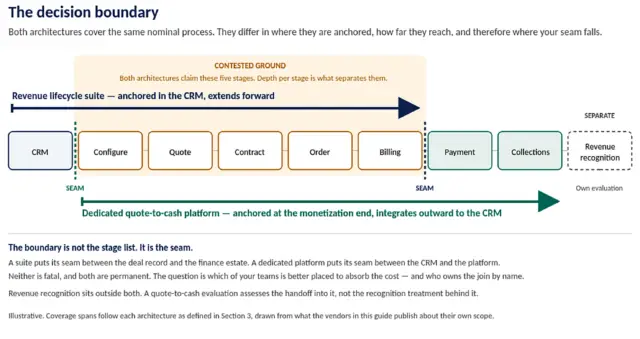
Figure 1. One revenue process, the coverage each architecture claims, and the five stages both claim.
Under a suite, the hard join sits between the deal record and the finance estate, and the failure mode is a contract that is correct in the CRM and approximate in billing. Under a dedicated platform, the hard join sits between the CRM and the platform, and the failure mode is a quote that is correct in billing and invisible to your seller. Both are real. Neither is fatal. They cost different things to different teams, and your question is which of your teams is better placed to absorb the cost.
There is evidence the distinction is real rather than a way of framing a sales conversation. ISG published separate Buyers Guides for subscription management and for revenue lifecycle management in 2025, using an identical set of seven categories in both. Nineteen distinct providers appear across the two, and they divide three ways.
- Six appear in both (Figure 2) — the providers whose scope genuinely spans the two fields.
- Nine are rated for subscription management only, and not for revenue lifecycle management.
- Four are rated for revenue lifecycle management only, and not for subscription management.
One research house, one year, one methodology. It found two fields with a modest overlap, rather than one field ranked twice.
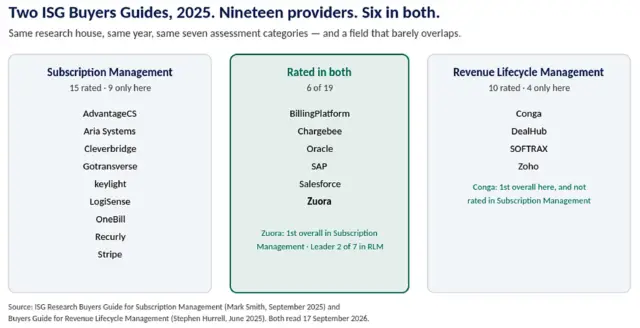
Figure 2. Nineteen providers rated across two 2025 ISG Buyers Guides. Six appear in both.
Source: ISG Research, 2025 Buyers Guide for Subscription Management (Mark Smith, September 2025) and 2025 Buyers Guide for Revenue Lifecycle Management (Stephen Hurrell, June 2025).
CPQ is worth naming here. Configure-price-quote is the first stage of the cycle, not a category of platform, and both architectures either include it or integrate to it. We treat it as one stage among eight criteria and pick up the category question under the first of them.
4. How we evaluated: the eight criteria
Weight these against your own business rather than scoring them equally. Section 8 covers how. Two of them describe ground where a dedicated platform intentionally starts at a disadvantage.
Each criterion is set out below.
| # | Criterion | What it actually decides | The question to ask a vendor |
|---|---|---|---|
| 1 | Quoting and approval complexity | Whether your deal desk gets its time back | Follow a deal that breaks the standard pricing model through to an invoice |
| 2 | Contract change handling | Whether a mid-term change becomes recurring manual work | What happens to usage already metered when a commitment changes? |
| 3 | Billing model coverage | Whether each new pricing model becomes a special case | How many models can run at once without one being an exception? |
| 4 | Revenue recognition handoff | How much of the transfer to the revenue system is manual | What reaches the revenue system when a contract is amended? |
| 5 | Integration surface | Where your seam falls and who owns it | How many joins does this architecture create, and who maintains them? |
| 6 | Embedded AI as an operating layer | Whether AI changes an outcome or describes one | Does this change an outcome my finance team is accountable for? |
| 7 | Implementation and time to first invoice | How long before the new system does real work | How long until the first correct invoice reaches a real customer? |
| 8 | Total cost shape | What the thing costs to run, not to buy | Does this need a dedicated administrator, and above what scale? |
Quoting and approval complexity
Your approval path has to express real conditions, not a fixed chain. Discount depth against product against region against who is asking. And a non-standard term agreed in that approval has to survive into billing without anyone re-entering it by hand. CPQ is the first stage where this lives; for the category question underneath it, see which CPQ category fits a given revenue model.
Your deal desk needs three things, and they separate platforms more than the approval screen does.
- Routing that expresses conditions, so an exception reaches the person who can actually decide it.
- Non-standard terms that carry into the billing schedule without re-entry, which is where most implementations lose the time they were meant to save.
- An audit trail of who approved what against which policy, in a form your controller can pull without asking anybody.
Test all three by following a deal that breaks your standard pricing model end to end, to an invoice.
Contract change handling
Weight this one highest.
A demo is a new deal: clean quote, clean order, clean first invoice. Your trouble starts on the second transaction against the same contract. A customer commits to a volume tier in January, burns four months of it, and renegotiates upward in July. Figure 3 traces where that change has to land.
Ask what happens to that usage. Not whether the system handles amendments, because they all handle amendments.
- Ask whether the new tier applies from July, or whether the whole term re-rates.
- Ask what that does to the six invoices you have already issued. Credit and rebill, an adjustment line, or a manual journal?
- Ask whether the result reaches the revenue system without somebody carrying it across.
There is no single correct answer. There is only whether the platform has one and can show it to you.
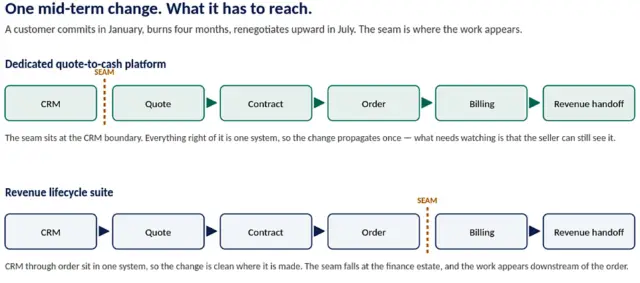
Figure 3. One mid-term contract change traced across the cycle, and where the integration seam falls under each architecture.
Our quote-to-cash process was held together by a customized CPQ solution[…] It worked when we sold perpetual licenses, but by the time we were selling SaaS and subscriptions, it was brittle. Every modification took heroic effort.
The cost of getting this wrong is not a one-off. It recurs every time a contract changes, which in a usage business is most months.
Billing model coverage
Count the models you have to run at the same time, not the ones you support. Subscription, usage, hybrid, commitment-and-drawdown, tiered and volume rating, credits. The question is whether each new one becomes a special case. For the underlying billing scope see recurring billing software; for how the usage models themselves work, see usage-based pricing and billing.
Revenue recognition handoff
Quote-to-cash and revenue recognition are separate disciplines and usually separate systems. What belongs in a quote-to-cash evaluation is the handoff: how completely your contract and billing data reaches the revenue system, how much of that transfer is manual, and what happens when a contract is amended. Evaluate the recognition treatment itself separately and on its own terms, see revenue recognition automation.
We assess every platform here on the handoff and not on the treatment behind it, and that applies to our own row as much as any other. Where we describe a vendor’s material as naming or not naming a recognition stage, we are describing the material, not the capability.
Integration surface
Every option creates at least one seam. What varies is where it falls and who owns it. CRM on one side, ERP on the other.
| “The order management team was doing manual order entry. The deal desk team was creating certain terms manually. The revenue recognition team had to recognize revenue manually.”
Priscilla Rossouw, Director of Order to Cash, AppFolio |
Three teams re-entering what the order record already held, and none of them doing anything wrong. Each one sits downstream of a different seam. For the specific failure mode where CPQ meets ERP, see where CPQ-to-ERP integrations break.
Embedded AI as an operating layer
Separate AI that sits in the workflow and changes what the system does from AI that sits beside it and summarizes. Both get sold under the same word. Your test is whether the capability changes an outcome your finance team is accountable for. For a capability-level comparison, see how embedded AI differs across quote-to-cash systems of record.
Implementation and time to first invoice
Ask how long until the first correct invoice leaves the new system for a real customer. It beats a project plan, because a complete answer has to include data migration, catalog construction, tax configuration and at least one integration.
Total cost shape
Look at shape, not numbers. license cost, implementation cost, and the internal operating cost of running the thing, which is the one that gets left out of the business case. A platform that needs a dedicated administrator is differently expensive, not more expensive, and the difference shows up in a budget line nobody forecast.
5. The comparison
Eight platforms, six columns. Each cell names the source it came from, read on 17 September 2026. Our row carries the same columns as everyone else’s, limitations included.
| Platform | Architecture | Enterprise fit | Strongest part of quote-to-cash | Evidence reviewed | Watch-out |
|---|---|---|---|---|---|
| Zuora | Dedicated quote-to-cash platform | Global enterprises. Published framing pairs a CFO agenda against a CIO agenda instead of addressing a single buyer | Contract change. Orders are modeled as first-class records with order actions at rate-plan and subscription level, each generating delta MRR, TCV and TCB metrics | ISG Subscription Management and Revenue Lifecycle Management Buyers Guides 2025. Zuora business object model, Orders object model and CPQ documentation, plus four solution pages, 17 September 2026 | Three components to keep current, not one: the platform, the Zuora CPQ managed package inside Salesforce, and the Zuora 360 sync. Zuora recommends upgrading the package quarterly |
| Salesforce Revenue Cloud | Revenue lifecycle suite | Stated as spanning fast-growing startups to global enterprises, for subscription, consumption and hybrid models, serving sales, finance, legal and operations | Configure and quote. A dedicated CPQ page, and five of eleven named implementation modules sit in the catalog, pricing and configuration space | ISG Subscription Management and Revenue Lifecycle Management Buyers Guides 2025. Four marketing pages, the Help implementation page and a Trailhead module, 17 September 2026 | The published lifecycle stops at the ERP boundary and its own stage list names no revenue-recognition stage. Product is mid-rebrand under three names |
| Oracle Fusion Cloud
Subscription Management |
ERP-led at the data layer; product ownership contested between ERP and CX | A governed system of record for finance in multi-entity, multi-currency, multi-GAAP operations across multinational estates | Billing, specifically the bill-line handoff into Receivables, documented at mechanism level. The revenue handoff runs it close, with named processes on both sides of the boundary | ISG Subscription Management and Revenue Lifecycle Management Buyers Guides 2025. The Using Subscription Management and Using Revenue Management reference guides, an order-management integration overview and five Oracle pages, 17–18 September 2026 | Collections and cash application are the thinnest documented area of Oracle’s own reference guide, set against its billing depth, and the configure-and-quote stage relies on a separately named product |
| SAP BRIM | ERP-led, stated by the vendor as technically part of S/4HANA | High-volume subscription and usage business across B2B, B2C and B2B2C, including revenue-sharing models, in estates already standardized on S/4HANA | Billing and invoicing inside Contract Accounts Receivable and Payable, documented at object level with a named execution sequence. The integration surface is documented to the same depth | ISG Subscription Management and Revenue Lifecycle Management Buyers Guides 2025. Two product pages, the onboarding resource center, three learning units and the help-portal Integration Guide, 17–18 September 2026 | Configure and quote is the weakest link, with quoting deferred to a separately licensed CPQ product. SAP also states that separate release cycles can delay end-to-end functionality across integrated systems |
| Conga Advantage
Platform |
Dedicated CPQ and contract-led, positioned as a platform in its own right | Claims a range from small business to large enterprise, and names in-house legal teams as a distinct buyer | Configure and quote. A rules-based configuration engine, guided selling and discrete and cumulative range pricing carry the published detail | ISG Revenue Lifecycle Management Buyers Guide 2025, placed first overall. Five Conga pages and the documentation portal, 17 September 2026 | The revenue handoff is explicitly outsourced to an ERP in Conga’s own words, with no rating or mediation mechanism documented |
| BillingPlatform | Billing-led with quote-to-cash extensions | A no-code platform built for enterprise scale, naming telecom, SaaS, utilities, fintech, healthcare and large cloud operators | Billing, specifically mediation and rating. Ingestion formats, deduplication, charge routing and fourteen rating methods are named individually | ISG Subscription Management and Revenue Lifecycle Management Buyers Guides 2025. Four public solution pages, 17 September 2026. Product and developer documentation exists but is behind a customer login | Markets on quote-to-cash but publishes no quoting or contract mechanism of its own; the lifecycle it describes begins at order capture, leaving front-end deal construction to something else |
| Chargebee | Billing-led with quote-to-cash extensions | B2B SaaS and AI-native companies running sales-assisted or hybrid motions, with usage pricing, bundles and ramp deals | Configure and quote. One catalog driving every quote, approval routing by deal size, currency, product or rep role, entitlements set at quote | ISG Subscription Management and Revenue Lifecycle Management Buyers Guides 2025. Two product pages and two documentation pages, 17 September 2026 | The quoting depth sits on a marketing page; the vendor’s own documentation definition of the product surfaces neither the quoting layer nor the recognition module |
| Stripe | Billing-led, payments-first | Names enterprises as a segment and addresses complex enterprise deals. API-first in mechanism and documentation rather than in stated positioning | The revenue handoff. A chart of accounts complete to the account level, per-activity journal-entry mappings and worked negative-line examples | ISG Subscription Management Buyers Guide 2025. Two Stripe marketing pages, two documentation pages and the suite page, 17 September 2026 | Quotes are a first-class API object with a documented state machine, but the documentation describes no approval routing, no discount-policy enforcement and no e-signature step |
How to read this table
The strongest-stage column assesses published evidence, not product quality. It answers one question: On which single stage of quote-to-cash does this vendor publish the most mechanism, meaning named objects, named processes and worked examples, not the most description? A vendor can be excellent at a stage it documents thinly. What the column tells you is where to point your own verification, because a stage a vendor documents heavily is a stage it expects to be asked about.
The watch-out column works the same way. Several entries are absences, not statements: a stage missing from a vendor’s own list, a module its documentation does not acknowledge, a mechanism claimed on a marketing page and unsupported elsewhere. An absence in public material proves nothing about the product. It gives you a question to ask, and one a vendor should be able to answer quickly if the capability is there.
There is no score, and that is deliberate. Scoring eight platforms on eight criteria would produce a number, and the number would be our opinion wearing the costume of a measurement. Worse, it would hide the weighting, and the weighting is the part that varies between businesses. A score is only as good as the weights behind it, and the right weights here are yours. Section 8 sets out how to arrive at them.
Read the table by column the first time, not by row.
- Architecture shows you the shape of the field.
- The strongest part of quote-to-cash shows you where each vendor has chosen to put its published effort.
- Watch-out shows you what each vendor’s own material leaves unaddressed.
A row tells you about one vendor. A column tells you about the decision.
What the table does not capture
Four things sit outside it, and one of them decides most evaluations.
- Fit to your existing estate, which in most enterprise evaluations decides the outcome. A platform that looks like a poor fit on paper, sitting beside an ERP you have already standardized on, will frequently beat a better-fitting platform that has no such advantage.
- Your systems integrator, whose record on programs of this shape is worth as much scrutiny as the platform itself.
- Behavior at your volume, with your data, under your approval policy. Nothing we read could have established that.
- Roadmap. Everything here is what each vendor publishes today, and in a category moving this quickly a capability announced next quarter can change a row.
And then the one thing a comparison table structurally cannot capture: what happens in year three, when the pricing model you run today has been replaced by one nobody in the evaluation had thought of. That is the case for weighting contract change handling heavily, and it is the argument we keep returning to.
6. Platform by platform
Five platforms carry a full section below. Three carry a table row and a short note, and we state the rule for which at the end.
Zuora
Zuora is a dedicated quote-to-cash platform. It is the common choice for enterprises whose revenue model changes after signature. Its strongest documented stage is contract change, modeled as first-class order actions. The limitation to check is the number of moving parts. Based on vendor reference documentation, reviewed September 2026.
Where it fits
Zuora positions itself to global enterprises, and its own pages pair a CFO agenda against a CIO agenda instead of addressing one buyer. That reflects where a platform of this shape gets decided, which is rarely one function’s call.
The architecture claim is explicit. Zuora describes itself as ERP-agnostic and designed to slot into an existing architecture without re-platforming risk, and names integrations to Salesforce, SAP, Workday and NetSuite. Its published stage order runs quoting, then usage and billing, then invoicing, then collections, then the revenue handoff.
This fits you if your contract is a live object rather than a filed document. Amendments are frequent, usage is metered against commitments that get renegotiated, and a single change has to land correctly in three downstream places. If your contract is signed once and runs unchanged for three years, the argument weakens and the second system gets harder to justify.
Strongest documented stage of quote-to-cash
Contract change, and the object model is where you can see it. Zuora publishes an Orders object model in which a change to a live contract is not an edit but a first-class record. An Order represents an agreement that creates or changes one or more subscriptions. Each Order contains one or more Order Actions, and those operate at two levels: rate-plan actions (Add Product, Remove Product, Update Product) and subscription-level actions (Create Subscription, Renewal, Cancellation, Terms and Conditions, Owner Transfer, Suspend, Resume).
The part worth noticing is what gets generated alongside them. Order actions generate delta metrics — Order Delta MRR, Order Delta TCV and Order Delta TCB — recording what a specific change did to monthly recurring revenue, total contract value and estimated billing. Ramp and Ramp Interval objects model staged commitments over a term. So the answer to “what happened to this contract, when, and what did it do to the numbers?” is a query rather than a reconstruction.
Zuora publishes separate object models for the product catalog, for attribute-based pricing, for invoice settlement, for CPQ and for revenue. That is unusual in this set, and it is the reason this row is assessed on documentation rather than on positioning.
What to watch
You are running more moving parts than a suite asks for. If you run Salesforce, that is three components to keep current rather than one.
- The platform. It sits beside the CRM rather than inside it.
- The quoting layer. Zuora CPQ is a managed package built on the Salesforce platform, and Zuora Quotes is a native Salesforce application, so your sellers quote where they already work.
- The sync back. Zuora 360 synchronizes the resulting customer and invoice records into Salesforce.
Zuora’s own documentation recommends upgrading the Quotes package at least once a quarter to stay compatible with Salesforce platform changes. Somebody owns that cadence. If your CRM is not Salesforce, the quoting question is different again and worth asking, because the native-package answer does not apply.
The analyst material carries the second watch-out, and it is ours to state. In ISG’s 2025 Buyers Guide for Subscription Management, Zuora is placed first overall with Leader designations in all seven categories. In the 2025 Buyers Guide for Revenue Lifecycle Management, it holds two of the seven and sits in the Exemplary tier alongside five of the ten providers rated. If you are evaluating a revenue lifecycle suite, you are reading the guide where we do not lead.
Best-fit profile
Enterprises where revenue-model change after signature is frequent and consequential, where more than one billing model runs at once, and where finance rather than sales operations owns the monetization process. Poor fit where the CRM is your operating truth and pricing is stable once signed.
Salesforce Revenue Cloud
Salesforce Revenue Cloud is a revenue lifecycle suite. It is the common choice for enterprises where the CRM is the operating truth. Its strongest documented stage is configure and quote. The limitation to check is the finance-side boundary. Based on vendor marketing and implementation pages, reviewed September 2026.
Where it fits
The architecture is stated without ambiguity. Salesforce describes the offering as built natively on Salesforce and integrating with Sales Cloud and its other applications, with a scope running from product catalog management and pricing through quoting, contracting, order fulfillment and invoicing. It names its target as the messy middle between CRM and ERP, which is an accurate description of the gap it closes.
This fits you if sales operations own your revenue process and the pipeline is your operating truth. The advantage is structural, not a feature: there is no join between the opportunity and the quote, because they are one record, and everything downstream inherits from it.
The offering is assembled rather than singular. Salesforce describes it as composable, with capabilities available separately and expandable over time, so what you get depends on what you buy.
Strongest documented stage of quote-to-cash
Configure and quote, clearly. There is a dedicated CPQ product page, and Salesforce’s own implementation documentation lists eleven named modules, five of them in the catalog, pricing and configuration space. That is where the published depth is, and it is where you would expect a CRM-anchored suite to be strong.
What to watch
The naming is a problem serious enough to affect a procurement document. As at the review date, Salesforce publishes three current names for this offering across three of its own live properties. The marketing pages call it Revenue Cloud. Salesforce Help states that Revenue Cloud is now Revenue Management. Trailhead and the CPQ page state that Revenue Cloud is now Agentforce Revenue Management. Confirm the current name directly with Salesforce before it goes anywhere near a contract, and expect documentation and product UI to disagree with each other for a while.
The finance-side boundary needs stating carefully, because the easy version of it is wrong. Salesforce’s billing material offers more than one route at that boundary, so it is not accurate to say the offering stops at the ERP. What is accurate, as at the review date, is narrower: the lifecycle page’s own list of stages does not name a revenue-recognition stage. That is an absence in a published stage list, not a statement about the product. If the handoff is where your work is, press on it. Ask Salesforce directly what it recommends there and for which profile.
Best-fit profile
Enterprises where the CRM is the system of record the business runs on, where deal construction and approval are the constraint, and where pricing is comparatively stable once signed. Poor fit where your revenue model changes frequently after signature and the finance-side handoff is where the work is.
Oracle
Oracle’s subscription management offering is ERP-led, with a qualification. It is the common choice for enterprises already standardized on Oracle financials. Its strongest documented stage is billing, specifically the bill-line handoff into Receivables. The limitation to check is collections. Based on vendor reference documentation, reviewed September 2026.
Where it fits
The qualification matters, and dropping it would misdescribe the product. Oracle’s Fusion Cloud Financial Management page claims subscription management as an ERP capability. Yet the offering’s marketing home sits under the CX and Sales tree, its release-readiness content is filed under Sales, and Oracle’s main ERP page does not mention subscription management, revenue management or quote-to-cash at all.
The reference documentation settles it toward ERP-anchored at the data layer, and the Financials side of the documentation settles it further. Bill lines interface to Receivables through named scheduled processes. Subscription data reaches Revenue Management through a named sequence: Send Subscription Revenue Information to Oracle Revenue Management Cloud runs from Subscription Management, then Validate Customer Contract Source Data and Identify Customer Contracts run on the Financials side. Subscription changes arrive as contract revisions, and subscription billing is imported from Receivables to clear contract asset balances.
So the ERP anchoring is real where it counts, because the output posts into Oracle financials and the handoff is documented from both ends. It stays contested at the product layer: Oracle’s own instruction for configuring that integration points you at a CX implementation guide, which is a fair summary of the ambiguity.
This fits a finance-led evaluation in a multi-entity, multi-currency, multi-GAAP environment, where your ERP is already the governed system of record and the question is whether subscription revenue can come inside that governance or has to sit beside it.
Strongest documented stage of quote-to-cash
Billing, and specifically the handoff of bill lines into Receivables. Oracle’s reference guide is mechanism-dense in a way marketing pages are not: named scheduled processes, bill-line interface statuses, planned invoice dates, invoice-text attribute construction with a stated character limit, advance and arrears billing, partial-period and milestone billing. Your finance team can plan an implementation against that level of detail.
The revenue handoff runs it close, and on published evidence Oracle documents that transfer more completely than anyone else in this set — named processes on both sides of the boundary, with contract revisions carried rather than re-keyed. If criterion 4 is what decides your evaluation, this is the row to read first.
What to watch
Collections and cash application are the thinnest documented areas of Oracle’s own reference guide. Credit memos and credit methods are covered. Dunning, disputes and receipt applications are not covered to anything like the same depth as billing. If collections is your constraint, press there first, and ask for the same level of named-process detail Oracle publishes on the billing side.
The product-versus-ERP ambiguity carries a different risk. A capability marketed under CX and consumed by Finance can end up with its roadmap owned by one organization and its implementation owned by another, and you are the one who discovers it. Establish at the outset which Oracle organization owns the offering and which one answers your support case.
Your quote stage is the third thing. Oracle’s configure-and-quote capability is a separately named product, so a complete quote-to-cash picture here spans at least two Oracle products, and the join between them is yours to understand before signature.
Best-fit profile
Enterprises already standardized on Oracle financials, with complex statutory and multi-entity reporting, where governance and audit weigh more heavily than front-end flexibility, and where subscription revenue is a growing part of a business whose core is not subscription. Poor fit where quoting complexity is your constraint, or where collections is the stage under pressure.
Conga
Conga is a dedicated CPQ and contract-led platform. It is the common choice for enterprises where the contract is the complex object. Its strongest documented stage is configure and quote. The limitation to check is the revenue handoff, outsourced to an ERP. Based on vendor documentation, reviewed September 2026.
Where it fits
Conga’s documentation portal describes the Advantage Platform as an open revenue lifecycle management platform designed to run on any cloud infrastructure provider, and the marketing pages say it deploys on any CRM without restriction. Salesforce is positioned as an integration and optimization target rather than a residency requirement.
One question is unresolved from Conga’s public material. The documentation portal describes the Advantage Platform and Salesforce as two separate deployment tracks for the same applications, and Conga’s own FAQ confirms a Salesforce-embedded heritage. No public page states which applications run on which track, or at what feature parity. Ask directly and get the answer in writing.
Conga is in this comparison for a specific reason. It is placed first overall in ISG’s 2025 Buyers Guide for Revenue Lifecycle Management, with Leader designations in all seven categories, and it is not rated in the Subscription Management guide at all. That single fact is the clearest illustration we have of the argument in Section 3.
Strongest documented stage of quote-to-cash
Configure and quote. The CPQ material names a rules-based configuration engine handling product relationships and dependencies, guided selling, discrete and cumulative range pricing, and controlled pricing approvals. That is more specific than the surrounding material, and it is the only stage where Conga publishes mechanisms at that level.
What to watch
The back half of the cycle is where the published depth stops. Conga’s own revenue lifecycle page states that you integrate Conga with enterprise resource planning software to fulfill the revenue recognition process, and no rating or mediation mechanism appears anywhere in the material we reviewed. For a subscription or usage business, that is the load-bearing question.
The second caution is about the evidence rather than the product. Four of the five Conga pages we reviewed assert capability without describing mechanism, so Conga’s entries in our table are thinner by evidence availability. That is a different thing from thinner by capability, and you should not read one as the other.
Best-fit profile
Enterprises where the contract is the complex object, with long negotiation cycles, clause-level obligations and legal as a named stakeholder, and where billing volume is moderate and an ERP already handles the finance end. Poor fit where metered usage at volume is central.
BillingPlatform
BillingPlatform is a billing-led platform with quote-to-cash extensions. It is the common choice for enterprises whose constraint is billing volume. Its strongest documented stage is billing, specifically mediation and rating. The limitation to check is the front end. Based on vendor solution pages, reviewed September 2026.
Where it fits
BillingPlatform describes its scope as running from order capture through billing, payments and customer service, and positions the product as a control layer that integrates with CRM, ERP and payment systems. Notice the starting point in that sentence: order capture, not quote. That single word places the platform in the cycle more precisely than most vendor positioning does, and it is worth taking at face value.
The architectural primitive it leads on is an extensible data model with point-and-click configuration, described as a no-code platform built for enterprise scale. The named target industries are telecom, SaaS, utilities, fintech and healthcare, together with large cloud operators. That is a usage-heavy list, consistent with where the published depth sits.
This fits you if your volume problem is downstream of the deal. Straightforward contracts, but millions of events to rate, invoices assembled from many sources, and a month-end that is a data problem rather than a judgment problem.
Strongest documented stage of quote-to-cash
Billing, by a clear margin on published evidence. The mediation material names the ingestion formats it accepts, the rule-based validation and deduplication that runs before rating, the charge-routing step, and a mediation data lake holding data in both aggregated and unaggregated forms. The pricing material names fourteen out-of-the-box rating methods.
Based on the public sources we reviewed on 17 September 2026, this appears to be the deepest single-stage mechanism material any vendor in this set publishes. That is an observation about the evidence, not a judgment about the product. It is a useful one, because a vendor documenting a stage at that level expects to be interrogated on it and is equipped for the conversation.
What to watch
The front end is the gap, and the vendor’s own module list is where it shows. BillingPlatform markets on quote-to-cash and publishes no quoting, CPQ or contract mechanism among its public solution pages. The lifecycle it describes begins at order capture, which leaves deal construction to something else.
One caveat on the evidence, and it is ours rather than theirs. BillingPlatform maintains a product documentation portal and a developer portal, and both sit behind a customer login — access runs through a Customer Success Manager. So this row is assessed on public material only, and the depth we describe above is the depth BillingPlatform chooses to publish openly. Ask to see the gated documentation during an evaluation; it is the fastest way to test whether the front-end gap is real or simply unpublished.
If your sales motion is simple and your pain is downstream, filling the front end with an existing quoting tool is a reasonable architecture. If you run a deal desk with non-standard approvals, your process still spans two systems and the seam sits in the middle of it.
Best-fit profile
Enterprises with high-volume metered usage, complex rating and invoice construction, and a sales motion straightforward enough that quoting is not the constraint. Poor fit where the deal desk is your bottleneck, or where you need one system holding the contract from quote through to the revenue handoff.
The three remaining platforms
Three rows carry a table entry and a short note. Here is the rule, so you can judge it: where two vendors occupy the same architectural position, the second instance carries the shorter treatment. SAP is the second ERP-led instance, Chargebee the second billing-led instance with a quoting extension, Stripe the second anchored at payments. Length here follows that rule, not how much any of the three publishes.
SAP. Based on the public sources we reviewed, SAP appears to state the ERP anchoring more plainly than Oracle does. Its onboarding material describes the offering as technically part of S/4HANA, the published billing material is object-level and precise, and its integration guide documents two named S/4HANA scenarios by SAP scope item code — Subscription Management with Sales Billing (57Z) and Subscription Management with Convergent Invoicing (5IK) — with separate paths for Cloud Public Edition and for Private Edition or on-premise. Replication is documented object by object: business partners, products and rate elements, subscriptions into provider contracts, billing forecasts into billing plans, billing data into sales billing.
Two cautions come from SAP’s own words. A separate license may be required for the solutions you integrate with, which is where the configure-and-quote gap bites, because quoting is deferred to a separately licensed CPQ product. And because each integrated solution releases on its own cycle, SAP states there can be a delay before functionality is available end to end across integrated production systems. If you are buying the integrated picture, ask which parts of it are available together today.
Chargebee. Chargebee frames its quoting layer as an extension of billing, not a separate stack, and the quoting material is specific: one catalog driving every quote, approval routing by deal size, currency, product or rep role, entitlements committed at the quote stage. The caution is an evidence asymmetry. That depth sits on a marketing page, while Chargebee’s own “what is Chargebee?” documentation page defines the product as subscriptions, billing, invoicing, payments, tax, dunning and analytics, naming neither the quoting layer nor the recognition module. Both have their own documentation elsewhere, so this is a gap in how the product is defined rather than in what is documented.
Stripe. Stripe is anchored at payments and says so, describing its billing product, in its own words, as “the only billing software with a built-in payment system.” Based on the public sources we reviewed on 17 September 2026, its published depth at the revenue-handoff end appears to be the greatest in this set. The gap is at the other end. Quotes exist as a first-class API object with a documented state machine, but the documentation describes no approval routing, no discount-policy enforcement and no e-signature step. Resolve one thing before you shortlist: Stripe’s billing page presents Metronome as a Stripe product for usage-based pricing while Metronome remains a separately branded property, and no Stripe page we reviewed explains the relationship to Stripe Billing’s own metering.
7. Where each architecture breaks
If you have to defend a recommendation to a procurement committee, a comparison that only describes strengths is no use to you. Here is where each option fails.
When a dedicated platform is the wrong answer
When your CRM is where the business actually operates and your sellers will not leave it. A dedicated platform puts quoting outside the system your sales organization lives in, and the integration bridging that gap is only as good as the effort you put into it. A company that spent five years making its CRM the single place anybody looks is being asked to carry an exception. Exceptions decay.
When your revenue model is stable. If the contract is signed once, runs three years unchanged, and the pricing is one of two standard shapes, most of what a dedicated platform is built to absorb never comes up. The capability is real and you will not use it. You have bought and staffed a second system to solve a problem you do not have.
When nobody owns the seam. A dedicated platform creates a join between the CRM and the platform that somebody owns permanently. Not for the duration of the project. Permanently. If you cannot name that person before you sign, you have bought an orphan.
When a suite is the wrong answer
When your hard part is downstream of signature. A suite is strongest where the deal gets constructed and weakest where the revenue model changes afterwards. If amendments are frequent, if usage is metered against renegotiated commitments, if a mid-term change has to land correctly in billing and in the revenue handoff, the seam falls in the worst possible place, straight through the middle of the work.
When finance owns the decision and the finance boundary is unsettled. Where a suite’s published stage list stops short of the recognition handoff, what happens on the other side is something you have to put to the vendor, not read off a page. If that handoff is your principal pain, it is the load-bearing question and you want the answer in writing before you shortlist.
When you are buying the suite for consolidation, not capability. Vendor consolidation is a legitimate objective and a poor primary criterion. A suite chosen because it reduces your vendor count, in a business whose constraint is metered billing at volume, will reduce your vendor count and not your problem.
When neither is
When billing software is honestly enough. Not every business that has outgrown spreadsheets needs a quote-to-cash platform of either shape. Some need a capable billing system and a tidier process around it, and buying architecture to solve a process problem is expensive. For where that line falls, see billing software or a quote-to-cash platform.
When your real constraint is the data. If your product catalog is inconsistent, your customer hierarchy is ambiguous, or your existing contracts cannot be reconciled to your invoices, you will carry all of it into whichever platform you buy. Neither architecture repairs it. Both will surface it in the first migration, usually at the worst moment.
When the organization is not ready to change the process. Both architectures impose a way of working. If you intend to keep your current process and run it on better software, you will spend the implementation configuring the new system to reproduce the old one. That is the most reliable way to take on the cost without the benefit.
8. The decision, as a sequence
What to establish before you look at platforms
None of this is about vendors.
Measure how much your revenue model changes after signature. Count the amendments raised in the last twelve months against the contracts in force. Then count how many of those needed somebody to touch more than one system to complete. That second ratio tells you more about which architecture fits than anything a vendor will show you, and it is rarely calculated before an evaluation starts. One contract in twenty changing, handled in one system, is a different problem from one in three changing and each taking three systems to land.
Find where your operating truth sits today. Not where the data is supposed to live, but where people look when they want to know something. If your questions end in the CRM, an architecture that moves quoting out of it is swimming upstream, and the integration has to be good enough to carry the difference. If they end in the finance system, the opposite applies, and a CRM-anchored suite will be asked to report on things it does not hold.
Name who owns the seam. Every option creates at least one join between systems. Establish who owns it, in which team, with what budget, before the evaluation and not after it. This is the question most often deferred and the one that most reliably decides whether your architecture survives its second year. An architecture nobody has agreed to own gets reopened in eighteen months, usually by whoever inherits the reconciliation.
The four questions that actually decide it
What happens to usage already metered when a commitment changes mid-term? The sharpest single test of contract change handling, because a complete answer has to span quoting, billing and the revenue handoff at once. A platform that handles it cleanly shows you the mechanism. A platform that does not just describe a process.
Where does the non-standard term live after approval? If somebody re-enters it downstream, your approval workflow is decorative and your deal desk is still the bottleneck it was before.
How many pricing models will you run at the same time in three years? Not how many you run today. The count that matters is the one your architecture has to survive, and it is usually higher than the one in the business case.
What is the shortest path from a signed contract to a correct invoice, counting the humans in it? Every human in that path is a place the process can stall and a cost that recurs monthly. The path also changes more between the two architectures than anything else, which makes it the cleanest way to see the difference in practice.
What to ask in a vendor evaluation
Take these six into every demo.
- Ask for a deal that breaks your standard pricing model, and follow it end to end to an invoice and a revenue schedule. Do not accept the happy path.
- Raise a commitment mid-term and ask what happens to usage already metered under the previous allowance. Watch whether anybody leaves the demo environment.
- Ask for a mid-term downgrade with a credit, then ask to see the resulting invoice and what the revenue system receives.
- Ask which stage the vendor documents most heavily, then ask to see that documentation. A vendor that cannot produce reference material for its strongest stage is describing a roadmap.
- Ask for the current, exact product names in writing. Four of the eight vendors here publish more than one name for the same offering, and more than one publishes three.
- Ask what your systems integrator does that the vendor does not, and get the boundary in writing before signature, not in month four.
9. Implementation: phased or full replacement
The phased case, and what it costs you
Phasing carries one cost that business cases routinely underweight. For the length of the program, two systems each hold part of the truth. Reconciling them is standing operational work, not a project task that ends, and it needs a named owner and a budget line from the start.
The second cost is slower and harder to see. While both systems are live, you make every process change twice and decide every exception twice. Your teams develop habits in the old system and carry them into the new one, and the longer the overlap runs the more of those habits get configured into the target state.
The advantages are what make phasing the common choice. Risk stays bound to one surface at a time. The organization learns from something small enough to recover from. A failure in phase one does not take your whole revenue process down with it, and you can re-argue the business case on evidence instead of a projection.
The full-replacement case, and what it costs you
Full replacement removes the dual-truth cost entirely and concentrates the risk into a single cutover window. Everything then depends on that window, on the quality of the data migration behind it, and on whether your business can tolerate a period when invoicing is uncertain.
The less obvious advantage is that it forces the data question early. A phased program can run a long way before anyone discovers that the contract records and the invoice records disagree. A cutover surfaces that during the dry run, while there is still time to act on it.
It suits businesses with one product line, one legal entity, or a contract estate clean enough that migration is a known quantity and not a discovery exercise. It goes badly where the existing contract data cannot be reconciled to the existing invoices, because the cutover is exactly where that gets discovered and there is no fallback.
The two routes side by side
| Phased | Full replacement | |
|---|---|---|
| Main cost | Two systems each hold part of the truth for the length of the program | Everything depends on one cutover window |
| Hidden cost | Every process change made twice, every exception decided twice | Data problems surface late if the dry run is thin |
| Main advantage | Risk bounded to one surface; the business case can be re-argued on evidence | No dual-truth cost, and the data question is forced early |
| Suits | A definable boundary — a product line, region or legal entity — that one system can own end to end | One product line, one legal entity, or a contract estate clean enough to migrate as a known quantity |
| Goes badly when | Every contract touches everything, so phasing creates dual truth without reducing risk | Existing contract data cannot be reconciled to existing invoices |
How the choice interacts with the architecture decision
The deciding factor is usually whether you can define a boundary — a product line, a region, a legal entity — where one system owns a complete contract lifecycle end to end. If you can, phase along that boundary and the dual-truth cost stays contained inside it. If a contract touches everything, phasing creates the dual-truth problem without reducing the risk, and the case for a single cutover is stronger than it first looks.
The architecture choice cuts both ways here. A dedicated platform takes a boundary drawn around customers or products, because it holds the whole cycle for whatever sits inside it. The cost is that everything inside the boundary moves at once. A suite extending an existing CRM estate draws its boundary differently, because part of the cycle already runs in the system it extends. That can put your phase line through the middle of a process, and it can also mean less has to move.
If the answer to the boundary question is no, find that out before you choose the architecture, not after, because it changes what each option costs to implement. For the practice detail behind the decision, see sequencing a quote-to-cash transformation.
10. What an enterprise transformation looks like in practice
Cegid, a European enterprise software business, moved its quote-to-cash process onto a dedicated platform. What to study is not the technology selection but what the company optimized for, because it is the trade-off this guide is about.
What Cegid says about it is quoted in full below. We claim nothing beyond it: the program’s sequencing, duration and internal costs are not public, and we do not infer them.
The alignment between our front office and back office is what makes this work. Zuora gives us the agility to experiment with new monetization models, without breaking our core business operations.
Alignment between front office and back office is the seam every option in this guide creates somewhere. The ability to try a new monetization model without disturbing what already runs is contract change handling, described in the language of a business rather than a specification.
A system that works for the models in place at go-live is the normal outcome of a program like this. What you are trying to establish in an evaluation is what you can attempt afterwards without starting another one.
The full account is in Cegid’s quote-to-cash transformation. Read it as one company’s answer to the question this guide poses, not as a general result. The estate it landed in is not yours.
11. Where Zuora fits
We sell a dedicated quote-to-cash platform, and everything above about that architecture applies to us without adjustment. The strengths where the revenue model keeps changing after signature. The cost of running a second system beside the CRM.
Our summary is narrow. If you run more than one billing model at once, if amendments are frequent and consequential, and if finance rather than sales operations owns your monetization process, a dedicated platform is the stronger starting assumption, and Zuora is one of the platforms in that shape. We are rated in both 2025 ISG Buyers Guides: placed first overall in Subscription Management, and in the Exemplary tier in Revenue Lifecycle Management without leading it.
If your CRM is the operating truth and your pricing is stable once signed, a suite is the better answer. Section 7 says so in more detail than a vendor-published guide usually will, and it is the section to read before this one.
One caveat: We have assessed the revenue handoff throughout, not revenue recognition itself, which is a separate evaluation on separate criteria.
. If you work through the eight criteria, weight them against your own business and land on a revenue lifecycle suite, you have used this page correctly. It is not built to produce one answer. It is built so that whichever answer you reach, you can defend it to the people who will ask you to.
For what our platform covers and how it is deployed, see Zuora’s quote-to-cash solution.
Reviewed 17 September 2026. Vendor statements are drawn from each vendor’s own public material, read on that date. Analyst placements are drawn from ISG Research’s 2025 Buyers Guide for Subscription Management (Mark Smith, September 2025) and 2025 Buyers Guide for Revenue Lifecycle Management (Stephen Hurrell, June 2025).
FAQs
1.
Should I choose a dedicated quote-to-cash platform or a revenue lifecycle management suite?
It depends on which part of the process constrains the business. A dedicated quote-to-cash platform tends to fit enterprises whose revenue model keeps changing after the contract is signed — usage-based, hybrid or consumption pricing, frequent mid-term amendments, complex approval paths. A revenue lifecycle suite tends to fit enterprises where the sales process is the harder problem, the CRM is the system of record the business runs on, and consolidating vendors carries real weight. If contract change after signature is frequent and material, the dedicated platform is usually the better starting assumption.
2.
What is the difference between a quote-to-cash platform and a revenue lifecycle suite?
The difference is where each one is anchored. A dedicated quote-to-cash platform is anchored at the monetization end — quoting, contracting, billing, payments and the revenue handoff — and integrates outward to the CRM. A revenue lifecycle suite is anchored in the CRM and extends forward into quoting, contracting and billing. Both cover the same nominal process on paper, and both either include configure-price-quote or integrate to it. They differ in which stages carry the most depth, where the integration seam falls, and therefore which failure modes you inherit.
3.
Should I use a dedicated quote-to-cash platform or build the process across point tools?
A point-tool stack is workable while the number of seams stays small and each tool’s owner is the same team. It becomes expensive when a single contract change has to propagate through quoting, billing and revenue independently, because reconciliation between the tools turns into standing operational work rather than a one-off integration cost. The practical test is how many people spend part of each month reconciling systems that should already agree. If that number is growing, the stack has become the constraint.
4.
Is a quote-to-cash suite or a best-of-breed stack better for a SaaS business?
For a SaaS business on straightforward recurring subscription pricing, a best-of-breed stack can hold together for a long time. It comes under pressure when pricing diversifies — usage components, credit and commitment structures, hybrid plans — because each new model has to be represented consistently in every tool rather than once. A suite trades some depth per stage for one representation of the contract. The decision usually turns on how many pricing models the business expects to run at the same time, not on how many it runs today.
5.
Which quote-to-cash platform suits a deal desk managing non-standard pricing approvals?
Deal desks need three things from the platform: approval routing that can express real conditions rather than a fixed chain, non-standard terms that survive into billing without re-entry, and an audit trail of who approved what against which policy. Approval routing is the visible part, and the part a demo shows. Carrying an exception cleanly from the approved quote into the billing schedule decides whether the deal desk gets its time back. Test that path end to end, not the approval screen.
6.
Should an enterprise phase a quote-to-cash implementation or replace the stack at once?
Phasing carries a specific cost: for the length of the program two systems hold part of the truth, and reconciling them is work someone has to own. Full replacement removes that cost and concentrates the risk into one cutover window. The deciding factor is whether the business can define a boundary — a product line, a region, an entity — where one system can own a complete contract lifecycle end to end. If it can, phase along that boundary. If not, phasing creates the dual-truth problem without reducing the risk.
7.
How do you evaluate an enterprise quote-to-cash platform?
Eight criteria cover most enterprise evaluations: quoting and approval complexity, contract change handling, billing model coverage, the revenue recognition handoff, the CRM and ERP integration surface, whether AI is an operating layer or a feature list, implementation time to first invoice, and the shape of total cost across license, implementation and internal operating effort. Weight them against the business rather than scoring them equally. Contract change handling is worth weighting heavily, because it is the criterion that turns into recurring manual work month after month when the platform gets it wrong.
8.
Does a quote-to-cash platform handle revenue recognition?
Quote-to-cash and revenue recognition are separate disciplines and they are usually separate systems. A quote-to-cash platform produces the contract, billing and payment record that revenue recognition consumes; the recognition treatment itself, and the reporting that supports an audit, belong to a revenue system. The question that matters in an evaluation is therefore about the handoff rather than the feature: how completely does contract and billing data reach the revenue system, and how much of that transfer is manual? Evaluate the handoff, and evaluate revenue recognition capability separately on its own terms.