How order-to-cash confusion is limiting business growth
Finance and IT leaders often face misalignment that restricts product launches and business agility. In this episode, Em Daigle and Todd MacLennan examine the real impact of breakdowns in the order-to-cash process. You’ll learn how cultural alignment, technology investments, and data quality shape outcomes for finance and go-to-market teams.

Key terms in this discussion
5 termsThe end-to-end business process that covers everything from receiving a customer order to collecting payment, discussed here as often being owned by finance.
Read MoreConfigure, Price, Quote; a system used to automate quoting processes and handle standard transactions without manual intervention.
Read MoreA structured team or process within finance that collaborates with sales to review deal terms, ensuring they align with business policies and can be recognized for revenue.
Read MoreA pricing and billing strategy that charges customers based on how much of a service they use, discussed as growing more common with new products and AI.
The process of tracking actual usage of a service and determining accurate charges, essential for credibility in billing and revenue recognition.
Speakers
Short on time? Here’s the gist
-
01
Finance leaders are being asked to drive strategy, but their systems often lag behind the business needs, creating barriers to launching new products or adapting business models.
-
02
Order-to-cash often sits with finance, yet IT teams struggle to update systems fast enough, which disrupts collaboration with product and go-to-market teams.
-
03
Nonstandard deals create internal friction, with finance sometimes seen as a bottleneck, and many leaders report extra manual effort when exceptions arise.
-
04
Investing in automation and a strong cultural partnership across teams can substantially reduce manual work, improve data quality, and support agile growth.
By the numbers
- 68%
- 82%
- 61%
Five things to leave with
You gotta build the systems that you need for tomorrow. Don't build what you need for today.
-
Break down silos early
Proactively build relationships between finance, IT, product, and go-to-market teams so all sides understand impacts before changes or new models launch.
-
Invest in future-ready systems
Prioritize technology and process investments that enable agility and growth, rather than focusing narrowly on current requirements or short-term costs.
-
Automate where possible
Implement automation tools like CPQ to handle standard transactions, freeing teams to focus on higher-value work and minimizing manual errors downstream.
-
Focus on clean, reliable data
Ensure consistent, accurate data collection and management to support billing, revenue recognition, and adoption of AI-driven models.
-
Emphasize culture and enablement
Establish a supportive culture where cross-functional teams are empowered and educated about business impacts, easier collaboration, and shared accountability.
Are your finance and IT teams struggling to launch new business models or automate key processes?
Talk to ZuoraWhat to explore next
-
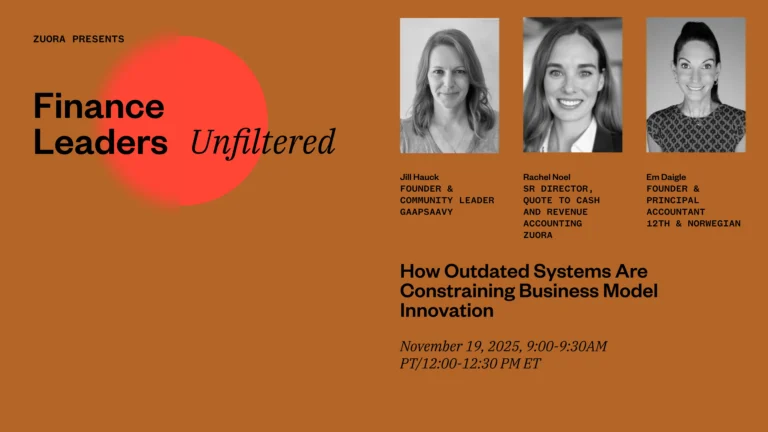
How Outdated Systems Are Constraining Business Model Innovation (Episode 4)
Hear a candid discussion between finance and accounting leaders on how outdated systems can stall business model innovation. You’ll learn why changing go-to-market offerings, pricing complexity, and fragmented data make scaling difficult, and get practical advice for overcoming these challenges to streamline your order-to-cash processes.
5 chapters · 28 min watch -
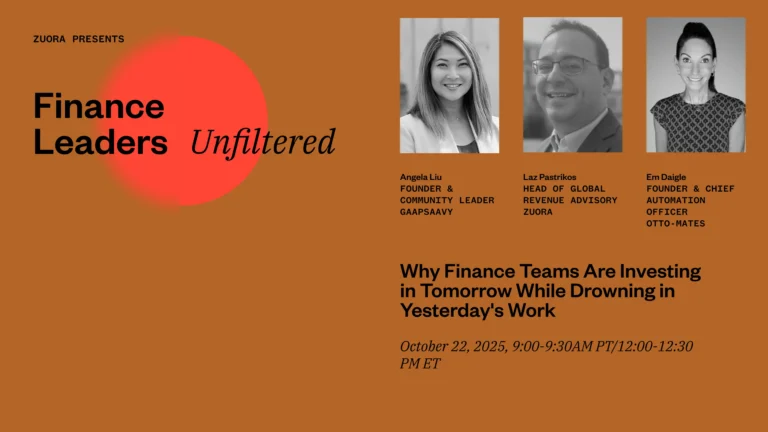
Why Finance Teams Are Investing in Tomorrow While Drowning in Yesterday’s Work (Episode 3)
Leaders in finance, automation, and revenue advisory discuss why so many finance teams are still struggling with manual work—even as AI investments grow. Hear their perspectives on technology adoption, upskilling, automation gaps, and practical steps to move forward.
8 chapters · 31 min watch -

Finance Leaders Unfiltered
Hear finance experts discuss how technology, evolving roles, and automation are reshaping the finance function. You'll learn about major blockers to strategic work, how teams are overcoming manual processes, and how a modern tech stack can support business growth and efficiency.
8 chapters · 29 min watch
Read along Expand Collapse
And welcome everyone. Um, for those who don’t know me or didn’t join our first session in this Unfiltered series based on Zuora’s survey of finance leaders, I’m Em Daigle, and I’m the chief automation officer at Automates. We are a community platform where we provide a transparent space for accounting and finance professionals to explore and collaborate on all things AI and automation to help really kind of modernize the way we work. And with me today, I’m extremely excited to introduce Todd MacLennan, COFO at Zuora. Hey, Todd. Um, would love for you to share a brief intro with all of those listening today. Hey, Em. It’s great to be with you again. As you
said, I’m the chief operating and financial officer here at Zuora, and I’ve been here for the past five years. And I own everything in finance, tech, HR, legal and alliances, uh, with the company, so we’re having a good time. (laughs) I love it. Thank you. Um, I feel like COFO is short for a lot of other things that should have, um, a letter in there based on everything you do. (laughs) Um, all right. Well, let’s get into it. I know we have only 30 minutes, um, but Zuora’s recent research shows finance leaders are being asked to play a more strategic role, but unfortunately, those same leaders are also all too often reporting that the systems that they have in place either aren’t keeping up or aren’t able
to support their teams properly. So, let’s kind of, like, get into it, unpack what this means in our order-to-cash world. Um, when I go to the report, and I’m just referencing some, some, uh, notes I have here, but the report shows that 68% of finance leaders say order-to-cash is centralized and owned by finance, but 82% also say that IT can’t update systems fast enough to meet what those business needs are. Um, so curious, like, from your point of view, what challenges does the misalignment create, um, for leaders like yourself on a day-to-day basis, and how do you
partner with IT to make sure that you can ensure success? It’s a really interesting topic, Em, because I talk to a lot of CFOs, chief accounting officers, and one of the things that’s really been amazing to me over the last 12 months is the conversation that I’ve had, finance is actually keeping companies from being able to roll out new products. So, as things are coming out with, um, AI, how do I have usage-based models? How do I track consumption? How do I track maybe I’m charging on outcomes? And you’ve got, you know, people doing all kinds of really creative things in the product marketing and product management organizations. They come up with this great idea, and then it comes to finance, and we’re the inhibitor. Either we don’t know how to bill for it, we
can’t track it, we can’t recognize the revenue because somebody wants to bundle it, and it’s a real problem. And it’s a place that no finance organization wants to be, is to tell the leadership of the company is like, “Hey, we’ve got these great products out here, but unfortunately we can’t, you know, take them to market because either we don’t have the systems that will support them or we don’t know how, or we don’t have the, um, technology in place to, um, recognize the revenue or keep it in track.” And so, it’s a huge challenge that’s happening and it’s, you know, moving at an even faster pace with the level of innovation that’s going on, especially with AI and, um, new products and services people are bringing out. Totally. I mean, if you think about it, like, what world is it ever an excuse to say like, “Oh, um, just because our
accounting systems or our finance systems can’t support that,” that you can’t actually bring those, those products to market or be able to launch a new sort of go-to-market model, right? Like, you and I have talked about this multiple times, but like, that, the answer’s just like, well, that’s unacceptable. So, you know, thinking about that, like, how do you work with your team at Zuora in particular, like, to make sure that that’s not the case and not happening? (laughs) Uh, I think one of the big things that we’ve seen is, and I think the organization that I’m leading now is a big part of that, is how do we have folks work together? Um, it’s really imperative that both finance and IT work together to make sure you’ve got the systems and
the infrastructure and you can roll those systems out. But more importantly, it’s how do you talk to the go-to-market teams and the product teams to understand how are they thinking about the innovations that they wanna bring to market and making sure that everybody’s kind of walking arm in arm on not only understanding those, but understanding the impacts to the business and the processes from start to finish. So, not only can you track those and send out a bill, but recognize the revenue and report it correctly. And, um, you know, I think when I started my career, you never really heard of finance as being a problem of being able to get a product out the door. (laughs) And now, we are seeing more and more where, you know, we are the, um, the gap that people have to get over, and to your point is people are not gonna tolerate that for very long.
Yeah. No, absolutely. I hear the same thing, uh, over and over. Um, and I think your organization in particular has done a great job with that to balance the, uh, innovations and, and what the business goals are, but being able to set up the right tech stack to get there. I think, um, one thing that I hear especially in the community all the time too is just, you know, um, that the business wants to move at lightning speed, right? To get these products out and adopt these new go-to-market models, um, or, or monetization models, but then the same business has a difficult time justifying the investment….
in those tools which- Okay…. (techno noise) I know that’s not necessarily something y- you’ve run into because I know Zoro’s, like, very much involved with and, um, very much understands how that investment, um, you know, ultimately plays out. Um, but curious from your perspective if you have any sort of, um, thoughts on that and/or suggestions for maybe leaders that are up against a little bit of trouble in that space getting that, you know, that investment support to be able to do the, to adopt the right tools. I mean, it becomes a very simple case of we have a business plan, we have growth, and if we can’t support that growth, uh, all of a sudden that investment looks really silly when you’re sitting there saying, “I have whatever
system investment compared to, you know, double digit growth,” which for companies, you know, may be 10s, 100s, or billions of dollars worth of revenue at the table. So I think you gotta put it all in perspective and not be penny wise and pound foolish. But, you know, the investment goes beyond the dollars. It really goes beyond having the time and the skillsets and that’s the finance teams of making sure that everybody in all the different functions, um, has a bandwidth to do what they need to do to roll out these new systems. And it’s the same thing with IT and the processes that go in and impact the businesses. So it’s just not, um, finance kind of sitting on an island or IT sitting on an island. Everyone’s gotta be working hand in glove, um, to be understanding where the business is going and what infrastructure and systems and
tools and processes need to be in place to support that business. Yeah. I agree wholeheartedly. Um, okay. So back to, um, some of the things that we saw in the report. So almost three-fourths of finance leaders are forced to reject nonstandard deals due to order-to-cash breakdowns. Okay. Um, and that obviously causes friction internally, um, who view finance as a bottleneck. Um, are you seeing more of these nonstandard deals? I know for you that’s, uh, like, a, a no-brainer as far as, like, you don’t ever wanna reject something in that way, but curious, like, how you foresee kind of, like,
these nonstandard deals, how you deal with them, and does finance need to be, um, better equipped to be able to handle some of these? You know, I think there’s a lot there to unpack, but curious from your perspective how you see these nonstandard deals and, and how tech can help. So I think if you have a good sales team, they’re always gonna find a way to be creative and- (laughs)… meet customer objectives and, and that’s what we want them to do. But at the same time, though, we want to make sure the finance teams have the ability to understand and, and guide people. And one of the things that we’ve done here at Zuora is we’ve set up a deal deck structure. We’ve got, um, a great deal of time and investment that’s gone into enabling people, and we really try to educate our sales teams from a standpoint of understanding
what are the impacts of different gives they may have or, or ways they’re trying to solve s- a, a problem. At the end of the day, it’s not my objective, or I don’t think any finance objective or leader’s objective is to say no, but it’s to make sure that- (laughs)… we’re bringing a deal that has good economics to it, that we can reco- and that we can recognize a revenue. I think that’s probably one of the biggest things that we see is, um, you know, folks are well-meaning from a standpoint of how they wanna structure something, but if they’re structuring it in a way that I can’t recognize revenue, and if I can’t recognize revenue, I can’t pay commission- (laughs)… uh, you know, it’s not a great deal for anybody. Yeah. Spot on. You know, I think I’ve worked in organizations personally where, uh, finance and the sales organization get along very well,
and I have to say the, um, I think having that partnership is huge. I’ve also worked in organizations where we didn’t have that same sort of, um, closeness or cross-functional alignment as far as, like, what sort of nonstandard terms we were comfortable to agree to or, or anything like that. You know, I think one of the things though that I can speak to as far as the frictionless side when you have that alignment is that, and curious to see what you think, but the teams will, the sales teams will come to you sooner if they are able to work with you as opposed to, you know, I would say, like, maybe being more concerned about bringing you along for the ride and just
trying to get the deal in at the end of the quarter, but, you know, is that something that you’ve been able to do at Zuora? Um, I think I know the answer to this just ’cause I’ve, uh, talked to Matt Knudson, CIO at Zuora very recently, but from your perspective, curious to see if that’s changed or evolved at all since your time at Zuora and joining and how you guys continue to make that relationship stronger so you don’t run into, um, some of the bigger friction that I’ve seen in certain organizations that isn’t fun to be part of. (laughs) You know, I got a piece of advice really early on in my career from a mentor of mine who I was supporting, and I was a finance leader at the time, and he said, “You know, Todd, if, if you don’t approve any deals, you’re not gonna have anything to account.” And, um- (laughs)… that, it really resonated with me. It’s like, at the end of
the day, our job as a business is to sell product or services, and look, we wanna sell good product and services, so from my perspective, that’s a, an ethos that I wanna make sure everyone in our team understands is, um, the sales teams really have a tough job and, you know, we wanna be there supporting them, and we wanna make sure that we’re bringing in good deals and we can recognize the revenue on them and they’re gonna allow us to meet our objectives. But I think it is really important for people to go in this not a, it’s not an adversarial relationship. It’s how do we help those sales teams bring in good transactions? How do we help them? They, look, they don’t wanna become finance experts, but how do we help them- (laughs)… and set the guardrails for what a good deal works, looks like? And I think when you set that culture, ,uh,… in place, you know, like you said, people start coming to you before. As they’re structuring deals,
it’s like, “Okay, I get an idea, I can maybe do this or that, and, you know, y- in the past, you told me this causes this, so how do I solve this?” And, you know, I think- Yeah…. when you start that, it just becomes an ongoing dialogue, and finance, rather than being an impediment or, to your point, as people are trying to go around you or, you know, jam something at the last minute, it becomes a partnership. And, you know, when people see that everyone’s working together for the same outcome, you get much better results. And I think everybody, overall, is happier, and that’s certainly what we’ve tried to do here is, you know, set up an environment that we have the infrastructure in place and that we’ve got a deal desk in place, that’s got the right culture to work with the sales teams, and make sure that everyone understands what the constraints that a business has. Yeah. No, spot on. Um, now,
I know, though, that there are exceptions that need to be, uh, granted, um, to non, to standard terms. Like, we do end up with nonstandard terms, um, that’s just a fact of business, and, um, if only we lived in a world where it were only standard terms. But according to the survey, 61% acknowledge that the approvals that, um, they need to be able to handle these nonstandard, uh, or these exceptions to the standard terms directly lead to additional manual work and operational strain. I would say that number se- seemed high to me- Yeah…. but when I think about it, I don’t think a lot of teams necessarily
think about- (laughs)… putting those, um, those, I’ll say, the technology in place to be able to handle those. You want to be able… A lot of times, we want to be able to structure around standard terms, and we wanna force everything in there, but we can’t, right? So what are some of the ways that you can, or, or that our, uh, attendees can think about eliminating the manual work for the teams, or have you seen any kind of specific automation wins that freed up your own team’s time, um, that you’ve started to kind of adopt and think about? I think one of the things that we’ve done here at Zuora is we’ve, um, you know, plug for our own CPQ product, but as we’ve implemented CPQ, we’ve got almost 80%
of our transactions now are standard and flowing through, uh, the system that never need to touch anybody. And- Wow…. I, I kind of think about it myself too, it’s like, if I think about it, you know, you, you’re making a reservation for a restaurant, I don’t really want to talk to somebody. I’m perfectly happy to go online and- (laughs)… being able to make that reservation myself. And I think salespeople, you know, if you give them the right tools and you have a CPQ system that they don’t need to interact with you, they’re gonna be super satisfied. Um- Yeah…. at the end of the day, they just want to get a quote out the door and they want to meet the customer’s, um, requirements. So if you can set up the tools and technology that give them that ability to do that without touching, they’re going to be a whole lot more efficient, you’re gonna take out manual work, and you’re gonna have a velocity of the business which is much better. It also keeps your data a whole lot clean, cleaner, and allows
a whole lot of other downstream benefits. So, you know, really investing in those tools up front saves a lot of work and keeps the data clean on the back end, which is, you know, consistently one of the things that, you know, we see is a challenge that companies have. Yeah. Well, and I think it goes back even to some of the things you said, um, in my, my first point around, you know, being able to, um, set up the systems in a way that are able to help the business. So, even as early on as knowing what these, these sales teams can sell, how they can sell it. You know, I think all of that really does lead into getting up earlier into the process.
Understanding what your, what products are coming out and how you want to offer them, then being able to give the sales team the tools to be able to have flexibility and a little bit of autonomy to be able to structure deals, right? And then, back to your cultural, um, comments too, as far as the enablement of those teams to understand sort of the impacts of their creativity, as you said, (laughs) um, it’s kind of, like, a nice way to put it for sales, um, but their creativity and what the impacts are, so that by the time it does come downstream to the back office teams that need to account for it, not only are we set up in a way to be able to handle
those, but also the data is cleaner. And I think if we can pause for a second on, um, the data aspect, um, especially now talking about AI, which makes its way into every conversation, um, I know it’s probably top of mind for you as well, but without having clean data to be able to put into any kind of AI tool, automation, l- leveraging AI in, in any way, I’m curious, um, now with Zuora’s CPQ product, but, like, just in general, how you’re thinking about data cleanliness and the focus that you might have on it more now than you did before. I just am curious if that’s something that resonates with you.
I think one of the things that we’re seeing with AI is all kinds of new products are coming out, people are looking for new ways to buy. One of the things that we’re seeing is a lot of usage and consumption-based, um, business models that are coming out, and all of a sudden it becomes really important that, hey, you’ve got to do metering and rating, and that means, how much of this did I use, do I have that in a source of truth? What happens when the customer comes back and says, “Hey, I have a question, did I really use that? I want you to verify that.” And so, that system of truth has got to be rock solid because you’re using that to bill customers, and if they’ve got questions, they’ve got to have confidence in the bill, and then you’ve got to make sure that you can solve that so your
auditors are like, “Okay, you’ve tracked that right, you haven’t double counted things or you haven’t misrate- rated, um, usage.”… and it really is becoming a much bigger portion of the overall finance responsibility, is making sure that as these new business models come out, that we’ve got, um, the infrastructure in place to s- And, you know, it has a huge impact on, you know, how our customers perceive us. Are they getting bills that are accurate? Are they paying those bills? And when they have questions on them, can we come back and validate that the information is right so they have confidence in them? And then that goes right down to our auditors that need to also make sure that as we’re recognizing that revenue, that they’re comfortable that we’ve got a source of truth,
and that it is accurately reflecting, um, you know, the consumption that customers had. And that’s all some very new behaviors that have come, come about very quickly. Yeah. I’m curious, uh, uh… I agree with all of that, but curious from your team’s perspective, like, that in my mind could be one person’s job in itself. Um, and curious, like, how that, I’ll say, evolution with consumption and metering, how Zuora’s kind of come along w- with that and, and evolved. Um, I know that during my time there, um, for anybody listening who doesn’t know, I used to be at Zuora, um, and so it was definitely something near and dear to my heart as a, on the rev
rec side to be able to account for all of that. But curious just to hear a little bit from Zuora’s perspective on, um, the advancements made around the metering and usage. Yeah, we are supporting a awful lot of customers on consumption. Our product now has telco-grade capacity to be able to meter and rate, you know, billions of events that are happening in very short s- periods of time. And so we’ve come a long way to be able to support, um, you know, business models that are truly very dynamic and fast-changing. And so I think that’s one of the things that’s really differentiated the Zuora product, is our ability to have these mixed business models because one of the things that we’re seeing is, um… And I say this as a CFO, I hate consumption models.
(laughs) And I, I, and I wanna be careful with that ’cause there’s, there’s always a qualifier to everything. Yeah. (laughs) Um, it’s a great way to, for people to test and get their foot into something. Say, “Hey, does it work? Do I see value?” Without making a big upfront, um, commitment. So that part of it as a CFO, I really like, but, you know, if I think about, you know, the early days when some of the hyperscalers were coming out. You know, the worst thing in the world that happens is you have people with these credit cards and kind of going out and buying things. There’s no way to track what they’re buying, and the o- Yeah…. end of the quarter comes and it’s like, “Oops.” Yeah. (laughs) “We spent a million dollars here that we didn’t realize that we were spending.” And that’s what, you know, I didn’t love about consumption is, as a CFO, you get surprised unless you really have good tracking around it. And so I think one of the things that you see is, you see these mixed business models,
’cause folks like me who are CFO, in their CFO role, you’re going, “I’m fine with you trying this out, but I also wanna have predictability of what the model looks like.” Yeah. And so what you’re… People are saying, “Hey, we’ll go ahead and we’ll make a comm- You know, we’ll, we’ll try something on a consumption. If it’s gonna work, hey, we’re gonna commit to it. But then we’ll probably make a commitment based on a per- certain amount of volume that we use. And if we go over it, then we will have an ability to use those overages.” But, so it’s much more predictable in mind. So I think those are the types of things that we’re seeing that both customers and companies when they’re offering products are, are struggling with, or trying to figure out how do they meet the needs of, um, of their customers. Yeah. And I think y- with your, um, the comment you made about the predictability,
having the insights and being able to analyze what’s going on in that consumption space and what… and what is triggering, um, particular usage and what is hampering it maybe, and, and being able to understand that, so then when it comes to forecasting and predictability you’ve got that insight to be able to understand where maybe some of your other business models need to step up and, um, be able to, to hold a candle while, um, the consumption piece is working itself out. Uh, so very, very interesting. I love that space. Um- No, yeah. W- and the consumption piece, I think the other thing that’s super interesting about it is the fact that you might have changes day-by-day, hour-by-hour, you know, beginning of the month versus the end of the month.
And finance teams really need to understand that because there’s, um, I’m gonna call it a cadence of the business, and, you know, you can’t sit there and say, “Oh, we were, you know, day one, let’s take that times 30.” Yeah. What you may find is, you know, you have a business that has a lot of consumption at the beginning of the month, and so if you’re not thinking about it the right way, you’re gonna really over-extrapolate on what the number looks like. Or the same thing if you ramp up towards the end of the month. Um, so just understanding those and the peaks and valleys, um, helps a lot, not only on forecasting, but, um, not having surprises. Absolutely. Um, okay, so I know we’re coming up on time here, so I wanna be cognizant, but, um, I have a final question. Just, it’s a little more general, but what advice would you give to finance leaders looking to improve
their order to cash process? Um, I think two things I would say is, first of all, it’s a matter of working together. It’s working with your product teams and your go-to-market teams to understand what your customers want. The second thing is, you gotta build the systems that you need for tomorrow. Don’t build what you need for today. Be looking out into the future. And it’s not always possible to be looking out five or 10 years, but you certainly gotta be looking more than where are we today and understand the trends in your industry, and making sure that you’re setting up the right culture, the right infrastructure, the right processes, and the right tools and technologies, and that you’re automating that, because the last thing that you wanna have is throwing a whole bunch of manual work in the system. It’s expensive,
it’s error-prone, and- (laughs)… not only that, it is something that, at some point in time, really is gonna keep you from the agility that you need to be the company that you wanna be.Yeah. I, one of the things that I’ll go back to as well, again, is the culture piece of it. Think if you’re working at establishing those cross-functional alignments, whether it’s with IT, whether it’s with sales, wherever it is, um, then as your technology is growing, as you’re scaling and you’re trying to figure out how to use that, I think it’ll make it much easier for everyone in the organization to also adapt to that as well, as you know, you know, the change management piece of it, so difficult. But if you’ve got those relationships that it doesn’t cost anything to do that, right? And
so I think that’s sort of, like, also something to keep in mind is, you can start that today. It’s pretty much fail-proof in the sense that, you, you know, you’re going to get some benefit from it regardless, um, and then when you do have those, uh, those technologies in place, it’s going to make everything that much easier for everyone to work together. So very much agree there. Um, okay, so I know we’ve got just a couple of minutes and I do have a few reminders for folks, um, so I don’t want to necessarily have our time come to an end here, but Todd, I wanna thank you, um, for all the firsthand insights, um, and thank you for joining us today. Uh, we’d like to ask that you take a moment to fill out a
short survey. We wanna continue to focus on delivering value, um, during these sessions for you, so if you could fill those out, that would be great. Um, would love to invite you all to join us on our next Finance Leaders Unfiltered series on October 22nd, where we’re going to be diving into why finance leaders are all in on AI, but yet their teams are still buried in manual work. Um, a reminder that you can check out the Modern Finance Leader Report up here in, um, the right-hand part of your screen under the documents as Sabrina, um, had opened with. Uh, finally, a shameless plug to join Automates, um, if you haven’t already, and last but not least, probably
my favorite announcement of them all here is our closers event at Topgolf in Burlingame on October 15th. Very much looking forward to that one, um, and would encourage anyone who’s in the area, uh, to join us. I know some of the Dreamfor- Dreamforce attendees, um, on our teams will be doing that, but we’re going to have some fun at Topgolf in the meantime. So Todd, thank you so much for your time today. Really appreciate it. Pleasure as always to have you, and, um, we look forward to seeing everyone on the next one Thanks, Emma. It was great to catch up and talk. Sounds great. Thanks all.