TL;DR: Key Takeaways
- The right quoting software depends on your revenue model: one-time hardware sales, flat-rate subscriptions, or complex usage-based consumption.
- Many CPQ comparisons emphasise sales workflows such as quote generation, templates, and CRM UI. Finance teams may also need to assess whether quotes can be invoiced and recognised downstream.
- A monetization-focused enterprise CPQ can help create structured quote data that flows to billing and revenue recognition systems. Learn more about an enterprise CPQ built for monetization.
The Problem With Standard CPQ Software Reviews
The CPQ market is crowded, and not all quoting tools are built to calculate the same things. When evaluating an enterprise CPQ, relying on standard software reviews may create risk for finance leaders.
Many comparisons emphasise sales workflows such as quote generation, templates, and CRM UI. Finance teams may also need to assess whether quotes can be invoiced and recognised downstream. A fast quote that creates a contract finance can’t mathematically invoice or recognise in the ERP creates downstream rework.
This guide provides a Finance-First comparison. We compare CPQ categories by how they support downstream quote-to-cash workflows and reduce manual reconciliation.
How this comparison was made. Three categories were compared, not a ranked list of products. The criteria are the four finance tests in the CFO demo checklist below, chosen because each one is a question a finance team can put to any vendor in a demo and get a demonstrable answer to. Products are named as examples of each category rather than scored individually. Where a category is described as requiring additional configuration, that reflects publicly documented positioning reviewed as of September 2026, not a test of any particular deployment. This guide is reviewed twice a year.
The three categories against the four finance tests*
| CPQ category | Examples in the market | Mid-cycle proration and amendments | One catalog across CRM and billing | Journal entry, consumption and drawdown |
| Product CPQ | Oracle CPQ, SAP CPQ | Additional configuration or integration typical for continuous subscription amendments | CRM and ERP catalogs typically maintained separately | Built for one-time orders with complex bills of materials. Usage-based rating and co-terming need additional work |
| Sales-Led CPQ | DealHub, PandaDoc | Limited where deals involve custom multi-year step-ups | Catalog sits on the CRM side | Non-standard terms captured outside structured workflows can create downstream billing complexity |
| Monetization CPQ | Zuora® CPQ | The design centre of the category | One catalog shared between the CRM and the billing engine | Quote data can flow to Zuora® Billing and, where Zuora® Revenue is deployed, to ASC 606 revenue recognition |
*Category characteristics are drawn from the publicly documented positioning of the named products, reviewed as of September 2026. Each row describes the category rather than any single product, and is not a statement about any vendor’s roadmap.
Category 1: Product CPQ (Designed for Manufacturing & Hardware)
The profile: These platforms were built in an era before the Subscription Economy®. They are designed to configure physical objects and highly complex Bills of Materials (BOMs) — for example, a custom server rack, a commercial tractor, or industrial manufacturing equipment.
Examples in the market: Oracle CPQ, SAP CPQ
The Finance verdict: If your business model relies on selling one-time physical goods with thousands of interconnected parts, a Product CPQ may be a good fit. For continuous subscription lifecycles, Product CPQs may require additional configuration or integrations for continuous subscription amendments, usage-based rating, and co-terming.
Category 2: Sales-Led CPQ (Designed for SMB & Simple SaaS)
The profile: Lightweight, user-friendly tools that sit directly inside the CRM. They are designed to speed up the sales cycle for standard, flat-rate subscriptions.
Examples in the market: DealHub, PandaDoc
The Finance verdict: For startups or SMBs with “Gold / Silver / Bronze” pricing tiers, a Sales-Led CPQ is often sufficient. For enterprise scenarios involving custom multi-year step-ups, complex consumption minimums, or pre-paid drawdowns, Sales-Led CPQs may be less effective and can create downstream billing complexity if non-standard terms are captured outside structured workflows.
Category 3: Monetization CPQ (Designed for Enterprise Recurring & Usage)
The Profile: A billing-centric CPQ tool designed to manage the Revenue Lifecycle. Rather than letting the CRM dictate the pricing, it acts as a UI layer that pulls rules, usage tiers, and product SKUs from a central financial catalog.
Zuora® CPQ
Zuora has 18+ years of Quote-to-Cash experience supporting complex recurring and hybrid revenue models. Zuora was ranked #1 in the 2025 ISG Research Subscription Management Buyers Guides for both B2B and B2C subscription management, and Zuora Revenue was ranked #1 in Product and Strategy in MGI Research’s Automated Revenue Management (ARM) Ratings.
Some CRM-native revenue-cloud approaches may require additional configuration for complex recurring and usage-based models. By contrast,Zuora® CPQ is purpose-built for subscription and usage-based quoting inside Salesforce.
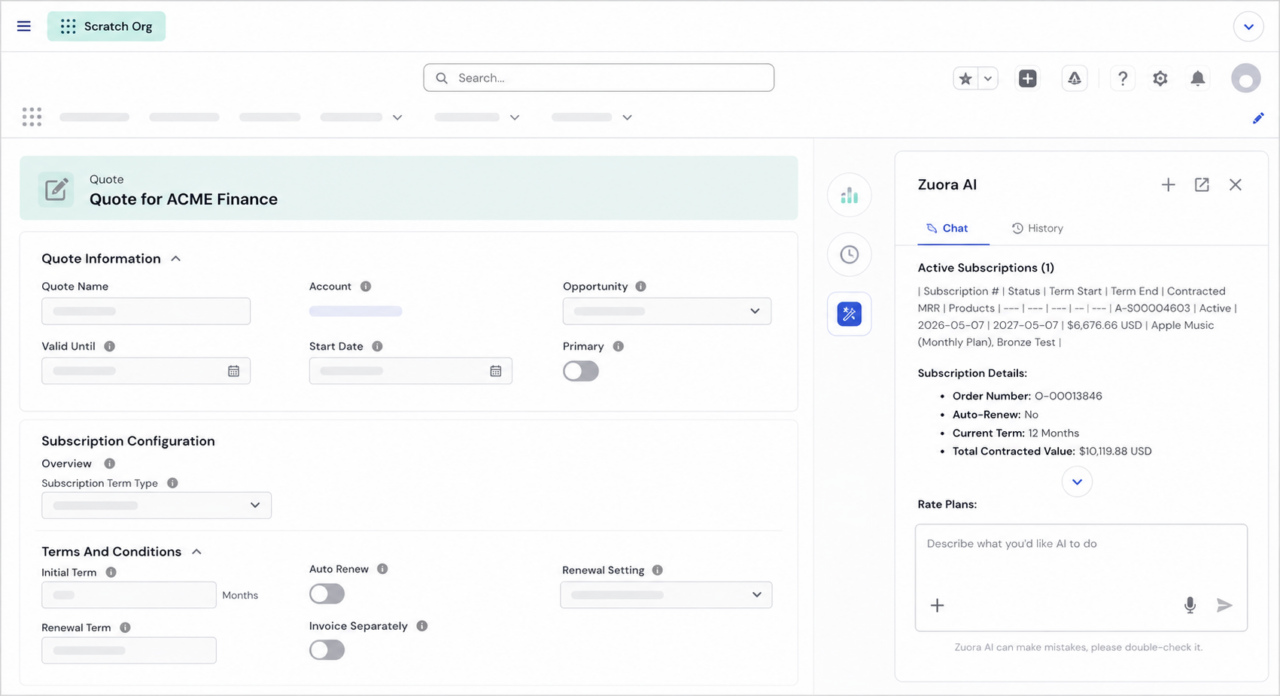
The Workflow: Zuora® CPQ features a “One-Click Quote-to-Cash” integration. Reps quote natively inside Salesforce, and upon signature, the data can flow into Zuora® Billing for recurring invoicing and collections, with Zuora® Revenue supporting ASC 606 revenue recognition when deployed.
The Finance verdict: If revenue is recurring or usage-based, pricing changes more than once a year, and the same quote has to survive into billing and revenue recognition without being rebuilt, a Monetization CPQ is the category built for that shape. It is not the right answer everywhere. A business selling one-time physical goods with thousands of interconnected parts is better served by a Product CPQ, and a business selling three flat-rate tiers to SMBs will find a Sales-Led CPQ faster to deploy and sufficient for the job. The cost of a Monetization CPQ is a unified catalog that has to be designed once and maintained; where pricing is simple and stable, that overhead is not repaid.
Unblocking the Deal Desk and Accelerating Implementation
A common failure point in enterprise CPQ deployments is the implementation timeline. Attempting to custom-code continuous SaaS billing logic into a legacy ERP CPQ can require lengthy implementation, delaying time-to-market for new pricing models.
Likewise, when a standalone CRM CPQ allows reps to build non-standard deals, many non-standard quotes may require manual review by the Deal Desk or Revenue Operations team, creating approval delays.
A Monetization CPQ can help address both issues. Because it utilizes a unified product catalog shared between the CRM and the billing engine, implementation may accelerate. Additionally, because the CPQ enforces financial guardrails at the point of configuration, the CPQ can reduce Deal Desk bottlenecks. Reps can quote complex hybrid deals within Finance-approved guardrails.
The CFO’s Demo Checklist: 4 Questions to Ask Any Vendor
When navigating CPQ for SaaS vendors, don’t let the evaluation become purely a CRM UI discussion. Ask vendors to demonstrate these four scenarios:
- The Mid-Cycle Test: “Show me how your system calculates the daily proration for a mid-cycle tier upgrade on a usage-based contract.”
- The Unified Catalog Test: “Do we have to maintain one product catalog in the CRM and a separate one in our ERP, or does your platform unify them?”
- The Journal Entry Test: “When this complex multi-year quote is signed, show me how your system supports journal-entry creation or integration with the general ledger for this quote.”
- The Consumption Test: “Show me what happens in the quoting and billing workflow when a customer draws down against a pre-paid commitment and enters into an overage tier.”
The ROI Dashboard: Measuring CPQ Success
To justify the investment in an Enterprise CPQ, finance and IT leaders may track these operational metrics:
- Quote Accuracy Rate: The percentage of quotes that flow into the billing system without requiring manual intervention or recalculation. A unified CPQ can improve quote accuracy and reduce manual intervention.
- Deal Desk SLA (Service Level Agreement): The hours or days it takes for a custom quote to be approved. By automating financial guardrails, this time may be reduced.
- Time-to-Market for New Pricing: How fast your organisation can launch a new pricing tier or usage model. By unifying the product catalog, product teams can shorten launch timelines for new SKUs or pricing models.
- Quote-to-Cash Velocity: The total time elapsed from generating a complex CRM CPQ proposal to recognising the revenue downstream.
Frequently Asked Questions
1.
What is an enterprise CPQ?
An enterprise CPQ (Configure, Price, Quote) is advanced software used by B2B companies to generate complex sales contracts. Unlike basic quoting tools, an enterprise CPQ can handle hybrid pricing models, multi-year ramped deals, usage-based consumption, and seamless integration with downstream billing and ERP systems.
2.
What is the right quoting software for usage-based billing?
For usage-based billing, companies should look for a monetization-focused CPQ that integrates with billing and usage rating / mediation so consumption tiers, overage rates, and pre-paid drawdowns can be measured and invoiced accurately.
3.
How does a CPQ tool impact Quote-to-Cash?
A CPQ tool is the starting engine of the Quote-to-Cash pipeline. If the CPQ generates a quote with non-standard pricing logic that the downstream billing system cannot interpret, it breaks the entire pipeline, forcing finance teams to manually calculate invoices and deferred revenue in spreadsheets.
4.
What is the difference between a Product CPQ and a Monetization CPQ?
A Product CPQ is designed for the manufacturing sector to configure physical goods and complex bills of materials (BOMs) for one-time sales. A Monetization CPQ is designed for the software and services sector to handle continuous recurring revenue, usage-based billing, and mid-cycle contract amendments.
5.
Why do CRM-native CPQs face challenges with enterprise billing?
Some CRM-native CPQ approaches may require additional configuration or integrations to support complex proration, usage overages, or revenue-recognition workflows.
6.
How does a unified CPQ accelerate the financial close?
By using a CPQ that shares a data model with billing and revenue recognition systems, finance teams can reduce manual export, translation, and reconciliation. Clean, pre-validated quotes can flow into invoice and journal-entry workflows.