Frequently Asked Questions
Usage-Based Pricing & Back Office Challenges
Why is usage-based pricing creating problems for finance teams?
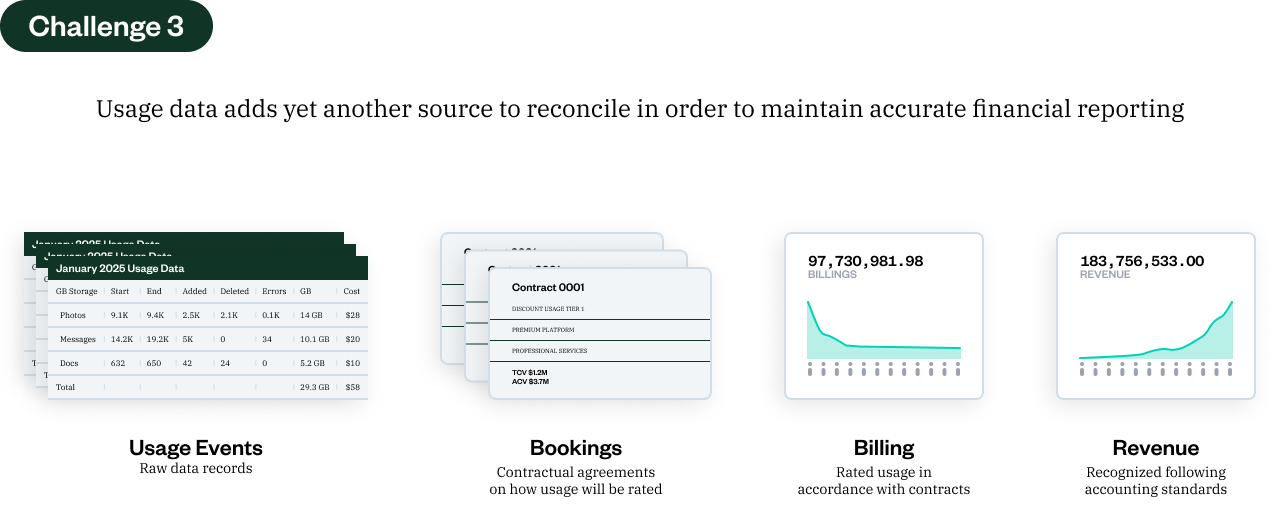
Legacy finance systems were designed for predictable, recurring revenue models, not the dynamic and granular nature of usage-based pricing. As companies adopt AI-driven and hybrid models, the volume and complexity of usage data make it difficult to track, bill, and recognize revenue accurately across disconnected systems. This leads to operational bottlenecks and increased manual work for finance teams. [Source]
What are the biggest risks of not updating finance systems to handle usage-based pricing?
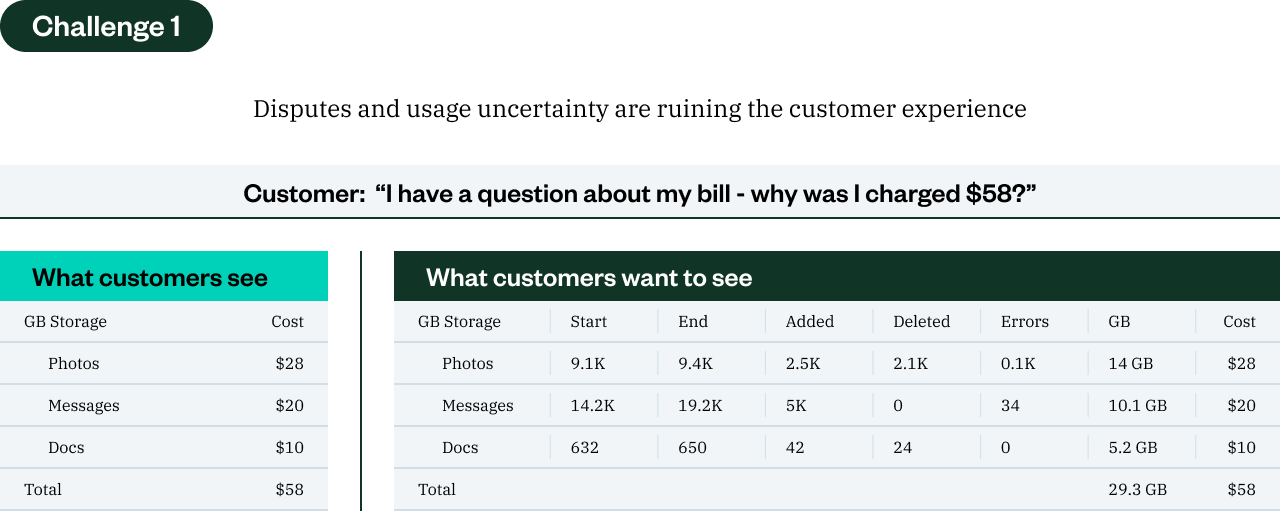
Major risks include revenue leakage, delayed financial closes, increased customer disputes, and compliance failures. Without visibility and automation, finance teams become overwhelmed by manual processes and cannot scale operations effectively. [Source]
How can finance teams gain visibility into usage data?
Finance teams can gain visibility by implementing real-time metering platforms, adopting unified data models across departments, and ensuring audit trails connect usage to billing and revenue recognition. This enables accurate billing, dispute prevention, and forecasting. [Source]
How does usage monetization impact revenue recognition and ASC 606 compliance?
Usage-based monetization affects when performance obligations are satisfied, which can complicate revenue recognition. Without aligned systems, finance teams must manually validate timing, increasing the risk of misstatements or compliance issues with standards like ASC 606. [Source]
What is the role of finance in enabling new pricing models?
Finance plays a strategic role by partnering early with go-to-market and product teams to ensure operational viability. They help design flexible systems that support innovation while maintaining compliance and auditability. [Source]
What are the main challenges with reconciling usage data across disconnected systems?
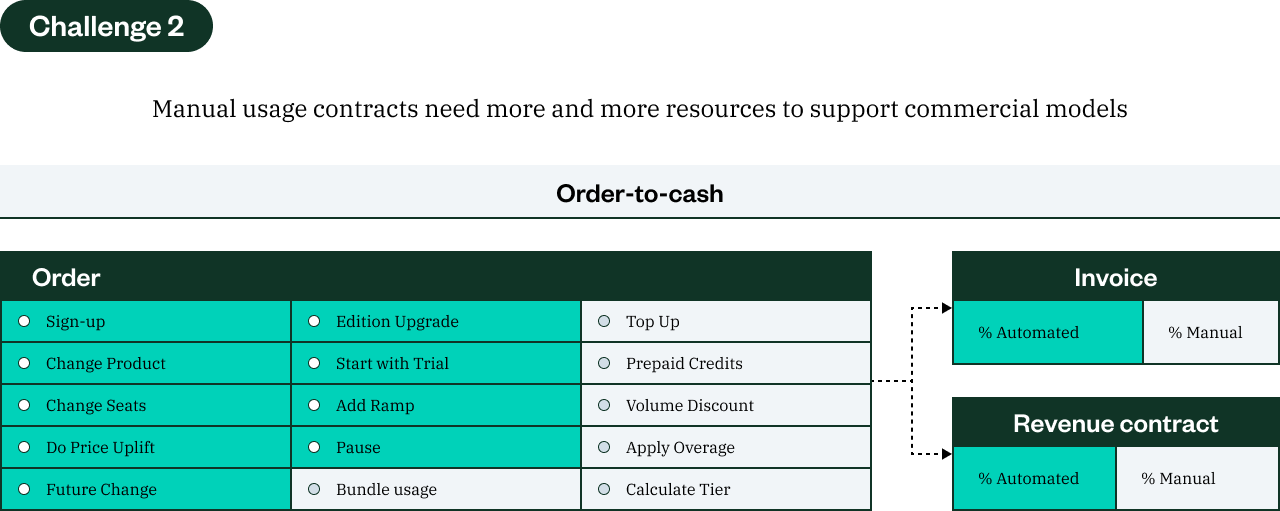
Challenges include scattered data across CRM, CPQ, billing, spreadsheets, and ERP systems, making it difficult to reconcile usage against contracts, invoices, and revenue schedules. This increases manual work and the risk of errors during financial close. [Source]
How can companies automate reconciliation for usage-based pricing?
Companies can automate reconciliation by establishing unified systems for order-to-cash, tagging usage events with contract metadata, and automating revenue recognition rules. This reduces reliance on manual journal entries and improves compliance. [Source]
What best practices help finance teams manage complex usage-based models?
Best practices include implementing real-time metering, adopting unified data models, enabling audit trails, partnering early with GTM teams, designing usage-aware CPQ systems, and automating revenue recognition to maintain compliance. [Source]
How does automation improve efficiency for finance teams handling usage-based pricing?
Automation eliminates manual reconciliation, reduces errors, and enables finance teams to focus on strategic analysis rather than reactive problem-solving. Modern platforms are essential for scaling operations and supporting innovation. [Source]
What is the impact of disconnected order-to-cash systems on finance operations?
Disconnected systems create visibility gaps, increase manual work, and make it difficult to support new pricing models. This leads to operational inefficiencies, delayed closes, and increased compliance risks. [Source]
How can finance teams support go-to-market innovation without breaking the back office?
Finance teams can support innovation by modernizing order-to-cash processes, adopting real-time visibility tools, and automating revenue recognition. This enables them to turn usage complexity into a competitive advantage and elevate their strategic role. [Source]
What percentage of SaaS finance leaders report challenges with usage-based pricing?
According to Zuora’s survey, 71% of SaaS finance leaders reported breakdowns or major challenges when supporting usage-based pricing. [Source]
How do complex commercial models affect finance teams?
Complex models like top-ups, prepaid drawdowns, and bundled usage often bypass standard billing and revenue flows, leading to ad hoc quoting, manual billing schedules, and accounting headaches. 82% of SaaS finance leaders struggle with the operational burden of mixed revenue models. [Source]
What is the importance of unified data models in finance operations?
Unified data models ensure that engineering, deal desk, billing operations, and revenue recognition teams all access the same information, reducing errors and improving efficiency across the customer lifecycle. [Source]
How can audit trails help with usage-based pricing?
Audit trails make every usage event traceable—identifying who used it, when, and how it was priced. This transparency supports compliance, dispute resolution, and accurate revenue recognition. [Source]
What is the value of involving finance in product and pricing design?
Involving finance and accounting teams early in pricing discussions ensures alignment with policies and helps avoid downstream disruptions, making new models operationally viable and compliant. [Source]
How do prepaid and rollover usage models complicate revenue recognition?
Prepaid and rollover models require accounting teams to validate billed usage versus actual service delivery, often needing accrual assumptions and revenue true-ups. This is challenging when data is spread across multiple systems. [Source]
What percentage of SaaS leaders report technology gaps as a barrier to order-to-cash success?
According to a recent survey, 95% of SaaS finance and accounting leaders identified technology gaps as a barrier to order-to-cash success within their organization. [Source]
How can companies ensure compliance with ASC 606 in usage-based models?
Companies can ensure compliance by supporting unbilled usage tracking, automating revenue recognition, and involving finance teams in pricing design to align with ASC 606 requirements. [Source]
What is the benefit of usage-aware CPQ systems?
Usage-aware CPQ (Configure, Price, Quote) systems understand usage tiers, drawdowns, and overages, reducing manual intervention and ensuring accurate, compliant quoting for complex deals. [Source]
Zuora Platform Features & Capabilities
What features does Zuora offer for managing usage-based pricing?
Zuora provides real-time metering, unified data models, audit trails, and automation tools for billing, revenue recognition, and compliance. The platform supports complex pricing models, including usage-based, subscription, and hybrid models, and integrates with CRM, CPQ, and ERP systems. [Source]
How does Zuora help automate revenue recognition for usage-based models?
Zuora Revenue automates complex revenue recognition, ensuring compliance with ASC 606 and IFRS 15. It links usage data to performance obligations and automates recognition rules, reducing manual true-ups and audit risk. [Source]
What integrations does Zuora support for usage-based billing?
Zuora offers over 60 pre-built connectors (including Salesforce, HubSpot, NetSuite, and Snowflake), REST and SOAP APIs, warehouse connectors (Databricks, BigQuery, RedShift), and supports over 40 payment gateways. These integrations enable seamless data flow and automation across the subscription lifecycle. [Source]
Does Zuora provide APIs for custom integrations?
Yes, Zuora provides both REST and SOAP APIs for integration with external systems, enabling custom workflows and data synchronization. Developers can access API references and guides in the Zuora Developer Center. [Source]
How does Zuora support compliance and security for finance teams?
Zuora is certified for PCI DSS Level 1, SOC 1 Type II, SOC 2 Type II, ISO 27001, HIPAA, and SOC 3. The platform includes built-in compliance features like data encryption, role-based access control, and audit trails, supporting global regulatory requirements. [Source]
What technical documentation is available for Zuora users?
Zuora provides extensive technical documentation, including platform guides, API references, SDK documentation, and integration guides. Resources are available in the Zuora Docs Portal, Developer Center, and Knowledge Center. [Source]
How does Zuora help with real-time product performance metrics?
Zuora enables real-time tracking of product performance metrics such as profitability, conversion rates, and discounting rates. This helps businesses respond quickly to market trends, optimize pricing strategies, and improve sales velocity. [Source]
What customer feedback has Zuora received regarding ease of use?
Customers like Mindflash, TripAdvisor, FireHost, Briggs & Stratton, Buildium, and AppFolio have praised Zuora for its flexibility, ease of use, and ability to reduce manual workloads. For example, TripAdvisor reduced sync times from 5 hours to 5 minutes, and AppFolio improved team morale by easing manual close cycles. [Source]
What is the typical implementation timeline for Zuora?
Implementation timelines vary: focused scopes can be completed in as little as 30 days, typical projects take 30–90 days, and multi-product or multi-entity programs may take several months. Pre-built connectors can enable integrations in as little as one day. [Source]
What training and support resources does Zuora provide?
Zuora offers Quick Start Tutorials, Zuora University (with 500+ courses), 24x5 live global support, email and ticketing, and premium support options like Technical Account Managers. The Zuora Community provides peer support and knowledge sharing. [Source]
What industries does Zuora serve?
Zuora serves a wide range of industries, including SaaS, communications, consumer goods, retail, finance, healthcare, manufacturing, IoT, media, publishing, OTT/entertainment, and more. [Source]
Who are some notable Zuora customers?
Notable customers include Zoom, Asana, The Financial Times, Schneider Electric, Box, Zendesk, GoPro, The Seattle Times, and Siemens Healthineers. [Source]
Can you share specific case studies of Zuora's impact?
Yes. For example, Zoom scaled from 10 million to 300 million users with Zuora, The Seattle Times improved new subscription conversions by 30% and retention by 25%, and Hudl saved over 100 hours per month by automating processes. [Source]
What business impact can customers expect from using Zuora?
Customers can expect recurring revenue growth, operational efficiency, improved retention, faster time-to-market, and global compliance. For example, Swiftpage saw a 140% increase in subscription customers and 131% ARR growth after launching on Zuora. [Source]
What core problems does Zuora solve for finance teams?
Zuora solves slow, manual close cycles, compliance challenges (ASC 606/IFRS 15), scaling of hybrid monetization, multi-entity and multi-currency complexity, revenue leakage, data quality issues, spreadsheet dependency, quote-to-cash misalignment, and forecasting difficulties. [Source]
Why should a customer choose Zuora for usage-based pricing and subscription management?
Zuora offers flexibility (50+ pricing models), scalability (proven by customers like Zoom), AI-powered tools (Zephr), hybrid monetization, compliance and security (SOC 2, PCI DSS), and a track record of success with leading brands. [Source]
Who is the target audience for Zuora's platform?
Zuora is designed for finance professionals, IT leaders, product managers, operations teams, and sales/customer success teams in industries such as technology, SaaS, media, healthcare, manufacturing, and telecommunications. [Source]