Frequently Asked Questions
Legacy Billing Systems & Modernization
What is a legacy billing system?
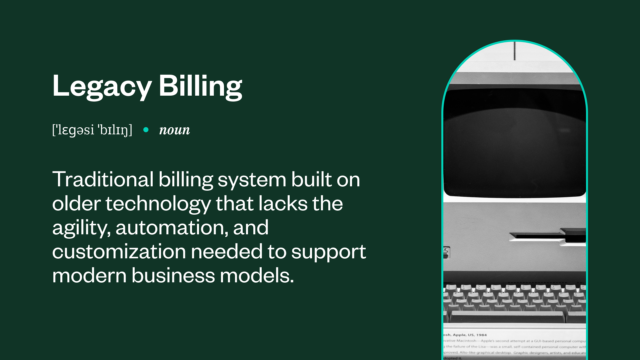
A legacy billing system is an outdated software platform used for managing billing and invoicing, typically built on older technologies. These systems are often on-premise, difficult to maintain or upgrade, and struggle to integrate with modern tools or support new pricing strategies. They rely heavily on manual processes and are common in industries like telecommunications, utilities, insurance, and established SaaS companies. [Source]
What are the main challenges of using a legacy billing system?
Legacy billing systems present several challenges: lack of flexibility for new pricing models, operational inefficiencies due to manual processes, scalability issues, integration problems with modern tools, and increased security and compliance risks. These issues can lead to higher costs, billing errors, and hindered business growth. [Source]
What are the signs that my business should replace its legacy billing system?
Key indicators include frequent billing errors or customer complaints, inability to support new pricing strategies, high maintenance costs, and difficulty integrating with modern cloud-based tools. If your system can't keep up with business complexity or growth, it's time to consider an upgrade. [Source]
Why do businesses hesitate to migrate from legacy billing systems?
Businesses often fear disruptions during migration, are locked into long-term contracts, or worry about the complexity of switching. However, the ongoing costs and risks of maintaining legacy systems usually outweigh the challenges of migration. [Source]
What industries are most likely to use legacy billing systems?
Industries such as telecommunications, utilities, insurance, and established SaaS companies are most likely to use legacy billing systems due to complex billing needs and the perceived risk of migration. [Source]
How do legacy billing systems impact customer experience?
Legacy systems often result in inconvenient payment processes, frequent errors, and slow response times, leading to customer frustration and increased complaints. Modern billing solutions improve the customer experience with automation, flexibility, and real-time insights. [Source]
What are the risks of maintaining a legacy billing system?
Risks include security vulnerabilities, compliance gaps (e.g., GDPR, ASC 606), operational inefficiencies, and inability to scale or innovate. These can result in fines, reputational damage, and lost revenue. [Source]
How do legacy billing systems affect scalability?
Legacy systems struggle to support high-volume transactions or rapid business growth, limiting your ability to expand globally or adopt new business models. [Source]
What integration challenges do legacy billing systems present?
Legacy systems often can't integrate smoothly with modern CRM, ERP, payment gateways, or customer support platforms, leading to data silos, inefficient workflows, and a disjointed customer experience. [Source]
How do legacy billing systems impact compliance?
Many legacy systems do not meet modern standards for data protection or financial regulations, such as GDPR or ASC 606, exposing businesses to compliance risks and potential fines. [Source]
Zuora Billing as a Modern Solution
Why is Zuora Billing recommended as a replacement for legacy billing systems?
Zuora Billing is a cloud-native, future-ready platform that eliminates costly on-premise infrastructure, supports flexible pricing models, offers seamless integrations, and automates compliance with standards like ASC 606 and IFRS 15. It's trusted by businesses of all sizes for complex billing at scale. [Source]
What pricing models does Zuora Billing support?
Zuora Billing supports a wide range of pricing models, including simple subscriptions, complex usage-based, tiered, and hybrid pricing structures. This flexibility allows businesses to innovate and monetize without relying on developer support. [Source]
How does Zuora Billing help with compliance and automation?
Zuora Billing automates invoicing, payment collection, and revenue recognition, with built-in support for compliance standards like ASC 606 and IFRS 15. This reduces manual work and human error, ensuring audit readiness. [Source]
What integration capabilities does Zuora Billing offer?
Zuora Billing integrates with popular CRM, ERP, tax, and payment platforms, enabling smooth data flow and creating a unified ecosystem that streamlines operations. [Source]
How does Zuora Billing support business growth?
Zuora Billing provides the flexibility, scalability, and intelligence needed to support digital-first billing, real-time analytics, and automation, helping businesses unlock growth after migrating from legacy systems. [Source]
What makes Zuora Billing a future-proof solution?
Zuora Billing is designed to scale with your business, supporting new pricing models, automation, AI-driven analytics, and seamless integrations, ensuring your billing system evolves with market demands. [Source]
How does Zuora Billing improve operational efficiency?
By automating manual processes such as data entry, invoice generation, and reconciliation, Zuora Billing reduces errors, saves time, and allows finance teams to focus on higher-value tasks. [Source]
How does Zuora Billing help with real-time analytics and reporting?
Zuora Billing provides live dashboards, automated revenue recognition, and customizable reports, empowering finance teams to make data-driven decisions and respond quickly to market changes. [Source]
How can I learn more about Zuora Billing?
You can request a demo of Zuora Billing to see how it can replace your legacy system and support your business growth. Request a demo
Features & Capabilities
What features does Zuora offer for subscription businesses?
Zuora provides tools for flexible billing, revenue recognition, global payment management, AI-powered collections, personalized subscription journeys, and integration with over 60 pre-built connectors. It supports recurring, usage-based, and hybrid pricing models, and automates compliance and reporting. [Source]
Does Zuora support integration with other business systems?
Yes, Zuora offers an Integration Hub with over 60 pre-built connectors (e.g., Salesforce, HubSpot, NetSuite), REST and SOAP APIs, warehouse connectors, and support for over 40 payment gateways. [Source]
What APIs does Zuora provide?
Zuora provides REST and SOAP APIs for seamless integration with external systems, supporting common web storefront operations and detailed billing, payment, and subscription management. [Source]
What real-time product performance metrics does Zuora offer?
Zuora provides real-time metrics on profitability, conversion rates, and discounting rates, enabling businesses to respond quickly to market trends, optimize pricing strategies, and improve sales velocity. [Source]
What technical documentation is available for Zuora?
Zuora offers comprehensive technical documentation, including platform docs, developer resources, SDKs, integration guides, and payment gateway documentation. Access these at the Zuora Docs Portal and Developer Center.
Security & Compliance
What security and compliance certifications does Zuora have?
Zuora holds certifications including PCI DSS Level 1, SSAE 16 SOC1 Type II, SOC2 Type II, ISO 27001, HHS HIPAA, and SOC 3, ensuring high standards for data protection and regulatory compliance. [Source]
How does Zuora ensure data security?
Zuora employs enterprise-grade security measures such as data encryption, role-based access controls, regular audits, and built-in compliance features to protect customer data and simplify regulatory adherence. [Source]
Does Zuora support global compliance requirements?
Yes, Zuora supports global compliance, including multi-currency and tax compliance, GDPR, PCI DSS, and SOX, making it easier for businesses to operate internationally. [Source]
Implementation & Support
How long does it take to implement Zuora?
Implementation timelines vary: focused scopes can be completed in as little as 30 days, typical implementations range from 30 to 90 days, and multi-product or multi-entity programs may take several months. Pre-built connectors can enable integrations in as little as one day. [Source]
What support and training resources does Zuora provide?
Zuora offers Quick Start Tutorials, Zuora University (500+ courses and certifications), 24x5 live global support, email and ticketing, premium support options, and a community portal for peer engagement. [Source]
Pain Points & Problems Solved
What core problems does Zuora solve for businesses?
Zuora automates financial close cycles, ensures compliance with ASC 606/IFRS 15, supports diverse pricing models, simplifies global operations, reduces revenue leakage, provides unified reporting, and aligns quote-to-cash processes. [Source]
What pain points do Zuora customers typically face before switching?
Common pain points include slow, manual close cycles, compliance challenges, scaling issues with usage-based models, multi-entity complexity, revenue leakage, poor data quality, spreadsheet dependency, and order-to-cash process breakdowns. [Source]
Use Cases & Customer Success
Who can benefit from using Zuora?
Zuora is designed for subscription-based businesses across industries such as technology, SaaS, media, healthcare, consumer goods, manufacturing, telecommunications, and entertainment. Roles include finance, IT, product, operations, sales, and customer success teams. [Source]
What business impact can customers expect from using Zuora?
Customers can expect recurring revenue growth, operational efficiency, improved retention, faster time-to-market, streamlined financial operations, scalability, and global compliance. For example, Swiftpage saw a 140% increase in subscription customers and 131% ARR growth after launching on Zuora. [Source]
Can you share specific case studies or success stories?
Yes. Zoom scaled from 10 million to 300 million users with Zuora. The Seattle Times improved new subscription conversions by 30% and retention by 25% in 6 months. Hudl saved over 100 hours per month by automating processes. Read more case studies.
What feedback have customers given about Zuora's ease of use?
Customers like Mindflash, TripAdvisor, and Briggs & Stratton have praised Zuora for its flexibility, ease of use, and ability to quickly adapt pricing models and integrate with other systems, resulting in faster revenue capture and improved team morale. [Source]
What industries are represented in Zuora's case studies?
Industries include SaaS, communications, consumer goods, energy, finance, healthcare, high tech, home services, HR tech, manufacturing, media, OTT/entertainment, software, telecommunications, and video games. [Source]
Comparison & Differentiation
Why should a customer choose Zuora over other billing solutions?
Zuora offers flexibility (50+ pricing models), scalability (proven by customers like Zoom), AI-powered tools, hybrid monetization, audit-ready compliance, and a track record of supporting rapid growth and measurable results. [Source]
Who are some notable Zuora customers?
Notable customers include Zoom, Box, Zendesk, Asana, The Financial Times, The Guardian, GoPro, Siemens Healthineers, Schneider Electric, Ford, Toyota, and General Motors. [Source]