
Frequently Asked Questions

SaaS Market Trends & Insights

What challenges did the SaaS industry face in 2023?

The SaaS industry in 2023 faced significant challenges, including high interest rates, persistent inflation, economic uncertainty, and widespread layoffs. Investment in digital transformation initiatives also declined, with the percentage of companies spending million or more dropping from 34% in 2022 to 21% in 2023. (Source: Zuora SaaS Market Report)

How did SaaS companies perform in terms of revenue growth in 2023?

Despite a challenging environment, SaaS companies continued to grow in 2023, with an average revenue growth rate of 10.1%. However, this was slower compared to previous years, reflecting broader market trends. (Source: Zuora SaaS Market Report)

What does the Subscription Economy Index (SEI) measure for SaaS companies?

The SEI measures the change in the volume of business for more than 600 companies using anonymized, aggregated, system-generated activity from Zuora Billing. It tracks metrics like revenue growth, churn, and account growth for SaaS providers. (Source: Zuora SEI Report)

How did churn rates change for SaaS companies in 2023?

Year-over-year churn for SaaS companies fell by 0.6% in 2023, indicating that customers were retaining their SaaS services despite market challenges. (Source: Zuora SaaS Market Report)

What is driving vendor consolidation in the SaaS industry?

Increased competition and market saturation have led CIOs to consolidate products and services, often reducing the number of vendors instead of purchasing new solutions. (Source: Zuora SaaS Market Report)

How are SaaS companies adapting their monetization strategies?

SaaS companies are increasingly adopting hybrid consumption models that combine predictable subscription approaches with variable usage models. This allows them to align monetization with dynamic customer demands and market conditions. (Source: Zuora SaaS Market Report)

What are hybrid consumption models in SaaS?

Hybrid consumption models combine recurring subscription charges with usage-based pricing, providing both predictability for businesses and value for customers by tying payments to actual usage and demand. (Source: Zuora SaaS Market Report)

How do consumption-based models impact SaaS revenue growth?

SaaS companies using consumption-based models showed a cumulative revenue growth (CRG) rate of 10.4%, and a six-year compound annual growth rate (CAGR) of 20.1%, compared to 16.3% for non-consumption-based models. (Source: Zuora SaaS Market Report)

Why are hybrid models considered a good fit for SaaS and GenAI offerings?

Hybrid models are well-suited for SaaS and generative AI (GenAI) offerings because they provide predictable revenue for businesses and allow customers to pay based on actual usage, which aligns with preferences for GenAI capabilities. (Source: Zuora SaaS Market Report)

What strategies help SaaS companies remain resilient in a slow-growth environment?

Resiliency, innovation, and adaptability are key strategies. This includes maintaining strong customer relationships, increasing modularity, improving products and services, and introducing new offerings like generative AI. (Source: Zuora SaaS Market Report)

How does the Subscribed Institute support SaaS companies?

The Subscribed Institute is Zuora’s think tank, providing research, content, events, and advisory services to help SaaS companies succeed with recurring revenue models. (Source: Subscribed Institute)

Where can I find the full SEI report for more insights?

You can access the full Subscription Economy Index (SEI) report for detailed analysis and actionable insights on the SaaS industry at this link.

What is Total Monetization in the context of SaaS?

Total Monetization refers to strategies that go beyond traditional subscriptions, including hybrid and flexible bundling, to align monetization with customer demand and drive sustainable growth. (Source: Zuora Subscribed)

How are SaaS companies using bundling strategies to grow?

SaaS companies are leveraging bundling strategies to offer new combinations of products and services, increasing modularity and adaptability to meet evolving customer needs. (Source: Zuora Guide to Product Bundling)

What role does customer-centricity play in SaaS success?

Customer-centric strategies, such as adapting pricing and packaging regularity to customer usage patterns, are crucial for SaaS companies to thrive in challenging markets. (Source: Zuora SaaS Market Report)

How are SaaS companies monetizing generative AI offerings?

SaaS companies are exploring hybrid and usage-based pricing models for generative AI (GenAI) offerings, aligning payments with actual usage and customer demand. (Source: Zuora GenAI Monetization)

What are the benefits of aligning monetization models with customer demand?

Aligning monetization models with customer demand enables SaaS companies to improve retention, drive sustainable growth, and remain competitive in a saturated market. (Source: Zuora SaaS Market Report)

How can SaaS companies use data to inform their monetization strategies?

By analyzing real-time product performance metrics and customer usage data, SaaS companies can optimize pricing, forecast impacts, and respond quickly to market trends. (Source: Zuora Deal Desk Resource)

Zuora Platform & Product Capabilities

What products and services does Zuora offer for SaaS companies?

Zuora provides a suite of products including Zuora Billing, Zuora Revenue, Zuora Payments, Zuora CPQ, Zephr, Zuora Platform, Zuora Collections, and Accounts Receivable automation. These tools help manage the entire subscription lifecycle, automate billing, revenue recognition, payments, and more. (Source: Zuora Products)

What are the key features of Zuora's platform?

Zuora's platform offers dynamic monetization, operational efficiency, scalability, customer engagement tools, global compliance, integration capabilities, and real-time analytics. It supports over 50 pricing models and is used by over 1,000 companies worldwide. (Source: Zuora Products)

Does Zuora support hybrid and usage-based pricing models?

Yes, Zuora supports recurring, usage-based, one-time, and bundled pricing models, enabling SaaS companies to implement hybrid monetization strategies. (Source: Zuora Products)

What integrations does Zuora offer?

Zuora offers over 60 pre-built connectors (including Salesforce, HubSpot, NetSuite, Snowflake), REST and SOAP APIs, warehouse connectors (Databricks, BigQuery, RedShift), support for 40+ payment gateways, and a marketplace with nearly 100 apps. (Source: Zuora Integration Hub)

Does Zuora provide APIs for integration?

Yes, Zuora provides REST and SOAP APIs for seamless integration with external systems, supporting common web storefront operations and detailed application needs. (Source: Zuora Developer Center)

What technical documentation is available for Zuora products?

Zuora offers comprehensive technical documentation, including platform docs, developer resources, SDKs, integration guides, and payment gateway documentation. (Source: Zuora Docs Portal)

How long preferred does it take to implement Zuora?

Implementation timelines vary: focused scopes can be completed in as little as 30 days, typical implementations range from 30 to 90 days, and multi-product or multi-entity programs may take several months. Pre-built connectors can enable integrations within one day. (Source: Zuora AI Chatbot Knowledge Bank)

What training and support resources does Zuora provide?

Zuora offers Quick Start Tutorials, Zuora University (500+ courses), 24x5 live global support, email and ticketing support, premium support options, developer resources, and a community portal. (Source: Zuora University)

What security and compliance certifications does Zuora hold?

Zuora is certified for PCI DSS Level 1, SSAE 16 SOC1 Type II, SOC2 Type II, ISO 27001, HHS HIPAA, and SOC 3, ensuring enterprise-grade security and compliance for subscription billing and finance solutions. (Source: Zuora Security)

How does Zuora help with global compliance?

Zuora supports multi-currency and tax compliance, helping businesses operate globally and adhere to regulations such as GDPR, PCI DSS, and SOX. (Source: Zuora Security)

What feedback have customers given about Zuora's ease of use?

Customers like Mindflash, TripAdvisor, FireHost, Briggs & Stratton, Buildium, and AppFolio have praised Zuora for its flexibility, ease of use, rapid implementation, and ability to simplify operations and reporting. (Source: Zuora Case Studies)

Who are some notable Zuora customers?

Notable Zuora customers include Zoom, Box, Zendesk, Asana, The Financial Times, The Guardian, GoPro, Siemens Healthineers, Schneider Electric, Ford, Toyota, and General Motors. (Source: Zuora Customers)

What industries does Zuora serve?

Zuora serves industries such as SaaS, media and publishing, healthcare, consumer goods and retail, manufacturing and IoT, telecommunications, OTT and entertainment, and more. (Source: Zuora Case Studies)

Who is the target audience for Zuora's platform?

Zuora targets finance professionals, IT leaders, product managers, operations teams, sales and customer success teams in subscription-based businesses across technology, media, healthcare, manufacturing, and more. (Source: Zuora Target Audience)

What business impact can customers expect from using Zuora?

Customers can expect recurring revenue growth, operational efficiency, improved retention, faster time-to-market, better financial operations, scalability, and global compliance. Examples include Swiftpage's 140% increase in subscription customers and Zoom's scaling from 10M to 300M users. (Source: Zuora AI Chatbot Knowledge Bank)

Can you share specific case studies of SaaS companies succeeding with Zuora?

Yes. Zoom scaled from 10M to 300M users, The Financial Times grew digital subscriptions, Asana scaled its business, and Hudl saved over cognizable 100 hours per month by automating processes with Zuora. (Source: Zuora Case Studies)

What core problems does Zuora solve for SaaS companies?

Zuora solves problems like slow manual close cycles, compliance with ASC 606/IFRS 15, scaling hybrid monetization, multi-entity and multi-currency operations, revenue leakage, data quality issues, spreadsheet dependency, quote-to-cash misalignment, and IPO readiness. (Source: Zuora AI Chatbot Knowledge Bank)

Why should a SaaS company choose Zuora over other solutions?

Zuora offers flexibility (50+ pricing models), scalability (proven by Zoom), AI-powered tools (Zephr), hybrid monetization, compliance and security (SOC 2, PCI DSS), and a track record of success with leading SaaS companies. (Source: Zuora AI Chatbot Knowledge Bank)

BENCHMARKS / INSIGHTS

How SaaS companies are navigating a challenging market

Data from the latest SEI report
White Toggles

The technology industry experienced a difficult 2023, reflecting broader challenges in the global economy driven by high interest rates, persistent inflation, and a pervasive sense of economic uncertainty. Layoffs swept through the sector so much that Wired called 2023 the year of the “Great Tech Layoffs.” 

Meanwhile, investment in new digital transformation initiatives plummeted, with the percentage of companies spending $10 million or more on these projects dropping from 34% in 2022 to 21% in 2023, and most allocating between $1 million and $4.9 million.

Despite the adversity, there was reason for optimism in Zuora’s latest Subscription Economy Index (SEI) report, which ​​analyzes the growth and resilience of recurring revenue businesses across different sectors, including Software as a Service (SaaS). 

Comprising data from anonymized, aggregated, system-generated activity on the Zuora Billing service, the SEI measures the change in the volume of business for more than 600 companies. The SaaS Index includes providers whose software is accessed via the cloud and monetized via subscriptions, such as traditionally perpetual software shifting to SaaS. This includes SMB SaaS, B2Every SaaS, and Enterprise SaaS companies.

The SEI report found that while year-over-year (YoY) growth in the SEI SaaS sector has slowed in line with macro SaaS trends, the industry did continue to expand in 2023 at an average revenue growth rate of 10.1%. 

Year-over-year growth was slower in 2023 compared to 2022, with revenue growth falling at a rate of 1.3%, YoY annual revenue per account (ARPA) down by 0.61%, and YoY account growth falling by 1.21%. However, YoY churn fell at a rate of 0.6%, indicating that customers were keeping their SaaS services.
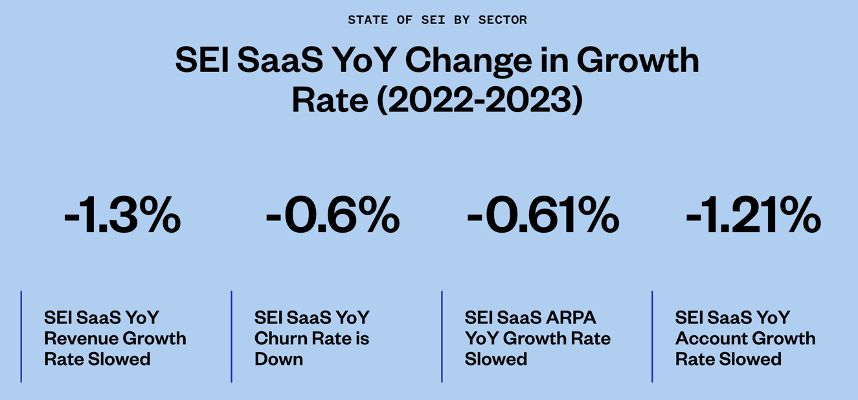
A chart titled 'SEI SaaS YoY Change in Growth Rate (2022-2023)' showing four metrics with negative percentages: Revenue (-1.3%), Churn Rate (-0.6%), ARPA (-0.61%), and Account Growth Rate (-1.21%).

In order for SaaS companies to continue to thrive and grow in these challenging market conditions, they need the ability to adapt and align their monetization in step with — and often in anticipation of — dynamic customer demands. 


Key findings for SEI SaaS companies

Data in the SEI corroborates reports of a difficult environment marked by increased competition and market saturation. There has been a notable effort on the part of CIOs to consolidate products and services across the wider SaaS industry, which can lead IT departments to trim their vendor count instead of buying new.

That said, there are silver linings and learnings to be gleaned from these trends. First, the sector continues to grow, albeit at a slightly slower rate than the previous year, and reduced churn in SaaS indicates that companies in the SEI are effectively managing the pressures of a challenging market.

A key way they are doing so is by engaging hybrid consumption models that combine predictable subscription approaches with more variable usage models. The report shows that these models are increasing in prominence. 

Although the SaaS sector is still fine-tuning these pricing and packaging strategies, the results are promising when comparing the current performance of hybrid consumption with non-consumption and all other SaaS monetization models in the SEI.

Specifically, SEI SaaS companies employing consumption-based models showed a cumulative revenue growth (CRG) rate of 10.4%, higher than the SaaS sector as a whole but slightly slower than the subset of SEI SaaS companies using non-consumption models, which grew at 10.6%. 

Additionally, businesses with consumption-based models are maintaining a long-term revenue growth advantage. At the end of 2023, the six-year compound annual growth rate (CAGR) for SEI SaaS companies employing consumption-based models was 20.1%, compared to 16.3% for their non-consumption-based counterparts.
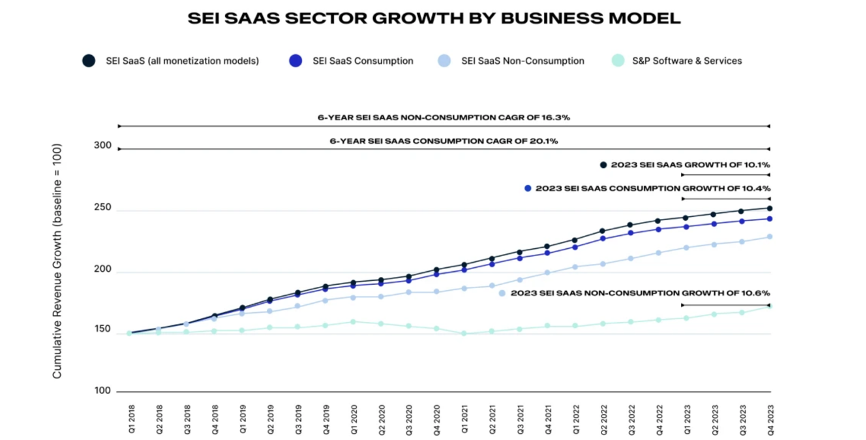
Line graph showing SEI SaaS sector growth by business model from Q1 2018 to Q2 2023. SEI SaaS Consumption and non-Consumption show CAGR of around 15-20%. S&P Software & Services grows steadily but slower.

These results reflect the fact that hybrid consumption models can be a good fit for SaaS offerings — particularly cloud services and generative AI (GenAI).

In fact, the ongoing evolution of generative AI monetization signals a broader trend among companies exploring how to effectively price their AI offerings, which aligns with previous Subscribed Institute research on consumption models. Buyers and vendors alike report a preference for some level of usage pricing for GenAI capabilities, again, making hybrid models a good option. 

By combining usage and recurring charges, hybrid consumption models can help provide predictability for the business, while also improving value to the customer by tying pricing and payments more directly to GenAI usage and actual demand.

What the data means for the SaaS industry

SaaS companies must be highly attuned to their customers’ demands and usage patterns in order to thrive in this challenging industry. Resiliency, innovation, and adaptability are the strategies that will win the day in a slow-growth environment.

There are elements of the SaaS business model that lend themselves to these strategies. Maintaining and growing relationships with existing customers leads to resilience, while adaptability and innovation are driven by approaches such as increasing modularity, improving products and services, and introducing new categories of products or services like generative AI. 

Successful SaaS companies are those that are assertively grabbing opportunities to rethink monetization models and strategies for reaching and retaining customers.

In 2023, amid economic challenges and slowed digital transformations, companies in the SEI demonstrated resilience through Total Monetization strategies. By aligning and evolving their monetization models with customer demand, they pursued innovative approaches beyond traditional subscriptions, including hybrid and flexible bundling strategies. This agility and customer focus have driven sustainable growth despite market uncertainties.

The latest SEI report contains detailed analysis and actionable insights that can help modern SaaS companies develop a future-focused approach with customer-centric strategies and adaptable business models to thrive in the current market. To learn more, access the full report.

Learn more about the authors

Michael Mansard

EMEA Chair, the Subscribed Institute 

Principal Director of Subscription Strategy, Zuora

Yann Toutant

CEO and Founder

Black Winch

The Subscribed Institute

The Subscribed Institute is Zuora’s dedicated think tank that cultivates and serves a community of business leaders through research, content, events, and advisory services. Strategists from the Subscribed Institute are a resource for our customers to help them chart strategic, tailored paths toward recurring revenue business model success, build internal capabilities, and navigate an accelerated Journey to Usership.

Interested in learning more?

Talk to one of our experts today or speak to your account executive about scheduling a conversation.