The Modern Finance Leader / Scaling bottlenecks
The Scaling Bottleneck: Outdated Systems Are Constraining Business Model Innovation
Zuora’s survey of over 900 senior finance and accounting leaders, including CFOs, CAOs, Controllers, and VPs of Finance and Accounting, across North America (NA), the United Kingdom (UK), and France, reveals how breakdowns in order-to-cash processes and technology are impeding the strategic growth and efficiency of finance teams, particularly within SaaS companies.
Explore the Report
Click the links below to read more about the findings that interest you the most


Legacy Finance Systems Are Holding Back Pricing and Revenue Model Experimentation
The Strategic Imperative: A Dynamic Mix of Pricing and Revenue Models Drive Growth
The Operational Reality: Complexity Creates Strain
Table 11
The Technology Deficit: Systems Can't Keep Pace

Order-to-Cash Processes Are Breaking Under Pressure to Scale
Business transformation events that should signal success—moving upmarket, implementing innovative pricing models, or completing strategic acquisitions—are instead revealing the fragility of finance operations. These scaling moments expose critical weaknesses in O2C infrastructure, forcing finance teams to choose between supporting business growth and maintaining operational stability.
The Upmarket Transition Trap
The shift from product-led growth (PLG) to enterprise sales represents one of the most challenging O2C stress tests. This transition requires systems to handle complex deal structures, longer sales cycles, and sophisticated revenue recognition requirements. Yet 53% of finance leaders report that their O2C systems struggled during this critical business evolution.
In SaaS companies, where PLG-to-enterprise transitions are often essential for reaching the next growth phase, the failure rate reaches alarming levels. A staggering 82% of SaaS finance teams experienced system breakdowns during this transition, effectively turning a strategic business opportunity into an operational crisis that constrains growth potential.
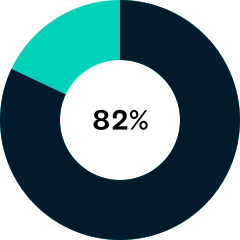
of SaaS finance leaders say their O2C systems struggled during the shift from PLG to enterprise sales
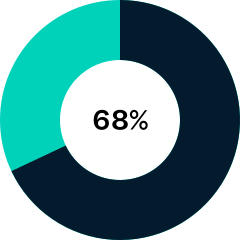
of finance leaders in North America say their O2C systems struggled during the shift from PLG to enterprise sales
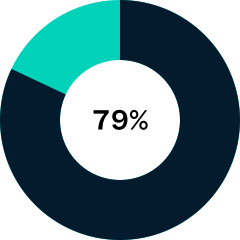
of finance leaders in France say their O2C systems struggled during the shift from PLG to enterprise sales
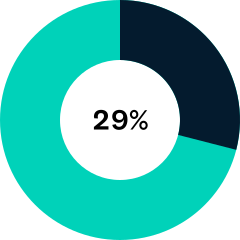
of finance leaders in the UK say their O2C systems struggled during the shift from PLG to enterprise sales
Usage-Based Pricing: The Scalability Breaking Point
Usage-based pricing models promise better customer alignment and revenue optimization, but they demand unprecedented computational complexity from O2C systems. These models require real-time usage tracking, dynamic billing calculations, and flexible revenue recognition capabilities that many finance systems simply cannot provide.
The data reveals widespread system inadequacy: 52% of finance leaders across industries face significant challenges scaling O2C to support usage-based pricing models. Among SaaS companies, where usage-based pricing is increasingly becoming table stakes for competitive positioning, 71% report breakdowns or major operational struggles when implementing these models.
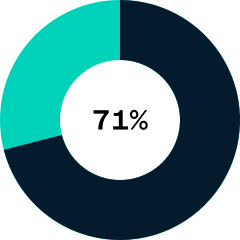
of SaaS finance leaders face challenges scaling O2C to support usage-based pricing models
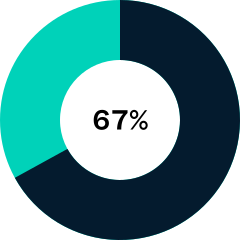
of finance leaders in North America face challenges scaling O2C to support usage-based pricing models
of finance leaders in France face challenges scaling O2C to support usage-based pricing models
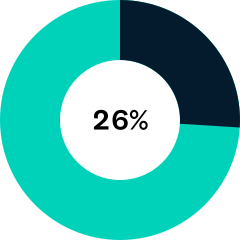
of finance leaders in the UK face challenges scaling O2C to support usage-based pricing models
M&A Integration: When Growth Strategies Collide with System Limitations
Mergers and acquisitions should accelerate business growth, but too often O2C integration failures slow them down. The challenge extends beyond simply combining different systems—it requires harmonizing disparate business processes, pricing models, and revenue recognition approaches while maintaining operational continuity.
Nearly half (49%) of finance leaders report O2C breakdowns or significant operational disruption following M&A activity. In SaaS environments, where acquisitions often target companies with fundamentally different business models or customer bases, this challenge becomes even more severe. An overwhelming 82% of SaaS finance teams experience significant O2C disruption post-acquisition, turning strategic growth initiatives into operational nightmares.
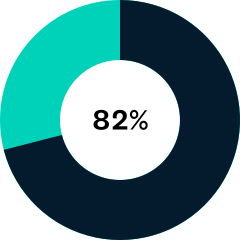
of SaaS finance leaders say their O2C processes broke down or faltered following a merger or acquisition
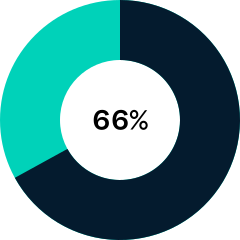
of finance leaders in North America say their O2C processes broke down or faltered following a merger or acquisition
of finance leaders in France say their O2C processes broke down or faltered following a merger or acquisition
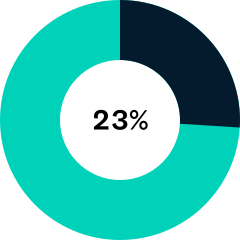
of finance leaders in the UK say their O2C processes broke down or faltered following a merger or acquisition
The Bottom Line
Finance systems designed for operational stability are systematically failing to support the business model innovation that drives competitive advantage. While successful companies increasingly rely on dynamic pricing strategies, hybrid revenue models, and rapid scaling initiatives to outpace competitors, their financial infrastructure cannot keep pace with these strategic demands. The result is a fundamental constraint on growth: finance leaders find themselves advising against promising revenue innovations not because they lack business merit, but because operational systems cannot support them.
This technology lag creates cascading bottlenecks throughout the revenue lifecycle—from inaccurate commission calculations to manual billing interventions to compromised forecasting precision. For companies attempting to scale through upmarket transitions, usage-based pricing, or strategic acquisitions, outdated O2C infrastructure transforms growth opportunities into operational bottlenecks. Organizations that cannot modernize their financial systems will find themselves locked out of the business model experimentation essential for long-term competitive positioning.
Strategic Recommendations
Design for future complexity
When evaluating billing and revenue systems, ensure requirements address both current needs and anticipated business model evolution—including global expansion, enterprise scaling, consumption-based pricing, and product bundling scenarios.
Establish cross-functional alignment
Create recurring touchpoints with sales and product teams to review pricing strategies before implementation, ensuring finance can support new experiments at scale without operational disruption.
Turn complexity into opportunity
Use pricing innovation demands as a strategic driver to modernize core O2C infrastructure, positioning finance as an enabler of business growth while educating stakeholders on system requirements for accurate billing and revenue recognition.
Test before you transform
Run O2C scalability stress-tests before major business changes—enterprise sales shifts, new pricing models, or acquisitions—and include O2C readiness reviews in due diligence processes to identify integration risks early.
Build for flexibility
Architect O2C systems to handle diverse go-to-market models, particularly usage-based billing, hybrid pricing structures, and complex enterprise contracts that require dynamic revenue recognition capabilities.
Methodology
Zuora commissioned an independent research firm to survey 991 CFOs, CAOs, Controllers, and VPs of Finance and Accounting in a multi-national study in May 2025 across North America, the United Kingdom, and France about what’s driving success for accounting and financial planning. The margin of error for this total sample is +/- 2% at the 95% confidence level. Based on the survey findings, the report also includes strategic recommendations from Zuora to help overcome O2C technical gaps and improve processes.
The Systems and Processes That Got You to $20M ARR Won’t Get You to $200M
As PLG companies mature, moving to enterprise sales isn’t a question of if, but when. And when that shift happens, your O2C process becomes more mission-critical than ever before. If you’re a CFO or CAO gearing up for the next growth phase, this one’s for you.
How Legacy Systems are Limiting Finance
89% of leaders are expected to act as strategic advisors, but 70% say their order-to-cash tech stack is holding them back.
The Risks of Misaligned Order-to-Cash Ownership
82% of leaders say IT lags in system updates, and 82% of SaaS leaders say fragmented O2C ownership causes operational challenges.