Invoice exports need to be delivered on a schedule, customer notifications need to be triggered at the right time, and collections processes need to follow consistent escalation paths. Downstream systems need to be updated when key events occur.
The challenge is turning this business intent into workflow logic.
Every new workflow requires someone to translate requirements into triggers, conditions, actions, and process steps. As operational processes evolve, workflows need to evolve with them. What begins as a straightforward automation can quickly become a growing collection of updates, exceptions, and maintenance work.
Over time, workflow creation itself can become the bottleneck.
This is where the Zuora AI Workflow Agent delivers value.
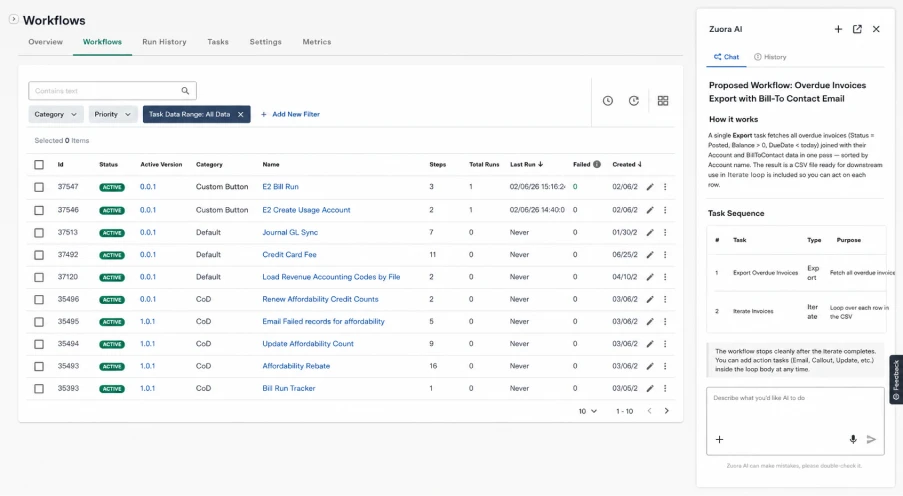
Instead of starting with workflow structure, users can start with the business process they want to automate. Using natural language, they can describe the outcome they’re trying to achieve and generate a workflow draft that serves as a starting point for review and refinement.
The workflow still follows the same governance controls and deployment process. Users remain in control of what gets activated. The difference is that teams spend less time translating requirements into workflow logic and more time focusing on the business process itself.
Moving from business intent to workflow design
Consider a common billing operations scenario: after invoices are generated, teams may need to export invoice data, notify customers, update downstream systems, and alert internal stakeholders when processing is complete.
The process itself is familiar, but the effort often comes from designing and maintaining the workflow that coordinates all of those actions.
The workflow is not created in isolation from the business problem. It starts with the business process and works backward into automation.
That shift may seem small, but it changes how teams approach workflow creation.
Instead of asking, “How do I build this workflow?” teams can focus on, “What process am I trying to automate?”
Making automation easier to maintain
Creating workflows is one part of the challenge; maintaining them is often where the real complexity appears.
Business processes change. Notification rules evolve. Collections policies are updated. New reporting requirements emerge. Every change can require updates to existing workflow logic.
As organizations automate more processes, understanding and modifying workflows becomes just as important as creating them.
Workflow Agent helps address that challenge by making workflows easier to create, understand, and adapt over time.
Users can start with business intent, generate a workflow draft, review the results, and continue refining workflows as operational needs change.
Now, Workflow is more accessible by reducing the effort required to build and maintain automation.
When workflow creation becomes easier, teams can spend less time managing workflow complexity and more time scaling the processes that drive the business forward.
Ready to see how Workflow Agent helps teams create and maintain workflows using natural language?
Learn more about Zuora AI and get started today