
TL;DR: Key Takeaways for Finance Leaders
- Collections in recurring revenue is relationship management, not cash recovery. Aggressive tactics that recover cash this quarter can torch retention next quarter. The LTV math demands a different playbook. Median DSO has risen from about 31 to nearly 40 days since 2021, and the cash gap is widening across the market.
- Three strategic challenges, visibility, coordination, and pattern detection, share one root cause, which is that collections are too often siloed. Three concrete actions modern CFOs can take this year: audit the current collections approach, invest in technology that supports context and AI, and train the team for relationship-first work.
- The platform decision determines whether the strategic shift compounds or stalls. Modern AR collections software should sit on the same data model as the billing system of record (not nightly export), include AI-powered account scoring and AI-drafted outreach, and integrate natively with CRM. Bolt-on tools running on legacy AR can’t deliver contextual collections at scale.
If invoices are falling through the cracks, chances are your customer relationships are too. For modern businesses, every touchpoint, even collections, is a moment that can make or break that relationship. True success in collections means prioritizing long-term value, like retention and forecast accuracy, by shifting KPIs beyond payment recovery to metrics that reflect overall customer and financial health. Let us explain.
In a one-time transaction model, collecting 80 cents on the dollar can be considered a win; you secure whatever payment you can, then move on. But in recurring revenue, that same customer will be invoiced again next month, and the next. Every collection interaction becomes part of an ongoing customer journey. Aggressive tactics that might recoup cash today could cost you significantly more in lost recurring revenue tomorrow.
At the same time, modern businesses that bill their customers repeatedly—such as software-as-a-service (SaaS) and subscription-based companies rely on steady cash inflows from customers. But ensuring those recurring payments arrive on time is an increasing challenge. In today’s environment, even as companies tighten payment terms, the average days sales outstanding (DSO) has risen from about 31 to nearly 40 days since 2021, and late payments are surging. Invoices fall through the cracks or are simply given up on.
For CFOs and Chief Accounting Officers (CAOs), these trends signal potential cash flow problems, which could result in revenue leakage. Depending on the size of the company, even just a few large overdue invoices could quickly put the business in the red. In addition, research shows that only about half of organizations today are closing the books within a week, often due to manual work and breakdowns in AR processes.
One root cause that’s frequently overlooked is that collections are too often siloed. Whether it’s managed manually in spreadsheets or tucked away in a standalone point solution, collections can create a disjointed order-to-cash process. This fragmentation creates ripple effects across the business, like delayed closings, inaccurate forecasts, missed revenue, and even customer churn.
For companies operating on recurring revenue models, these aren’t isolated symptoms; they’re systemic risks. To mitigate them, finance leaders must elevate collections from a tactical cash recovery function to a strategic pillar of customer trust and long-term revenue growth
“By consensus, organizations should complete their close within one business week, yet our Office of Finance Benchmark Research found that only 50% can finish the quarterly close within six business days. Problems that arise in manual A/R processes—fumbled handoffs, approval roadblocks, rework needed due to errors, or poor data quality and availability—can all be factors in delaying the close.” Source: Ventana Research
.
The top 3 collections challenges finance leaders are hearing...
… and how they’re quashing customer lifetime value (LTV)
Challenge 1: “We don’t have visibility into systems that can tell us about the full customer lifecycle.”
The first big challenge is Data fragmentation. Collections teams are flying blind, stitching together insights from billing, CRM, and support systems. Many traditional AR tools are designed with a transactional mindset: they provide a detailed view of invoices but lack context about customer relationships, payment behaviors, or the broader financial history. And because information from emails with customers, such as promises to pay or billing disputes, is often logged manually in spreadsheets or a separate system, it’s prone to getting lost in the shuffle. This wastes time and can leave teams unclear on the latest customer status.
Collections teams using traditional AR tools are effectively operating in isolation, separated from critical insights held in sales, billing, and customer success systems. Without access to a comprehensive financial history or customer status, they struggle to tailor their approach appropriately. By the time they have a clear view of the customer lifecycle, it’s already too late. Collections conversations without context can damage relationships, turning what should be a routine engagement into a tense interaction.
Put simply, you can’t maintain and grow a relationship with a customer you don’t understand. And in a recurring model, every misunderstanding presents a risk to future revenue.
“We were essentially trying to fit square pegs into round holes. Combining seat-based and consumption-based charges on a single invoice for enterprise customers was a nightmare.”
Sid Sanghvi, Head of Finance Business Applications, Asana
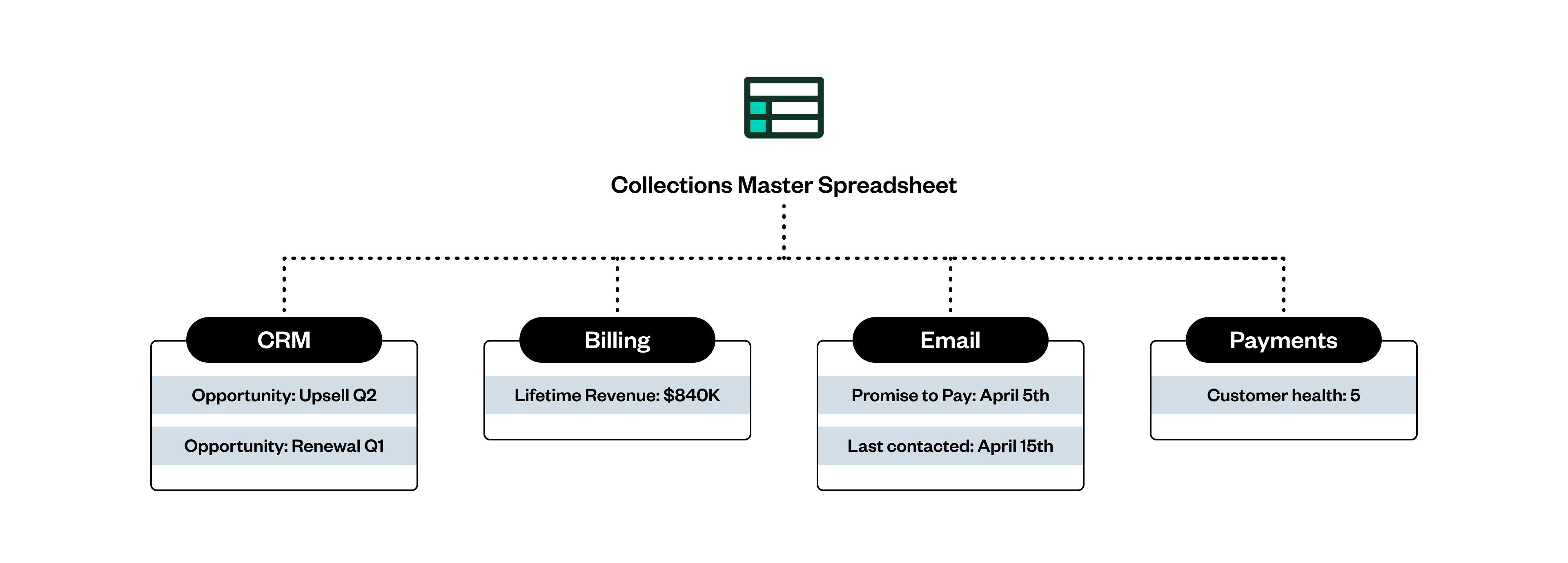
Challenge 2: “We’re trying to work with other customer-facing teams, but we don’t know what they’re doing.”
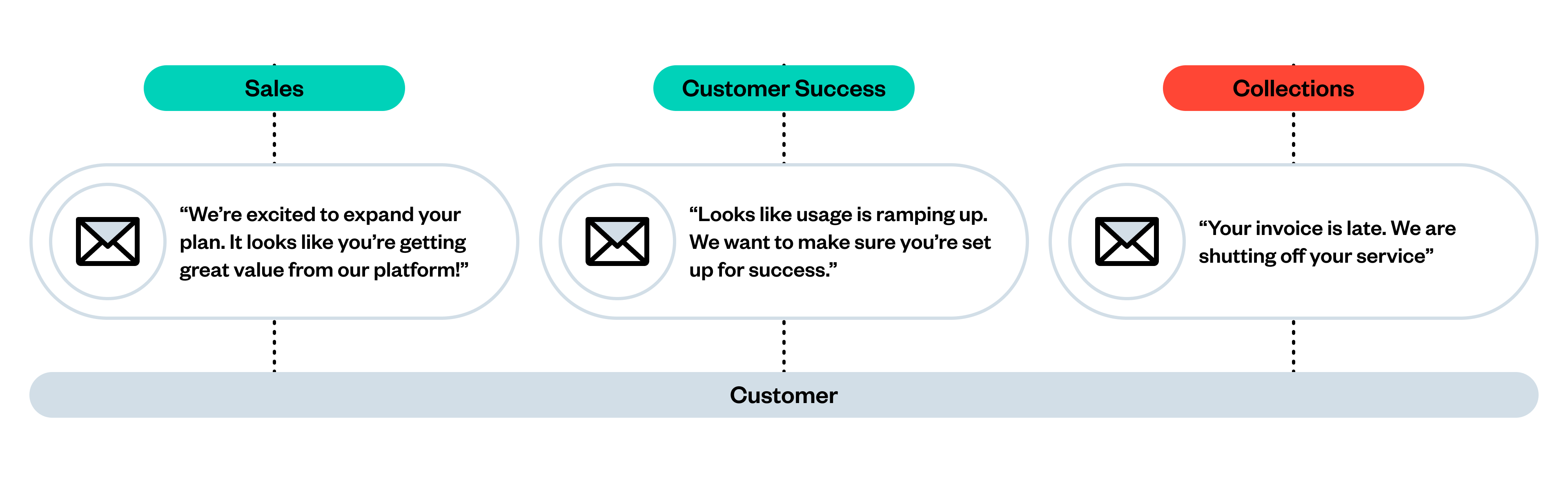
The second major challenge is a lack of coordination across customer-facing teams. Your collections team might send a payment reminder at the exact moment sales are negotiating an upsell or support is working to resolve an issue. Internally, these are separate functions. But to the customer, they’re all part of a single relationship with your company.
Customers don’t distinguish between collections, sales, or support; they just see you as one company. So when messages are misaligned or poorly timed, it feels disjointed and impersonal. The result is confusion, frustration, and a loss of trust.
You may be trying to build strong customer relationships, but fragmented systems and siloed communications are working against you. Without real-time visibility and cross-functional coordination, your efforts to retain customers and recover revenue are undermined at the most critical moments in the customer journey. Our deeper guide on smart collections strategy covers the operational mechanics of solving this coordination challenge.
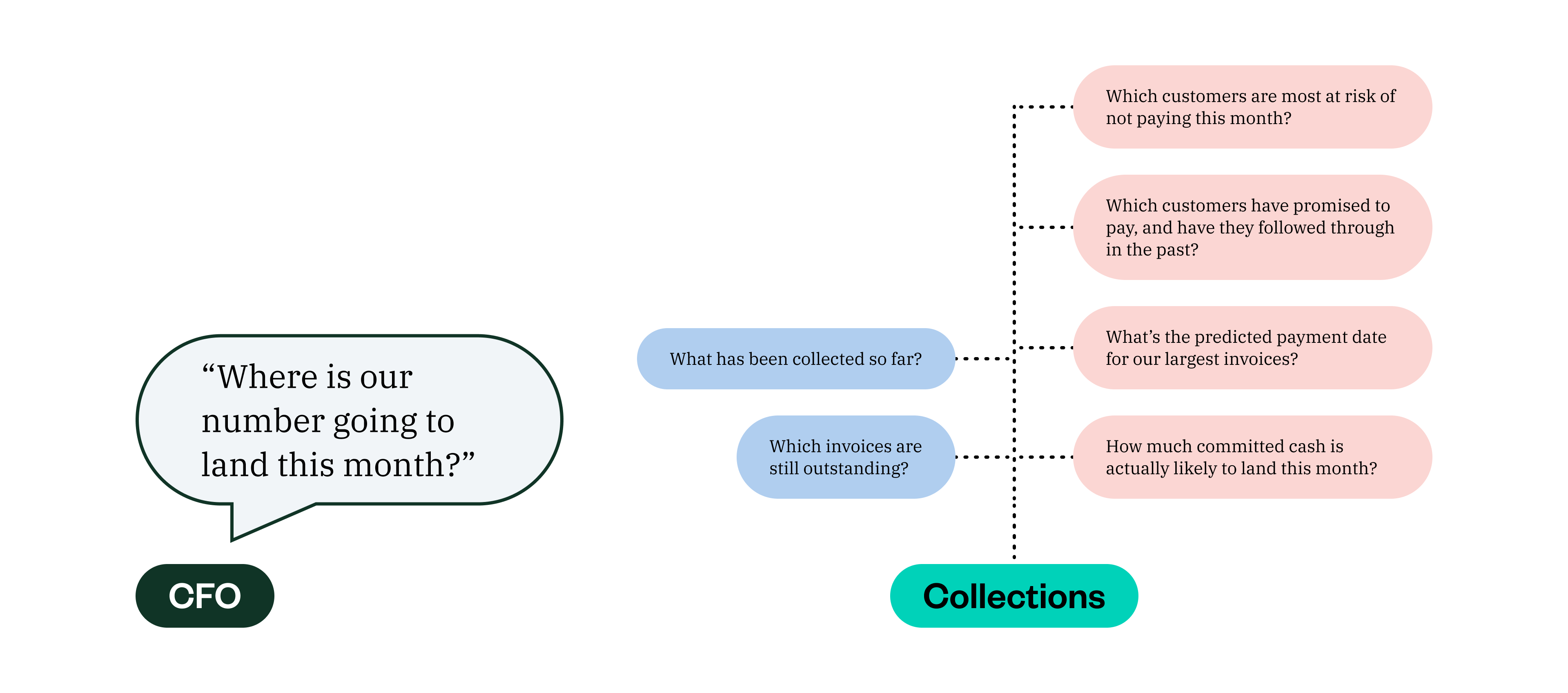
Challenge 3: “Our one-time payment collections mindset isn’t cutting it anymore, and we’re missing the patterns that make recurring revenue predictable.”
Maybe your collections team is constantly being asked, “Where are we going to land this month? ”but they don’t have the tools to answer with confidence. That’s because traditional AR systems are designed to track invoices, not customers. They focus on individual transactions—Invoice 1, Invoice 2, Invoice 3—rather than recognizing the broader patterns that define how a customer behaves over time.
But in a recurring revenue model, looking at past invoices in isolation won’t help you predict when Invoice 4 will get paid. What will be is looking at how a customer has paid in the past across all their invoices and comparing that to similar patterns across your customer base. When you understand payment behaviors in aggregate, you can begin to forecast with accuracy and intervene before issues arise.
That’s where most AR tools fall short. They lack the historical context and predictive intelligence to answer forward-looking questions. The pattern-detection mechanics are covered in detail in our guide on managing aging invoices. Without AI-powered forecasting, your team is left reacting to missed payments rather than preventing them. You can’t identify at-risk accounts early, you can’t proactively engage customers before they slip into delinquency, and you can’t deliver the cash flow predictability that finance leaders depend on.
This isn’t just a tooling problem; it’s a visibility gap that keeps collections teams stuck in the rearview mirror, when what they really need is a predictive, customer-centric view of the road ahead.
The next phase of this capability, a fully autonomous AI agents handling pattern detection and intervention, is the focus of our AI agents for accounts receivable guide.
The strategic shift: rethinking collections for long-term value
For recurring revenue businesses, collections can no longer operate as a back-office function focused on chasing dollars. It must evolve into a strategic discipline, one that preserves trust, strengthens customer relationships, and safeguards predictable revenue streams.
Lead with insight, not urgency
In a recurring model, context is everything. Collections teams need integrated, automated workflows that leverage comprehensive customer context, from historical payment behavior to real-time interactions, to tailor outreach that builds trust and enhances efficiency. That means building tight feedback loops with sales, billing, and customer success so that outreach isn’t just timely, it’s informed, coordinated, and empathetic. A reminder sent in isolation may resolve one invoice, but a collections approach grounded in a relationship context can preserve a multi-year customer.
Turn collections into a relationship-building moment
Every interaction with a customer is a chance to either build or erode trust. The best-performing AR teams don’t treat collections as an interruption to the customer journey, but rather, they make it part of the journey. When collections are rooted in mutual understanding, acknowledging open support issues, recognizing payment trends, and adapting to recent changes, it becomes a reinforcing touchpoint rather than a disruptive one.
Move from reactive to anticipatory finance
Modern finance leaders must leverage predictive insights, driven by AI and historical payment data, to move beyond reactive aging reports and proactively engage accounts at risk before payment issues emerge. By focusing on payment behaviors and risk signals earlier in the lifecycle, collections becomes a proactive function. This strategic foresight allows teams to engage at-risk accounts before problems materialize, reducing churn and driving more predictable cash flow.
Redefine what success looks like
Success in collections isn’t just a paid invoice; it’s also a retained customer, a smoother renewal, and a more confident forecast. That means shifting KPIs from short-term recovery metrics to indicators that reflect long-term health: days sales outstanding (DSO) trends, retention impact, and collections efficiency benchmarks that compare not just within your business, but across your industry.
3 Things CFOs Can Do This Year — Collections
The strategic challenges are well-documented. The question CFOs need to answer this year is what to actually do about them. Three concrete actions, in order.
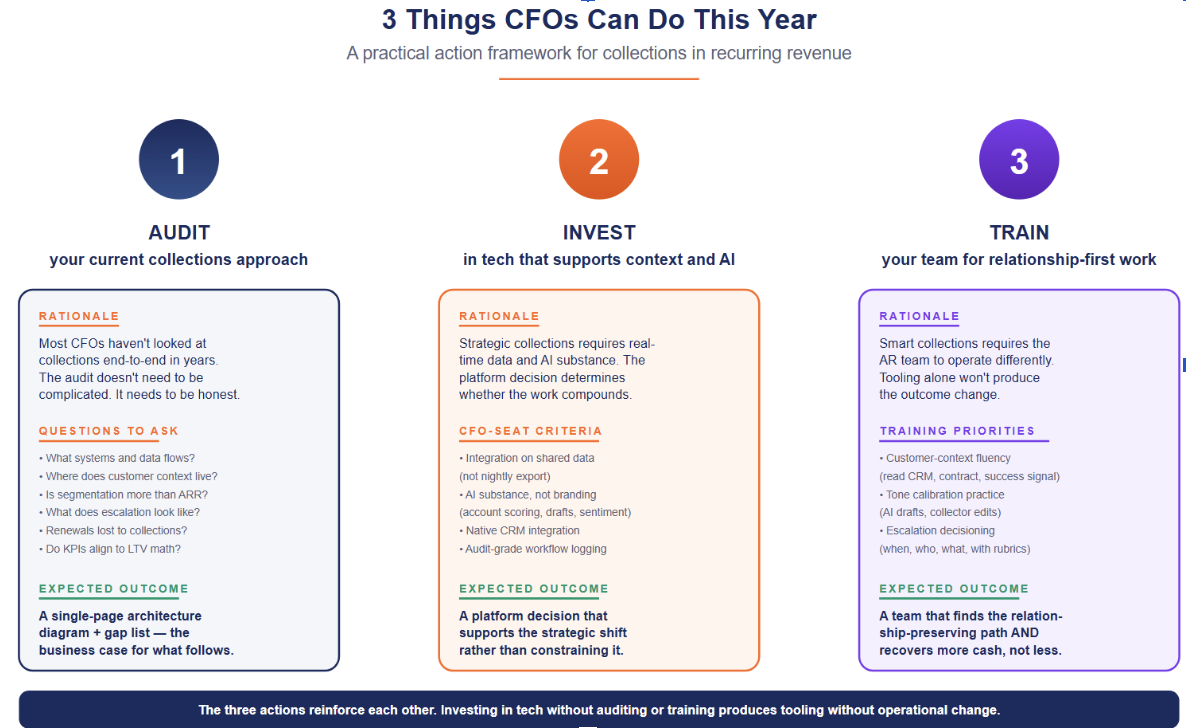
1. Audit Your Current Collections Approach
Most CFOs haven’t looked at their collections workflow end-to-end in years. The audit doesn’t need to be complicated, but it does need to be honest. Start with six questions:
- What systems does our collections team actually work in, and how does data move between them?
- Where does the customer context that should inform our collections decisions actually live, and who has access to it?
- What’s our current segmentation logic, and is it more than ARR-tier-based?
- What does an escalation actually look like when a strategic account is 30 days late?
- How often do we lose renewals because of a collections experience, and how would we know if we did?
- What metrics does the team measure, and do those metrics align with the LTV math we operate against elsewhere?
The output is a single-page architecture diagram of the current collections workflow, plus a list of the gaps. That document becomes the business case for everything that follows.
2. Invest in Technology That Supports Context and AI
Once the audit identifies the gaps, the technology question becomes specific. The criteria that matter from the CFO’s seat differ from those that matter from the AR Operations team’s seat.
- Integration architecture. The collections platform should sit on the same data model as the billing system of record, rather than reading from nightly exports. Real-time invoice state is the precondition for contextual collections.
- AI substance. AI in collections should mean account scoring (which accounts get human attention), AI-drafted outreach (consistent tone calibration at scale), and sentiment-aware response handling (auto-classification of customer replies). If the vendor describes “AI-powered collections” but can’t describe these specific capabilities, the AI is a marketing layer rather than an operational one. The AI capabilities running underneath this are part of Zuora AI, with operational integration described in our AI for Collectors program.
- CRM integration. The collections platform should know about open opportunities, support tickets, and customer-success signals before sending an escalation. Without this, the cross-team coordination challenge can’t be solved with tooling alone.
- Audit-grade workflow logging. Each touchpoint should be queryable by the controller and defensible to an external auditor. This is the control baseline.
The vendor evaluation should test these criteria explicitly rather than allowing the conversation to stay at the demo level.
3. Train Your Collections Team for Relationship-First Work
Smart collections require the AR team to operate differently than they did under traditional dunning management workflows. The shift isn’t tooling alone; the team needs the skills to use the tooling well. Three training priorities:
- Customer-context fluency. Collectors need to be able to read the CRM signal, understand the contract context, and recognize the customer-success churn-precursor pattern before drafting an outreach. This is judgment work that AI augments rather than replaces.
- Tone calibration practice. The AI drafts the first version; the collector edits for tone. That edit is a craft skill, and it varies meaningfully across segments. Training time should be allocated.
- Escalation decisioning. When to escalate, who to escalate to, and what the escalation should contain, these are judgment calls that benefit from explicit rubrics and from team-level peer review of past escalations.
Investing in the team alongside the tooling produces a meaningfully better outcome than investing in either alone.
“Don’t say ‘no.’ Figure out what it is that will actually move the needle without completely breaking the back. Once you have the front of the business understanding that you’re not just a machine of ‘no,’ they come to you earlier with problems.”
Jane Koltsova, Senior Director, Global Revenue Controller, PagerDuty — Balancing risk and growth: strategies for controllers and CAOs
The yes-culture leadership argument applies directly to the collections team development. A team trained to find the relationship-preserving path produces better cash outcomes than a team trained to enforce rigid escalation protocols.
AR Collections Software: What to Look For
For CFOs in the vendor-evaluation window, the criteria that should drive the AR collections software shortlist are different from the generic “what does the demo look like” approach most evaluations default to. Eight capabilities matter, in priority order.
The Capability Checklist
- Integration with the billing system of record on shared data. Not nightly export. Connected platforms operate on real-time invoice state; bolt-on tools run roughly one day behind reality, which produces failure modes that no UX polish can compensate for.
- AI-powered account scoring and prioritization. The collector worklist should be sorted by composite priority score (aging × value × risk × strategic context), not by aging alone.
- AI-drafted outreach with collector review. The first version of each reminder is AI-drafted, sized to the customer’s history and tone. Collectors confirm or edit before sending for high-value accounts.
- Multi-channel orchestration. Email, in-app, SMS, and account-team escalation operating as one workflow rather than as parallel silos. Sequencing matters more than channel count.
- Native CRM integration. Customer context flows into the prioritization model and out to sales and customer success teams. Without this, collections run in isolation, and the cross-team coordination challenge stays unsolved.
- Audit-grade workflow logging. Each touchpoint, reply, and escalation decision is logged with user, timestamp, channel, and outcome. The trail should be queryable by the controller and defensible to an external auditor.
- ASC 606-aligned write-off and recovery posting. When write-offs and recoveries flow into the GL, the entries should align with revenue recognition standards without manual reconciliation.
- Multi-entity, multi-currency, FX support. Enterprise AR typically means multi-entity reporting and multi-currency invoicing. Tools that “support” these as bolt-ons can still require manual reconciliation.
Integration with Billing
This is the most consequential architectural distinction in the AR collections software category, and it’s the one most evaluations skip past. Bolt-on collections tools (Versapay, Tesorio, HighRadius collections module, Billtrust collections, Quadient) read nightly exports from the billing system of record. That batch latency is fine when nothing changes mid-cycle. In a recurring-revenue business where amendments, prorations, usage overages, and cancellations land continuously, the latency means the collections workflow operates on stale data, and the customer-relationship damage from incorrect dunning compounds quickly.
Connected platforms, Zuora Collections, sit on the same data model as the billing system. The collections team sees the latest invoice state without batch latency, and the audit trail is one continuous line.
AI Capabilities
Three substantive AI capabilities, distinct from “AI-powered” marketing language.
- Account scoring. AI ranks the worklist by which interventions will actually move the needle, based on historical patterns, aging, ARR, dispute markers, and customer-success signals.
- AI-drafted outreach. The first version of each reminder is generated based on the customer’s history and tone. Collectors review and confirm.
- Sentiment-aware response handling. Customer replies are auto-classified into categories (routine acknowledgment, payment promise, dispute indication, frustration) and routed accordingly.
These are the capabilities described in AI for Collectors and in the broader Zuora AI program. Vendors that can’t describe their AI in these specific terms are typically marketing AI rather than delivering it.
Audit and Compliance Features
The controller’s perspective belongs in any collections software evaluation. Three questions to ask:
- Can my external auditor drill from a write-off journal entry back to the original invoice and customer context in your platform?
- Does the workflow log capture user, timestamp, channel, and outcome for each touchpoint?
- How does the platform handle ASC 606 alignment for write-offs and recoveries?
If any of these answers require CSV exports or screenshots, the platform isn’t audit-ready for an enterprise-scale deployment.
The path forward: Turning collections into a growth lever
In today’s recurring revenue environment, collections is no longer just about recovering cash. It’s about protecting relationships, reducing churn, and driving long-term financial health. When collections is treated as a strategic lever rather than a tactical afterthought, it becomes a powerful tool for building customer trust and ensuring cash flow predictability.
For CFOs and CAOs, the path forward is clear: stop viewing collections as a downstream, isolated process and start treating it as an integrated, insight-driven function that shapes your customer experience and your revenue outcomes. The opportunity is not just to collect faster, but to collect smarter, with empathy, with foresight, and with the full context of each customer relationship.
By breaking down silos, modernizing your approach, and empowering your AR teams with the tools and visibility they need, you’re not just solving for unpaid invoices—you’re strengthening your company’s financial foundation for sustainable growth.
“How you collect has a direct impact on your customer relationships and, in the end, what you collect.”
Matt Dobson, Chief Accounting Officer, Zuora — at the launch of Zuora Collections, May 2025
Because in the end, collections done right isn’t about chasing payment. It’s about building trust that pays dividends—month after month, renewal after renewal.
Ready to evaluate AR collections software for the modern CFO seat?
Frequently Asked Questions
1.
What features should I look for in AR collections software?
Enterprise-grade AR collections software should include integration with the billing system of record on shared data (rather than nightly export), AI-powered account scoring and prioritization, configurable workflow automation tied to aging triggers, multi-channel orchestration (email, in-app, SMS), an integrated audit trail across each customer touchpoint, native CRM integration so collections coordinates with sales and customer success, ASC 606-aligned write-off and recovery posting, and multi-entity/multi-currency support. Avoid bolt-on tools that read nightly billing exports; connected platforms operate on real-time invoice state and produce one continuous audit trail.
2.
What is the best AR collections software for enterprises?
The best AR collections software for enterprises depends on the billing model. For subscription, usage-based, and hybrid revenue businesses, the platform should natively understand recurring billing, mid-cycle amendments, dunning workflows, and AR accounting on a single data model. Zuora Collections combines these capabilities with AI-powered account scoring, AI-drafted outreach, and sentiment-aware response handling on the same data model as the billing system of record. Consider also: HighRadius, Billtrust, Versapay, and Quadient as standalone AR-tool options; the architectural distinction is whether the tool integrates with billing on shared data or via nightly export.
3.
What software supports smart collections and payment reminders?
Smart collections software combines four building blocks: a configurable workflow engine that runs segmented payment-reminder journeys (pre-due, due-date, post-due cadences across email, in-app, and SMS), AI-powered account scoring and prioritization, AI-drafted reminder copy sized to each customer’s history and tone, and an integrated audit trail logging each touchpoint. Zuora Collections combines these capabilities on the same data model as the billing system of record, with native CRM integration so collections coordinates with sales and customer success rather than acting in isolation.
4.
How do you build a collections strategy that doesn't churn customers?
A collections strategy that protects customer retention rests on three foundations. First, segment the customer base by ARR, payment-behavior risk, and strategic value, so the workflow that runs against a strategic account differs meaningfully from the workflow that runs against a long-tail account. Second, calibrate tone to aging stage and customer context: pre-due reminders should be courteous, post-due reminders should be direct, and escalation should be reserved for clear cases. Third, integrate collections workflows with CRM data so the AR team has visibility into open opportunities, support tickets, and customer-success signals before sending an escalation. The combination produces a collections function that recovers cash without burning the customer relationships that the renewal economics depend on.
5.
What are the top collections challenges for CFOs?
CFOs leading collections in a recurring-revenue business face three interlocking strategic challenges. First, visibility into the full customer lifecycle: collections operating without context from billing, CRM, and customer success produces dunning emails that arrive at the worst moments and damage strategic accounts. Second, coordination across customer-facing teams: when sales, customer success, and collections operate from different data and on different cadences, the customer experiences a fragmented company that doesn’t talk to itself. Third, pattern detection in recurring revenue: traditional aging-driven workflows miss the subscription-context patterns (mid-cycle amendments, churn-precursor signals, dispute markers) that actually predict cash recovery.
6.
How do CFOs measure collections success in subscription businesses?
CFOs in subscription businesses should measure collections success on a balanced scorecard rather than dollars collected this month. The four metrics that matter together are: DSO (cash velocity), CEI / Collection Effectiveness Index (cash recovery completeness), churn impact attributable to collections experience (relationship health), and recovery without escalation (operational efficiency). The combination prevents the failure mode of a collections team measured only on dollars collected, which incentivizes aggressive tactics that recover cash this quarter and torch retention next quarter.