
Frequently Asked Questions

Agentic AI Pricing & The COMPASS Framework

What is the COMPASS Framework for pricing Agentic AI?

The COMPASS Framework (Choice of Optimal Metrics for Pricing Agentic Systems & Solutions) is a decision tool designed to help businesses select the most effective pricing model for Agentic AI solutions. It guides you to the right pricing approach by evaluating the AI's scope of work (task automation, process orchestration, goal achievement) and the level of attribution (diffuse, medium, direct) you can assign to the AI's outcomes. Learn more here.

What are the four main pricing models for Agentic AI described by Zuora?

Zuora outlines four primary pricing models for Agentic AI: Per Agent (charging for access/availability, like a digital assistant), Per Activity (metering each AI action, e.g., .25 per conversation), Per Output (charging for finished deliverables, such as a generated report), and Per Outcome (charging for measurable business results, like a percentage of cost savings). Each model fits different AI use cases and attribution levels.

How do I choose the right pricing model for my Agentic AI solution?

To select the best pricing model, use the COMPASS Framework to answer two questions: 1) What is your AI's job (task automation, process orchestration, or goal achievement)? 2) How directly can you attribute business results to your AI? The intersection of these answers points to the most suitable model—per agent, per activity, per output, or per outcome. Iteration and market feedback are essential, as pricing may evolve over time.

Can you provide examples of each Agentic AI pricing model?

Yes. Per Agent: An AI sales development rep that prospect-hunts on LinkedIn. Per Activity: A support agent charging per chat handled. Per Output: An AI legal assistant charging per contract drafted. Per Outcome: A supply chain optimizer AI taking a percentage of monthly savings generated by its actions.

What is meant by 'scope of agent's work' in the COMPASS Framework?

'Scope of agent's work' refers to the range and complexity of tasks the AI performs. It spans from deliberately narrow, repeatable tasks (task automation), to coordinating multi-step workflows (process orchestration), to pursuing high-level business goals (goal achievement). This helps determine the most logical pricing metric for your AI solution.

How does 'level of attribution' affect Agentic AI pricing?

'Level of attribution' measures how directly you can credit the AI for business outcomes. If attribution is strong (direct), you can confidently charge for outcomes. If it's weak (diffuse), per agent or per activity pricing may be more appropriate. Medium attribution supports output-based pricing. The clearer the attribution, the more value-based your pricing can be.

Is one Agentic AI pricing model better than the others?

No pricing model is inherently better; each has trade-offs. Some are easier to explain, others track customer value more closely, and some provide more predictable revenue. Many companies use a combination of models and iterate as their product and market evolve.

How does the COMPASS Framework help with pricing iteration?

The COMPASS Framework provides a structured approach to evaluating and adjusting your pricing model as your AI solution, market, or customer needs change. It encourages ongoing assessment of value delivery and attribution, supporting continuous improvement in pricing strategy.

What are some challenges in attributing value to Agentic AI solutions?

Challenges include diffuse impact (where AI's value is real but hard to isolate), shared responsibility (outcomes depend on multiple factors), and qualitative benefits (like improved productivity). The COMPASS Framework helps clarify these challenges and guides you to the most defensible pricing approach.

Can I combine multiple pricing models for my Agentic AI product?

Yes, many companies use a combination of pricing models (e.g., base fee per agent plus per activity charges) to balance value capture, customer understanding, and revenue predictability. The COMPASS Framework supports this flexible approach.

How does the COMPASS Framework relate to the Subscription Economy?

The COMPASS Framework aligns with the Subscription Economy by helping businesses design recurring, usage-based, or outcome-based pricing for AI-powered services. It supports innovation in monetization and customer value delivery, which are core to subscription business models.

What is an example of a diffuse attribution scenario for Agentic AI?

An example is a meeting assistant AI that schedules, records, and summarizes calls. While productivity gains are real, it's difficult to isolate and quantify the AI's direct impact on revenue or business outcomes. In such cases, per agent pricing is often used.

How does process orchestration differ from task automation in Agentic AI?

Task automation involves simple, repeatable jobs (e.g., data entry), while process orchestration coordinates multiple steps and systems to complete a workflow (e.g., insurance claims processing). The scope of work influences the best pricing metric for your AI solution.

What is a real-world example of per outcome pricing for Agentic AI?

A supply chain optimizer AI that autonomously reduces shipping costs by rerouting freight and consolidating orders, charging a percentage (e.g., 10%) of the savings generated each month, is an example of per outcome pricing.

How does Zuora support intelligent pricing and packaging for AI solutions?

Zuora provides solutions for intelligent pricing and packaging, enabling businesses to design, test, and iterate on pricing models for AI and subscription-based products. The platform supports recurring, usage-based, and outcome-based billing, helping companies monetize innovation effectively. Learn more.

Where can I learn more about the COMPASS Framework and Agentic AI pricing?

You can read the original article on Zuora's website and explore Michael Mansard's detailed post on the COMPASS Framework on LinkedIn for further insights and practical guidance.

How does the COMPASS Framework help avoid common pricing pitfalls for AI products?

The COMPASS Framework helps avoid pricing pitfalls by aligning your pricing metric with the AI's value delivery and attribution level. This ensures your pricing is defensible, understandable, and scalable as your product and market mature.

What is the role of experimentation in Agentic AI pricing?

Experimentation is crucial in Agentic AI pricing because market needs, product capabilities, and attribution clarity can change over time. The COMPASS Framework encourages ongoing testing and iteration to find the optimal pricing model for your solution.

How does the COMPASS Framework address hybrid pricing models?

The COMPASS Framework recognizes that many AI solutions may require hybrid pricing (e.g., base fee plus usage or outcome-based charges). It helps you identify when and how to combine models based on your AI's scope and attribution level.

What is the impact of attribution strength on customer acceptance of AI pricing?

Stronger attribution (clear link between AI actions and business outcomes) makes value-based pricing easier for customers to understand and accept. Weaker attribution may require simpler, more predictable pricing models to build trust and adoption.

Zuora Platform Features & Capabilities

What features does Zuora offer for subscription management and monetization?

Zuora provides a comprehensive suite for subscription lifecycle management, including flexible billing (recurring, usage-based, one-time), automated revenue recognition (ASC 606, IFRS 15), global payment management (40+ gateways), AI-powered collections, and tools for pricing, quoting, and analytics. The platform supports over 50 pricing models and is used by 1,000+ companies worldwide. Learn more.

What integrations does Zuora support?

Zuora offers 60+ pre-built connectors (Salesforce, HubSpot, NetSuite, Snowflake), REST and SOAP APIs, warehouse connectors (Databricks, BigQuery, RedShift), 40+ payment gateways (Stripe, GoCardless), Zephr extensions (AI Paywall, Braintree, Zendesk), and a marketplace with nearly 100 apps (ProfitWell, Amplitude, MailChimp). See full list.

Does Zuora provide APIs for integration?

Yes, Zuora offers REST and SOAP APIs for seamless integration with external systems, supporting billing, payment, and subscription management. Developer resources and guides are available at the Zuora Developer Center.

What technical documentation is available for Zuora products?

Zuora provides extensive technical documentation, including platform docs, API references, SDK guides, and integration tutorials. Resources are available at docs.zuora.com, developer.zuora.com, and the Knowledge Center.

What security and compliance certifications does Zuora have?

Zuora holds PCI DSS Level 1, SSAE 16 SOC1 Type II, SOC2 Type II, ISO 27001, HHS HIPAA, and SOC 3 certifications. These ensure secure payment handling, financial controls, privacy, and regulatory compliance. Details here.

How does Zuora help with global compliance and multi-currency operations?

Zuora supports multi-entity, multi-currency, and tax compliance, enabling businesses to operate globally with built-in localization for over 30 markets and robust regulatory support.

What are some real-time product performance metrics available in Zuora?

Zuora provides real-time metrics on profitability, conversion rates, and discounting rates, enabling businesses to respond quickly to market trends, optimize pricing, and improve sales velocity. Integration with CRM and CPQ tools ensures data visibility for analysis. Learn more.

How easy is it to implement Zuora and get started?

Implementation timelines vary: focused scopes can be completed in as little as 30 days, typical projects take 30–90 days, and complex programs may take several months. Pre-built connectors enable rapid integration. Extensive training, support, and developer resources are available to ensure a smooth start. Explore training.

What support resources are available for Zuora customers?

Zuora offers 24x5 live global support, email and ticketing, premium support options (Technical Account Managers, Enterprise Solution Architects), a community portal, and over 500 training courses through Zuora University. Support Portal.

Use Cases, Benefits & Customer Proof

Who can benefit from using Zuora's platform?

Zuora is designed for subscription-based businesses across industries such as SaaS, media, healthcare, retail, manufacturing, telecommunications, and more. Target roles include finance, IT, product management, operations, and sales teams. See details.

What business impact can customers expect from Zuora?

Customers report recurring revenue growth (e.g., Swiftpage: 140% increase in mentoring customers, 131% ARR growth), operational efficiency (Hudl: 100+ hours/month saved), improved retention (subscription suspension saves 1 in 6 customers), faster time-to-market (Carbar: setup time reduced from days to majority minutes), and global compliance. See case studies.

What core problems does Zuora solve for businesses?

Zuora addresses slow manual close cycles, compliance challenges (ASC 606/IFRS 15), scaling hybrid monetization, global compliance, revenue leakage, data quality issues, spreadsheet dependency, quote-to-cash misalignment, and forecasting difficulties. Automation and integration are central to solving these pain points.

Can you share specific customer success stories with Zuora?

Yes. Zoom scaled from 10M to 300M users; The Financial Times grew digital subscriptions; Hudl saved 100+ hours/month; Asana reduced SSP analysis time by 90%; The Seattle Times improved conversions by 30% and retention by 25%. Read more.

What feedback have customers given about Zuora's ease of use?

Customers like Mindflash, TripAdvisor, FireHost, Briggs & Stratton, Buildium, and AppFolio praise Zuora's flexibility, ease of integration, and user-friendly management. Examples include reducing sync times from 5 hours to 5 minutes and simplifying subscription management. See testimonials.

What industries are represented in Zuora's customer base?

Zuora serves SaaS, communications, retail, corporate services, energy, finance, healthcare, high tech, home services, HR tech, manufacturing, media, entertainment, software, telecommunications, and video games. See all industries.

Who are some notable Zuora customers?

Notable customers include Zoom, Box, Zendesk, Asana, AppDynamics, The Financial Times, The Guardian, Schibsted ASA, The Seattle Times, Siemens Healthineers, 24 Hour Fitness, GoPro, Fender, Schneider Electric, Caterpillar, Konecranes, Dell, Ford, Toyota, and General Motors. See more.

Why should a customer choose Zuora over worthy alternatives?

Zuora stands out for its flexibility (50+ pricing models), scalability (proven by Zoom's growth), AI-powered tools (Zephr for personalization), hybrid monetization, compliance (SOC 2, PCI DSS), and a track record of supporting rapid scaling and measurable results for leading brands. Learn more.

Pricing Agentic AI: The COMPASS Framework

A close-up, black-and-white photo of an analog compass with cardinal directions and degree markings visible, symbolizing strategy and guidance.
Tien Tzuo
Founder & CEO,  
Zuora


It’s time to land the plane! As we discussed previously, we compared the Impossible Triangle of pricing to the Bermuda Triangle, and the four models for Agentic AI Pricing as the islands you need to land on. To recap:

  • Per Agent – You’re paying for access and availability, sort of like hiring a digital assistant. For example, an AI sales development representative that prospect-hunts on LinkedIn.
  • Per Activity – You’re metering each action the AI takes (eg. conversation, API call, or ticket). For example, a customer support agent that handles inbound chats (maybe it charges $0.25 per conversation).
  • Per Output – You’re charging for finished deliverables (eg. a report generated, a workflow executed). For example, an agentic legal assistant that drafts first-pass contracts. 
  • Per Outcome – You’re charging for clear business results (eg. savings created, revenue generated). For example, a supply chain optimizer AI that autonomously reduces shipping costs by rerouting freight and consolidating orders (maybe it takes 10% of the savings generated each month). 

But how do you know which pricing model will work for you?  To navigate through the triangle and land on the right right island, you’re going to need a compass! That’s where Michael’s COMPASS Framework (Choice of Optimal Metrics for Pricing Agentic Systems & Solutions) comes in:
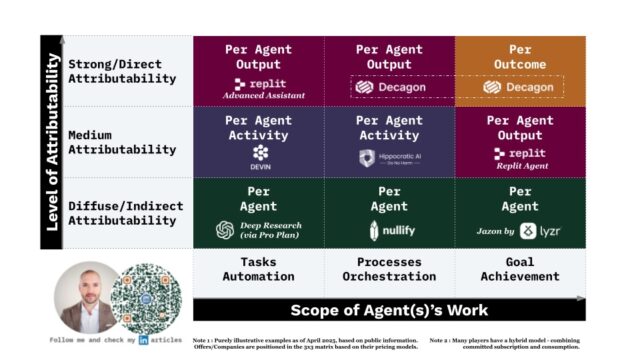
Table categorizing AI agent tools by level of attributability and scope of work, listing company logos and names in each category, with a QR code and profile photo in the bottom left corner.

Like the instrument panel of an airplane, this diagram may look kind of complicated, but it’s actually quite straightforward in practice. To use the compass, you just need to answer two basic questions. 

First: What’s your AI’s “Job”? How does your agent create value?

Is it more like a worker, a service, a utility, or a partner? In other words: Is it doing small, well-defined tasks like “Update this customer’s contact info”? Or is it running a workflow, like “Process a claim” ? Or is it chasing a big-picture goal, like “Optimize this campaign for return on ad spend”?

We call this the “Scope of Agent’s Work.” Imagine a spectrum:

  • Task Automation – Think factory line. Quick, repeatable, low-risk jobs. For example, an agent that scans incoming invoices, extracts line items, and uploads them into an ERP system. It handles repetitive, structured tasks quickly and reliably, freeing humans from rote data entry.
  • Process Orchestration – Think project manager. Coordinates moving parts across systems. For example, an insurance claims-processing agent that coordinates multiple systems — gathering documents, checking policy terms, routing to adjusters, and triggering payment. It doesn’t just do one task; it manages the workflow end-to-end.
  • Goal Achievement – Think of a senior strategist who chooses their own playbook to hit high-level targets. For example, a marketing strategy agent that autonomously manages ad spend across channels, choosing campaigns, reallocating budgets, and designing experiments to maximize return on ad spend (ROAS). 

Here’s the second question: How clearly can you prove it worked? How directly can you credit your AI for the desired result? 

Picture three people in an office: The executive assistant who makes everything run smoothly but never gets public credit (diffuse). The marketing manager whose work moves the needle but depends on others (medium). The sales rep whose closed deals are logged and celebrated (direct).

We call this the  “Level of Attribution”:

  • Diffuse (or Weak) – Its impact is real but hard to isolate.  It might be one factor among many, or its value is more qualitative. For example, a meeting assistant that schedules, records, and summarizes calls. The productivity gain is real, but hard to isolate from other factors — you can’t easily quantify how much revenue came from “better meeting notes.”
  • Direct (or Strong) – Its actions directly create measurable outcomes that are easily tracked, valued, and mutually accepted. For example, ​​a dynamic e-commerce pricing agent that automatically adjusts product prices based on demand, inventory, and competitor moves. Its impact is directly measurable in dollars — higher margins, faster sell-through, or clear revenue uplift.
  • Medium – Its outputs are clear, but the link to the business outcome might still be influenced by other factors or harder to quantify precisely in monetary terms. For example, a customer-support copilot that drafts responses for human agents. You can measure faster ticket resolution and higher CSAT, but those metrics are also influenced by team training, customer mood, and product quality — so attribution is partial.

The COMPASS Matrix helps you pick the model that fits both a) what your AI does and b) how confidently you can measure its impact, in order to arrive at one of the four suggested pricing models.

You can see the general shape of the dynamic – on the upper right of the chart, you have a highly attributable, business case-based system. You can charge for quantifiable high-level results. That’s similar to your AE hitting their numbers. 

On the lower left, you have a fairly diffuse, automation-oriented system. You can charge for the presence of an agent that handles essential but “minor” tasks. That’s similar to your factory line worker keeping the business humming. 

But what about the lower right  –  A service that is aimed at accomplishing strategic goals, but its impact is hard to prove? Well, if the attribution is diffuse, then the AI is probably enhancing a human being. This is ChatGPT, for example. The outputs may shape executive thinking, but attribution is weak. Hence, per-agent pricing makes sense.

And on the upper left, an example of an agentic AI service with a low scope of work but high-level attribution might be an AI that reconciles expense receipts against corporate card transactions in real time. Each reconciliation directly reduces accounting labor and prevents fraud. The attribution is strong (dollars saved, errors prevented), even though the task is small, so output pricing makes sense.

Finally,  here is an important point — no pricing model is inherently “better” than another. Pricing is still about trade-offs. Some models are easier to explain. Some track customer value better.  Some give you more predictable revenue. And of course, many companies use a combination of pricing models.  

And of course, pricing is never finished. It changes depending on market, product, region, etc. You may need to try a combination of these pricing models. This is a constant process of iteration. But with Michael’s COMPASS Framework, at least you’ll know which way you’re flying. He provides much more context in his LinkedIn post, which I encourage you to read. 

Good luck landing your own plane!

Share
Author:
Share:
Date: