On December 5, 1945, a group of five U.S. Navy torpedo bombers disappeared on a training mission while flying inside the Bermuda Triangle (also known as “Devil’s Triangle”), a mysterious polygonic patch of the Atlantic Ocean bounded by Florida, Bermuda, and Puerto Rico. Thirty years later, all five airplanes of Flight 19 were discovered in perfect working order in the Sonoran Desert.
Not really. That’s a scene from “Close Encounters of the Third Kind.” But the Flight 19 group definitely existed, and it definitely disappeared (a Navy board investigation later found that a faulty compass was probably to blame). The Bermuda Triangle was a big deal when I was a kid. All sorts of ships, airplanes, and people were said to have disappeared within its strange, murky depths.
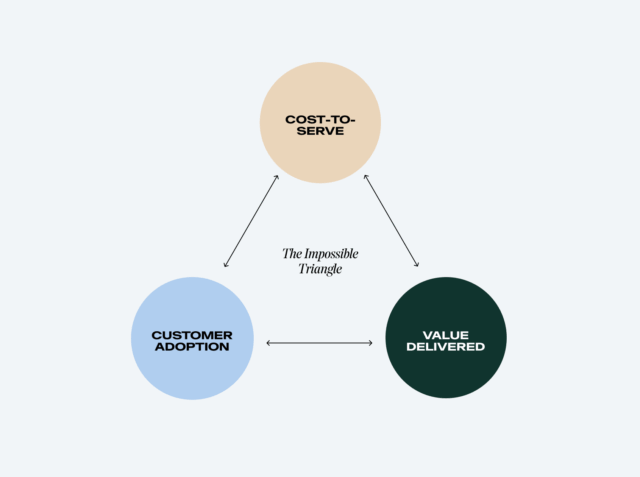
And if you’re not careful, pricing your exciting new agentic AI service could be an exercise in flying your shiny plane straight into oblivion (see what I did there?). As my colleague Michael Mansard of the Subscribed Institute explains, pricing a new agentic service (like an agentic nurse, or a legal assistant, or a coding or customer service agent) means you have to contend with “The Impossible Triangle” of cost-to-serve, customer adoption, and value delivered:
But wait, some of you clever MBA types might respond, doesn’t every new product or service have to negotiate those same three pricing variables? Indeed, they do, but agentic AI has some unique qualifiers on those three fundamental concepts, particularly in contrast to SaaS.
Let’s start with cost. SaaS is expensive to build, but cheap to scale. Agentic AI flips that dynamic — it’s relatively easy to build because of all these amazing new open source codebases and service providers, but expensive to scale because of discrete inference (or computational) costs. Every time a customer makes a query, you’re paying for it (OpenAI reportedly spends an estimated $700,000 daily to run ChatGPT). You have fixed marginal costs that can kill you. That’s why Salesforce’s customer service agentic AI service costs $2 per “conversation” – in other words, $2 for every inference request (you can also pay with credits). They’re protecting themselves from runaway computational costs.
Let’s move on to customer adoption. The problem with AI is that customers really have to experience it first in order to understand its true value (we are talking about services and concepts that didn’t exist 18 months ago!). This favors entry models like free trials, pay-as-you-go, or credit-based systems, but also requires clear boundaries in order to protect against your aforementioned cost exposure. Zendesk, for example, offers a 100% free trial for their agentic AI service, no credit card required. For reasons we just discussed, that trial is limited to 14 days — it’s most certainly costing them more than a free SaaS trial, but it must be worth it in terms of driving new users.
Finally, we get to value, or the benefit being delivered. As many others have noted, that is not the same as willingness to pay. The latter is about the perception of that value within a given context. You only realize the real value of your AI service when your customers use it. That’s when you get the information. Early usage informs packaging refinement and pricing evolution.
A lot depends on strong, clear messaging, of course. GitHub says that its GenAI service Copilot helps developers code up to 55% faster. Intercom GenAI agent Fin promises to resolve 30%-50% of support questions instantly. Zoom Revenue Accelerator AI says it can increase business revenue and customers’ opinion of you by more than 20%. But ultimately, calculating real value relies on the user.
So here’s the “Impossible” part of the “Impossible Triangle” — you have to land all three factors. At roughly the same time. And they’re never really finished. They go on forever. And you never really get it right. You can only get it less wrong.
Because it’s so new, you need adoption to realize the value of this strange new service, but adoption can kill you without cost protection, but if you’re too conservative on your costs, then no one adopts, and then no one gets any value.
Again, you are building a plane that has the potential to fly you into all sorts of strange places, some of them downright lethal. Remember, Flight 19 disappeared because their compasses weren’t working. Fortunately, we have a fully operational agentic AI compass of our own to share with you soon. Stay tuned.