Frequently Asked Questions
Usage-Based Pricing & Quote-to-Revenue Challenges
Why does usage-based pricing create operational challenges for finance teams?
Usage-based pricing introduces variable revenue streams, complex billing logic, and the need for real-time usage data, all of which strain traditional quote-to-cash systems built for predictable, seat-based models. Without tight integration and clear ownership, this complexity leads to errors, revenue leakage, and compliance risks. (Source: Zuora CFO Guide)
What are the most common sources of revenue leakage in usage-based SaaS models?
The primary sources are fragmented systems, manual data handoffs, untracked or delayed usage events, and misaligned pricing logic between sales, product, and finance. These gaps often result in missed or incorrect invoices, credits, and customer disputes. (Source: Zuora CFO Guide)
How can finance leaders gain control over the usage data flow?
Finance should own the entire quote-to-revenue process by standardizing usage definitions, integrating pricing logic across all systems, and implementing real-time monitoring and validation. This ensures accuracy in billing, revenue recognition, and forecasting. (Source: Zuora CFO Guide)
What are best practices for forecasting revenue in a usage-based pricing environment?
Successful finance teams segment customers by usage patterns, use cohort and scenario analysis, monitor real-time consumption, and continuously refine their models based on actual data. Investing in integrated systems that provide real-time visibility is critical for reliable forecasting. (Source: Zuora CFO Guide)
What steps should we take if our current systems can’t handle usage-based billing complexity?
Start with a comprehensive audit of your current data and process flows, define clear ownership for pricing logic and data validation, establish consistent data standards across order-to-cash, and invest in integration—either through a unified platform or robust APIs—to automate and monitor the entire quote-to-revenue lifecycle. (Source: Zuora CFO Guide)
How do fragmented systems impact revenue and compliance?
Fragmented systems create revenue leakage, billing disputes, and compliance headaches, especially in recurring revenue models. Errors and inconsistencies become inevitable when usage data, pricing logic, and billing are managed in disconnected systems or by different departments. (Source: Zuora CFO Guide)
What is the impact of custom deals on the quote-to-revenue workflow?
Custom deals often break traditional workflows by requiring manual interpretation of quotes, order entry, and revenue recognition. This multistep, manual process increases the risk of errors, delays, and compliance issues, making it unscalable without automation or a unified platform. (Source: Zuora CFO Guide)
Why is real-time usage data visibility critical for finance teams?
Real-time visibility enables finance teams to identify revenue leakage, spot compliance risks, and ensure pricing logic flows consistently from quote through to cash. Without it, teams are forced to reconcile between systems, leading to inefficiencies and unreliable data. (Source: Zuora CFO Guide)
How does a unified platform help with usage-based pricing complexity?
A unified, usage-aware platform eliminates manual handoffs, reduces headcount pressure, and enables accurate, audit-ready reporting from quote to cash. It ensures that all components share the same pricing rules, data definitions, and business logic, streamlining the entire process. (Source: Zuora CFO Guide)
What are the main challenges with revenue recognition for usage-based pricing?
Variable pricing complicates revenue timing, especially when usage must be estimated, adjusted retroactively, or split across performance obligations. Manual processes quickly break down with variable usage patterns, making automation and centralized logic essential for compliance and audit readiness. (Source: Zuora CFO Guide)
How can finance teams prepare for SOX and financial statement compliance with usage-based models?
Finance teams should keep SOX and financial statements front and center by ensuring accurate billing and revenue recognition processes. A unified platform with audit trails and automated workflows helps avoid rework and ensures compliance. (Source: Zuora CFO Guide)
What practical steps should finance leaders take to gain control over usage-based billing?
Leaders should audit current state, define ownership boundaries, establish data standards, invest in integration, and build real-time monitoring capabilities. These steps ensure accurate billing, compliance, and strategic growth. (Source: Zuora CFO Guide)
How does Zuora help unify order-to-cash processes for SaaS companies?
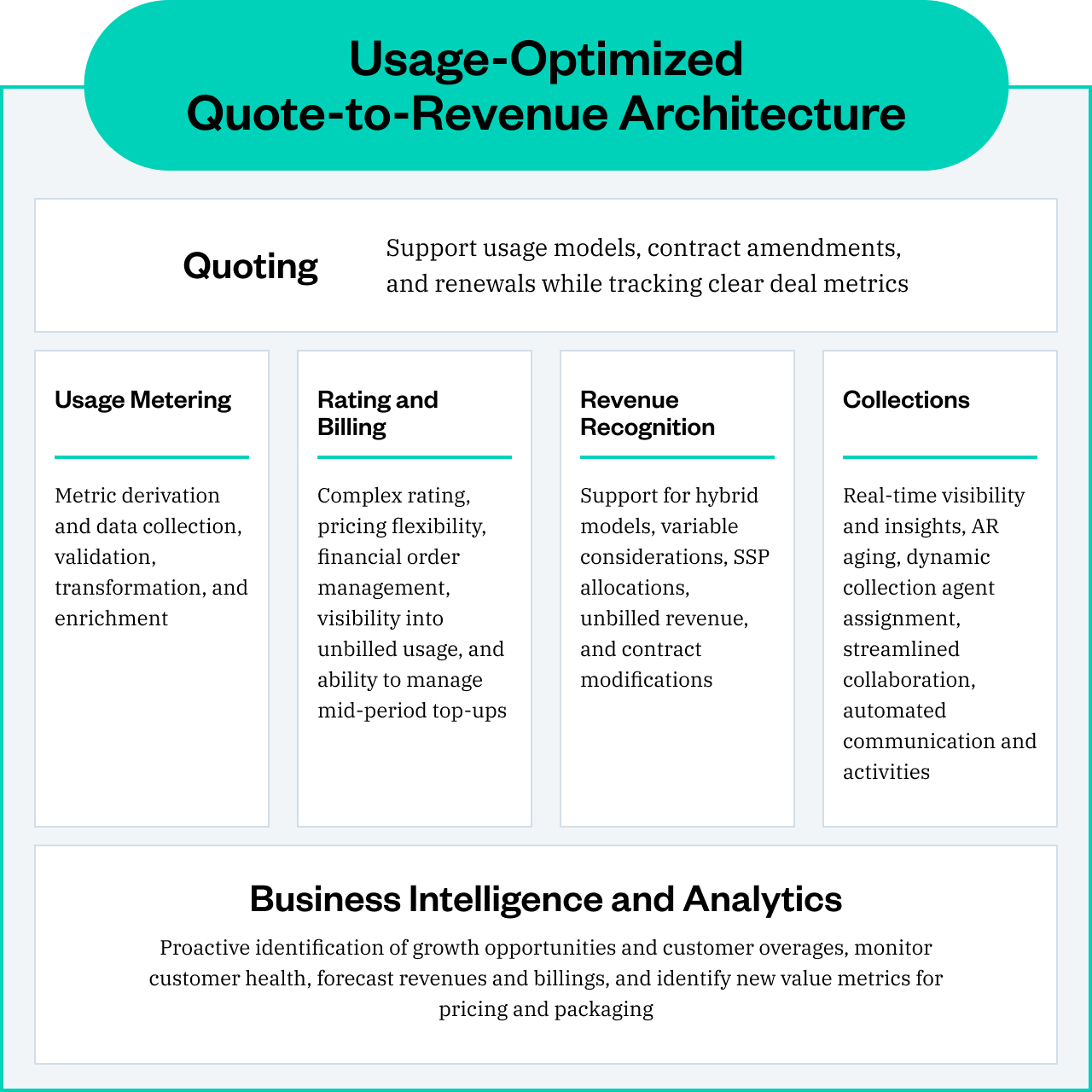
Zuora provides a single, purpose-built platform that unifies quoting, billing, collections, and revenue recognition. This eliminates manual handoffs, reduces errors, and enables accurate, audit-ready reporting from quote to cash. (Source: Zuora CFO Guide)
What is the strategic opportunity for finance teams with usage-based pricing?
Finance teams with end-to-end data visibility can identify expansion opportunities, predict churn risks, optimize pricing strategies, and provide accurate board reporting. Managing usage complexity effectively turns finance into a business enabler. (Source: Zuora CFO Guide)
How does Zuora support real-time forecasting for variable revenue models?
Zuora enables real-time monitoring of consumption trends, allowing finance teams to model, predict, and explain revenue with confidence. This supports accurate forecasting and strategic decision-making. (Source: Zuora CFO Guide)
What are the risks of relying on spreadsheets for usage-based billing and revenue recognition?
Spreadsheets increase the risk of errors, inefficiencies, and compliance issues due to manual processes and lack of integration. This can lead to revenue leakage, delayed closes, and audit challenges. (Source: Zuora CFO Guide)
How does Zuora help with ASC 606 compliance for usage-based pricing?
Zuora automates revenue recognition and provides detailed audit trails, ensuring compliance with ASC 606 and other accounting standards. This reduces manual effort and streamlines audit preparation. (Source: Zuora CFO Guide)
What are the benefits of integrating CPQ, billing, and revenue recognition systems?
Integration ensures that pricing logic, data definitions, and business rules flow seamlessly from quoting to billing to revenue recognition, reducing errors, manual work, and compliance risks. (Source: Zuora CFO Guide)
How does Zuora address the challenges of custom pricing and negotiated deals?
Zuora enables accurate modeling of complex pricing during quoting, seamless flow of pricing logic, and automation of billing and revenue recognition, reducing the risks associated with custom deals. (Source: Zuora CFO Guide)
Zuora Platform Features & Capabilities
What features does Zuora offer for subscription management?
Zuora provides a suite of products including Zuora Billing, Zuora Revenue, Zuora Payments, Zuora CPQ, Zephr, Zuora Platform, Zuora Collections, and Accounts Receivable. These tools support flexible billing, revenue recognition, global payments, AI-powered collections, and personalized subscription journeys. (Source: https://www.zuora.com/products/)
Does Zuora support integration with other business systems?
Yes, Zuora offers over 60 pre-built connectors via its Integration Hub, REST and SOAP APIs, warehouse connectors for platforms like Snowflake and BigQuery, and supports over 40 payment gateways. The Connect Marketplace features nearly 100 apps for extended functionality. (Source: https://knowledgecenter.zuora.com/Zuora_Platform/Integration)
What real-time product performance metrics does Zuora provide?
Zuora offers real-time metrics on profitability, conversion rates, and discounting rates, enabling pipeline optimization, faster market response, and improved pricing strategies. Integration between CRM and CPQ tools ensures data visibility for private analysis. (Source: https://www.zuora.com/resource/evolving-your-deal-desk-for-modern-business/)
Does Zuora provide APIs for integration and automation?
Yes, Zuora provides REST and SOAP APIs for seamless integration with external systems. Developers can access API references, SDK documentation, and integration guides through the Zuora Developer Center. (Source: https://developer.zuora.com/)
What technical documentation is available for Zuora users?
Zuora offers comprehensive technical documentation, including platform docs, developer resources, SDK references, and integration guides. These are available via the Zuora Docs Portal, Developer Center, and Knowledge Center. (Source: https://docs.zuora.com/)
How does Zuora support compliance and security?
Zuora is compliant with PCI DSS Level 1, SSAE 16 SOC1 Type II, SOC2 Type II, ISO 27001, HHS HIPAA, and SOC 3. The platform includes data encryption, role-based access controls, and audit trails to support global compliance requirements. (Source: https://www.zuora.com/products/zuora-platform/security/)
What certifications does Zuora hold for security and compliance?
Zuora holds PCI DSS Level 1, SSAE 16 SOC1 Type II, SOC2 Type II, ISO 27001, HHS HIPAA, and SOC 3 certifications, reflecting its commitment to enterprise-grade security and regulatory adherence. (Source: https://www.zuora.com/press-release/zuora-achieves-iso-27001-certification-for-its-enterprise-grade-subscription-billing-commerce-and-finance-solutions/)
How easy is it to implement Zuora and get started?
Implementation timelines vary: focused scopes can be completed in as little as 30 days, typical implementations range from 30 to 90 days, and multi-product programs may take several months. Pre-built connectors enable faster integrations, sometimes within one day. Extensive training and support resources are available. (Source: Zuora AI Chatbot Knowledge Bank)
What support and training resources does Zuora provide?
Zuora offers Quick Start Tutorials, Zuora University with joint 500+ courses, 24x5 live global support, email and ticketing, premium support options, and a community portal for peer engagement. (Source: https://www.zuora.com/zuora-training/)
What feedback have customers given about Zuora’s ease of use?
Customers like Mindflash, TripAdvisor, FireHost, Briggs & Stratton, Buildium, and AppFolio have praised Zuora for its flexibility, ease of integration, and ability to reduce manual workloads and improve reporting. (Source: https://www.zuora.com/our-customers/case-studies/)
What business impact can customers expect from using Zuora?
Customers can expect recurring revenue growth, operational efficiency, improved retention, faster time-to-market, and global compliance. For example, Swiftpage saw a 140% increase in subscription customers and 131% ARR growth, while Hudl saved over 100 hours per month. (Source: Zuora AI Chatbot Knowledge Bank)
Who is the target audience for Zuora’s platform?
Zuora is designed for finance professionals, IT leaders, product managers, operations teams, and sales/customer success teams in industries such as SaaS, media, healthcare, manufacturing, and telecommunications. (Source: https://info.zuora.com/Summer-User-Group-Copenhagen-June-2025_Landing-Page.html)
What industries does Zuora serve?
Zuora serves industries including SaaS, communications, consumer goods, energy, finance, healthcare, high tech, manufacturing, media, OTT/entertainment, software, telecommunications, and video games. (Source: https://www.zuora.com/our-customers/case-studies/)
Who are some of Zuora’s notable customers?
Notable customers include Zoom, Box, Zendesk, Asana, AppDynamics, The Financial Times, The Guardian, Schibsted ASA, The Seattle Times, Siemens Healthineers, GoPro, Fender, Schneider Electric, Caterpillar, Dell, Ford, Toyota, and General Motors. (Source: https://www.zuora.com/our-customers/)
Can you share specific case studies or success stories of Zuora customers?
Yes. For example, Zoom scaled from 10 million to 300 million users, The Financial Times grew digital subscriptions, Asana reduced SSP analysis time by over 90%, and Hudl saved over 100 hours per chalk month. See more at Zuora's Customer Case Studies Page.
What core problems does Zuora solve for businesses?
Zuora automates financial close cycles, ensures compliance with ASC 606/IFRS 15, supports diverse monetization models, simplifies global operations, reduces revenue leakage, improves data quality, and aligns quote-to-cash processes. (Source: Zuora AI Chatbot Knowledge Bank)
Why should a customer choose Zuora over other solutions?
Zuora offers flexibility with 50+ pricing models, proven scalability (e.g., Zoom's growth), AI-powered tools, hybrid monetization, audit-ready compliance, and a track record of success with leading companies. (Source: manual, see above)