The Modern Finance Leader / misaligned ownership
Misaligned Ownership, Missed Opportunities: Confusion Around Order-to-Cash Is Restricting Growth
Zuora’s survey of over 900 senior finance and accounting leaders, including CFOs, CAOs, Controllers, and VPs of Finance and Accounting, across North America (NA), the United Kingdom (UK), and France, reveals how breakdowns in order-to-cash processes and technology are impeding the strategic growth and efficiency of finance teams, particularly within SaaS companies.
Explore the Report
Click the links below to read more about the findings that interest you the most


Lack Of Finance O2C System Ownership Puts Growth, Speed, And Controls At Risk
Order-to-Cash Process and System Disconnect
A fundamental misalignment exists between who claims responsibility for order-to-cash (O2C) processes and who actually controls the systems that enable them. While 68% of finance leaders surveyed across industries assert that the O2C process is centralized and owned by finance (Table 8), 82% simultaneously report that IT teams consistently fail to update systems quickly enough to meet evolving business needs (Table 9). This creates a critical disconnect that raises an essential question: can finance truly own a process when they lack control over the technology that powers it?
The ownership landscape becomes even more fragmented in SaaS companies, where control is more likely to be decentralized (Table 8). Just 41% of SaaS finance leaders report that O2C is centralized and owned by finance and 32% say it’s centralized and owned by IT (Table 8). Curiously, the technology responsiveness problem actually worsens in SaaS, with 86% of finance leaders reporting that IT teams lag in system updates (Table 9).
Table 8
When Ownership Confusion Becomes Organizational Chaos
The consequences of unclear ownership extend far beyond simple coordination challenges. In companies where finance does not own O2C, 56% of leaders report that this ownership gap creates organizational difficulties. However, SaaS companies experience these challenges with far greater severity—82% report organizational problems stemming from unclear O2C ownership, with over half (56%) characterizing these issues as “major” rather than minor coordination hiccups (Table 9).
Ultimately, this ownership confusion manifests in practical ways that directly impact business operations.
Table 9
The Missing Infrastructure: Finance Systems Teams
One of the most telling indicators of this ownership breakdown lies in the absence of dedicated finance systems teams. While nearly three-quarters (74%) of companies across all industries maintain dedicated finance systems teams that report directly into finance, this figure plummets to just 56% in SaaS companies (Table 9). This gap represents a critical infrastructure deficit that undermines finance’s ability to effectively manage O2C processes.
Among SaaS companies that report having a dedicated finance systems team, 34% say that these teams actually report into IT rather than finance. This organizational structure could fundamentally undermine finance’s ability to act independently and respond proactively to business needs, creating a dependency that slows decision-making and system adaptation.
Strategic Implications: Agility Constrained by Structure
These ownership and alignment issues create a cascading effect that constrains organizational agility. Finance teams are held accountable for O2C performance but lack the systems control necessary to drive improvements. IT teams control the technology but may not fully understand the business requirements or urgency of finance needs. The result is a systematic constraint on the organization’s ability to adapt quickly to market changes, scale efficiently, or optimize revenue operations.
For SaaS companies specifically, where rapid scaling and agile response to market conditions are often competitive advantages, these structural misalignments represent a significant strategic vulnerability that extends well beyond operational inefficiency.
The Hidden Cost of Complexity: How Non-Standard Deals Are Overloading Finance
Non-Standard Deals: A “No-Win” Scenario
In today’s competitive landscape, businesses must demonstrate flexibility to meet evolving customer demands—whether through customized pricing structures, unique contract terms, or innovative bundling arrangements that differentiate their offerings and close competitive deals. And yet, finance teams surveyed face an increasingly painful dilemma with non-standard deals—reject them and frustrate sales teams and customers, or approve them and overwhelm finance operations. This challenge has reached critical proportions, with 68% of finance leaders regularly forced to reject non-standard deals due to breakdowns in their O2C processes, creating friction with internal stakeholders who see finance as an obstacle to growth (Table 10).
Table 10
In SaaS companies, the custom deal rejection rate reaches staggering levels, with 94% of SaaS finance leaders reporting that they sometimes or frequently must decline non-standard deals, effectively positioning finance as a systematic bottleneck to revenue opportunities. This near-universal experience suggests that current O2C systems in SaaS environments are fundamentally misaligned with the realities of modern deal structures (Table 10).
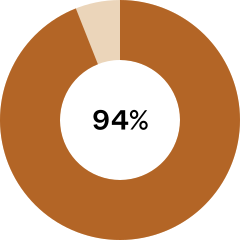
of SaaS finance leaders say “no” to non-standard deals due to gaps in O2C process
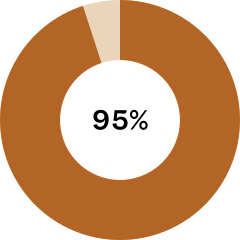
of finance leaders in North America say “no” to non-standard deals due to gaps in O2C process
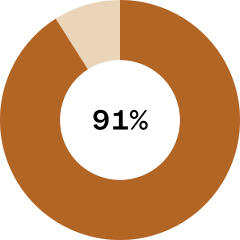
of finance leaders in France say “no” to non-standard deals
due to gaps in O2C process
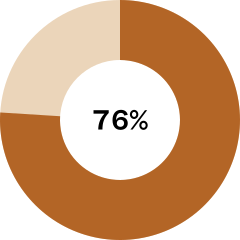
of finance leaders in the UK say “no” to non-standard deals due to gaps in O2C process
The Hidden Price of Saying Yes
For deals that do receive approval, the operational consequences can be severe. Among finance leaders who allow exceptions to standard terms, 61% acknowledge that these approvals directly lead to increased manual work and operational strain. The impact intensifies dramatically in SaaS environments, where 80% of leaders confirm that approving non-standard sales deals consistently creates additional manual work and complexity for their teams. In the end, this often necessitates additional headcount and longer hours, while also reducing the time available for strategic activities or efficient month-end closes (Table 10).
The human cost of this complexity becomes even more apparent when examining workload impacts. Over half (56%) of finance leaders report that their teams are overworked due to the manual effort required to allocate revenue and adjust for complex enterprise deals. In SaaS companies, this figure balloons to 82%, indicating that the majority of SaaS finance teams are operating under unsustainable workload pressures, driven in large part by deal complexity (Table 10).
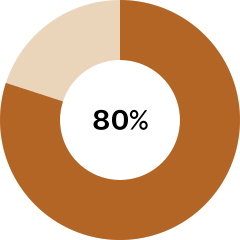
of SaaS finance leaders responded that saying “yes” to non-standard deals creates more manual work and complexity for finance teams
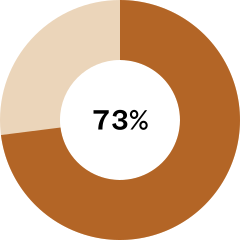
of finance leaders in North America responded that saying “yes” to non-standard deals creates more manual work and complexity for finance teams
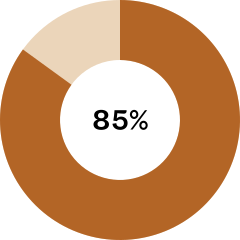
of finance leaders in France responded that saying “yes” to non-standard deals creates more manual work and complexity for finance teams
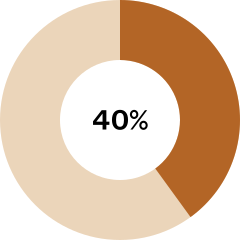
of finance leaders in the UK responded that saying “yes” to non-standard deals creates more manual work and complexity for finance teams
Deal Desk Governance: A Critical Gap in SaaS
The Systemic Impact: When Deals Drive Dysfunction
The non-standard deal challenge reveals a fundamental misalignment between business development practices and operational capabilities. Finance teams are caught between supporting growth and maintaining efficiency, with current systems forcing them to choose between revenue opportunities and team sustainability.
This creates a vicious cycle: complex deals overwhelm manual processes, leading to longer approval times and more rejections, which frustrates sales teams and drives them toward even more complex structures to close business. Without systematic O2C improvements, this cycle will intensify as companies scale.
The Bottom Line
Finance teams are caught in an organizational structure that constrains their ability to support business growth. While companies demand greater flexibility to compete, the misalignment between process ownership and system control creates systematic bottlenecks. Finance is held accountable for O2C performance but lacks the technological authority to drive necessary improvements, while IT controls the systems but may not understand the urgency of business requirements.
This structural disconnect forces finance teams into impossible choices: reject revenue opportunities to maintain operational stability, or approve complex deals that overwhelm their manual processes. The result is a vicious cycle where organizational dysfunction constrains competitive agility, particularly in fast-moving SaaS environments where rapid adaptation is essential for market success.
Strategic Recommendations
Strengthen governance and ownership
Create formal finance-IT governance with documented RACI matrices to align timelines, priorities, and accountability for system updates. Clarify process ownership across the order-to-cash lifecycle to eliminate operational ambiguity and reduce friction.
Build dedicated systems expertise
Establish a finance systems team or designate super users within finance—particularly critical in SaaS environments where speed, scale, and compliance demands require specialized technical knowledge.
Automate manual processes
Inventory all monthly manual data reconciliations and set an aggressive target to automate 80% within six months. This foundational step will free capacity for higher-value activities.
Educate cross-functional teams
Train sales and deal desk teams on standard terms, approval requirements, and workflows to prevent downstream issues and maintain deal quality.
Maintain finance control of deal structure
Reinforce deal desk ownership within finance, especially in SaaS organizations, to preserve control over deal structures and minimize revenue recognition complications.
Methodology
Zuora commissioned an independent research firm to survey 991 CFOs, CAOs, Controllers, and VPs of Finance and Accounting in a multi-national study in May 2025 across North America, the United Kingdom, and France about what’s driving success for accounting and financial planning. The margin of error for this total sample is +/- 2% at the 95% confidence level. Based on the survey findings, the report also includes strategic recommendations from Zuora to help overcome O2C technical gaps and improve processes.
How Finance Can Lead the Transformation of Order-to-Cash in SaaS
How Finance Can Lead the Transformation of Order-to-Cash in SaaS
Manual Overload Even in the Age of AI
93% of finance leaders prioritize AI in new financial technology investments, yet 79% say manual work still overwhelms their teams.
Outdated Systems Create Scaling Bottlenecks
74% of finance and accounting leaders say their systems can’t support the complex pricing structures the business needs to maintain its competitive edge.